
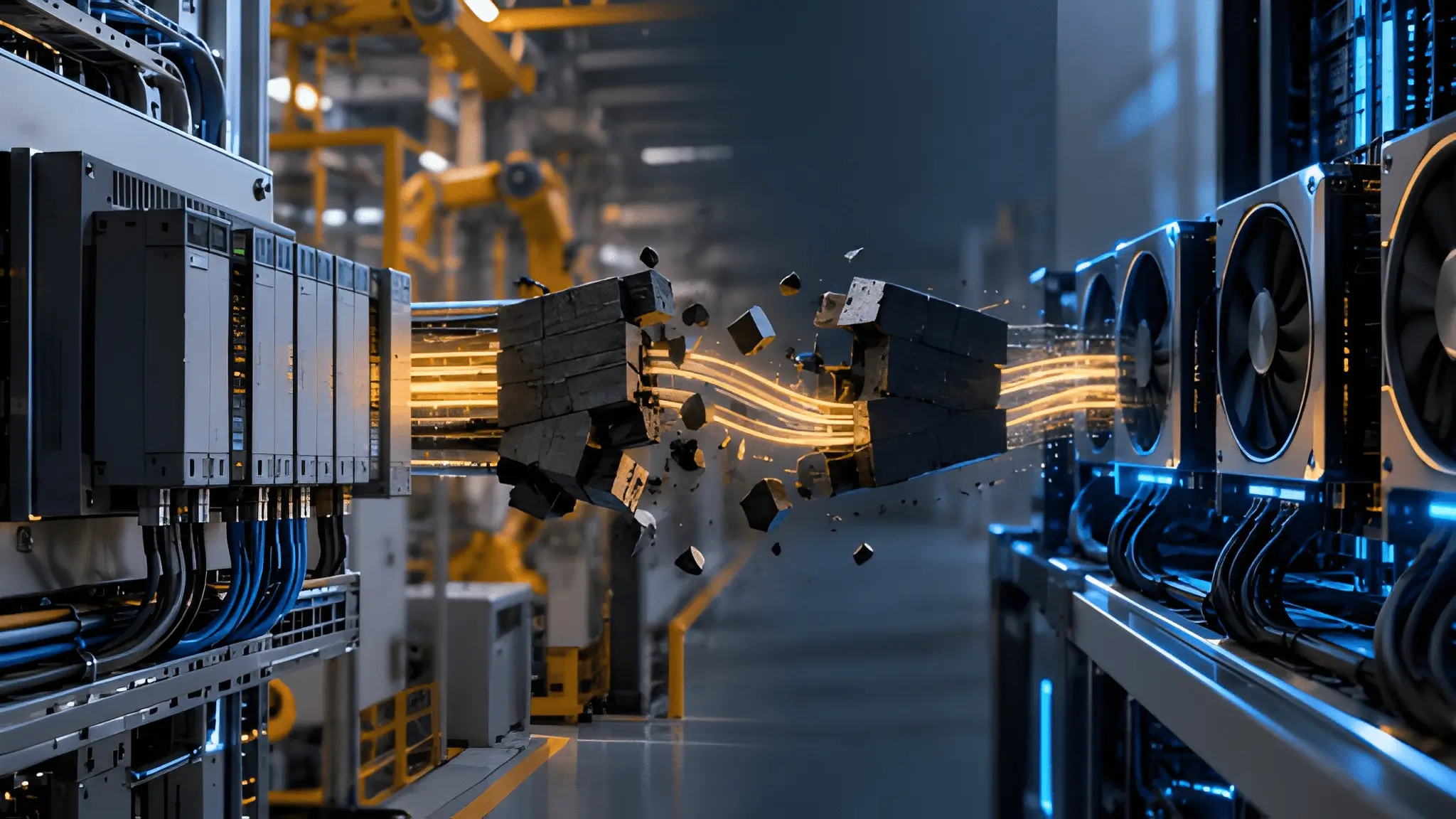
The first sign of a failed industrial AI deployment may not appear on the GPU at all. A model can process its input within the required compute window and still miss the machine event that mattered because the signal reached the inference layer late, arrived without its operating context, or crossed a gateway that changed its timing. Production equipment does not expose its state as a clean stream waiting for an AI application to consume it, since controllers, supervisory systems, manufacturing software, drives, sensors, and historians each handle information according to different operational rules. The problem becomes even harder when the output must travel in the opposite direction and reach an actuator without bypassing established interlocks, permissives, and control logic. Industrial AI therefore has a dependency that can receive less attention than model selection or accelerator capacity: the machinery connecting computation to the physical process.

The Shop Floor Still Speaks in Incompatible Dialects
Walk through the data path of a typical production asset and the problem becomes obvious before any model enters the picture. A PLC may expose values through one communication mechanism, a supervisory layer may organize those values into tags and alarms, an MES may attach production context, and a historian may preserve selected states at a sampling interval chosen for reporting rather than inference. Those systems can exchange information, but interoperability does not mean that they automatically share the same semantics, timestamps, quality information, or update behavior. OPC UA offers a structured way to represent industrial information and exchange it between systems, while TSN introduces networking capabilities designed for time-sensitive traffic, yet deploying both does not magically translate decades of equipment-specific assumptions into an inference-ready data stream.
OPC UA over TSN becomes valuable when the architecture needs more predictable communication across a shared Ethernet environment, but predictability at the network layer does not solve every problem above it. A gateway can still introduce buffering, serialization, transformation, protocol conversion, or queueing before a signal reaches the inference workload, while inconsistent data models can force additional processing at the edge. The result is a stack in which every handoff can alter the timing or meaning of the information without necessarily producing an obvious network failure. A temperature value that arrives successfully may still be useless if its timestamp no longer aligns with motor current, vibration, pressure, or machine state captured elsewhere. Edge architecture therefore needs to preserve more than connectivity because the inference engine requires temporal and operational context, not simply a collection of reachable tags.
The Line Doesn’t Wait for Inference
A production line has no obligation to slow down because an inference service needs another few milliseconds to finish its work. PLC scan cycles, communication intervals, task priorities, network scheduling, and device response times establish a temporal environment in which late information can become the wrong information even when the underlying prediction remains statistically correct. Jitter consequently matters as much as nominal latency when an edge model sits close to a control process, particularly when several workloads compete for the same compute or network resources. Time synchronization adds another dependency because correlations between signals only remain meaningful when different systems agree closely enough about when events occurred. An inference pipeline that ignores those constraints can look healthy in application metrics while behaving poorly against the timing requirements of the equipment it observes.

That changes how edge inference should be qualified because GPU processing time represents only one segment of the actual decision path. The useful measurement begins when the machine generates the signal and follows acquisition, transport, transformation, feature preparation, inference, validation, and delivery until the result becomes available to the consuming system. A model that completes quickly but consumes stale data may have less operational value than a slower model working from current and properly synchronized context. IT networking practices also cannot simply assume that every workload can share resources without consequences, since contention that barely affects a conventional application can introduce unacceptable variation into a control-adjacent workload. The practical architecture must reserve predictable behavior for machine communication while allowing inference workloads enough flexibility to scale, restart, or update without disturbing the production cycle.
Orchestration Without the Cloud Playbook
Putting containers beside production equipment does not turn a factory edge into a smaller cloud. An industrial node may have limited compute headroom, a local accelerator, several protocol services, persistent machine connections, and workloads that cannot tolerate arbitrary interruption or resource contention. Conventional orchestration can provide useful packaging and lifecycle capabilities, but its assumptions do not always match an environment where a protocol broker may matter more than application elasticity and where losing a telemetry service can obscure the state of an operating machine. Workload placement therefore needs to consider machine proximity, accelerator availability, network paths, restart behavior, and operational priority at the same time. A scheduler that sees two workloads as equal because they consume similar amounts of CPU can make a poor decision when one workload sits directly in the machine data path.
Model lifecycle management introduces another layer of complexity because changing an inference service can alter the behavior of the entire edge pipeline. A new model may require a different runtime, additional memory, another accelerator profile, a changed feature set, or updated dependencies in the acquisition layer, creating a deployment problem that resembles software maintenance more than simple model replacement. The runtime should be able to stage workloads locally, validate health, preserve the existing version during a controlled transition, and roll back without requiring the central cloud to remain reachable. Broker management also matters because protocol services often sit directly between physical equipment and application workloads, making their availability part of the inference path. Resource isolation becomes equally important when inference, data acquisition, logging, security, and model management compete on the same edge hardware.
Closing the Loop Is Where Rollouts Stall
The harder engineering question begins after the GPU produces an answer. A prediction about equipment condition, product quality, process behavior, or an impending fault has limited operational value if the system cannot determine whether that prediction is current, trustworthy, and appropriate for the machine’s present state. Sending an inference result directly toward a control output creates another problem because software confidence cannot replace interlocks, permissives, limits, and other mechanisms designed to constrain physical action. The safer architecture assigns the AI system a defined authority boundary and allows established control logic to determine whether a proposed action can proceed under current conditions. That boundary also needs explicit handling for stale results, missing inputs, communication failures, model faults, and unexpected operating states.
The architecture that ultimately scales across production lines will be the one that treats PLCs, data pipelines, edge inference, cloud services, and actuation as one connected operating system without pretending they perform the same job. Cloud infrastructure can handle training, fleet-level analysis, model development, and broader optimization, while local compute can maintain the timing and autonomy required when a machine cannot wait for a remote service. Between those environments, the middle layer must preserve protocol semantics, synchronize time, manage streams, place workloads, maintain model versions, and enforce the boundaries around control. A deployment team that solves only the path from PLC to GPU has therefore solved the easier half of the problem. The difficult half begins when the result needs to return to the line without creating a new failure path.











