
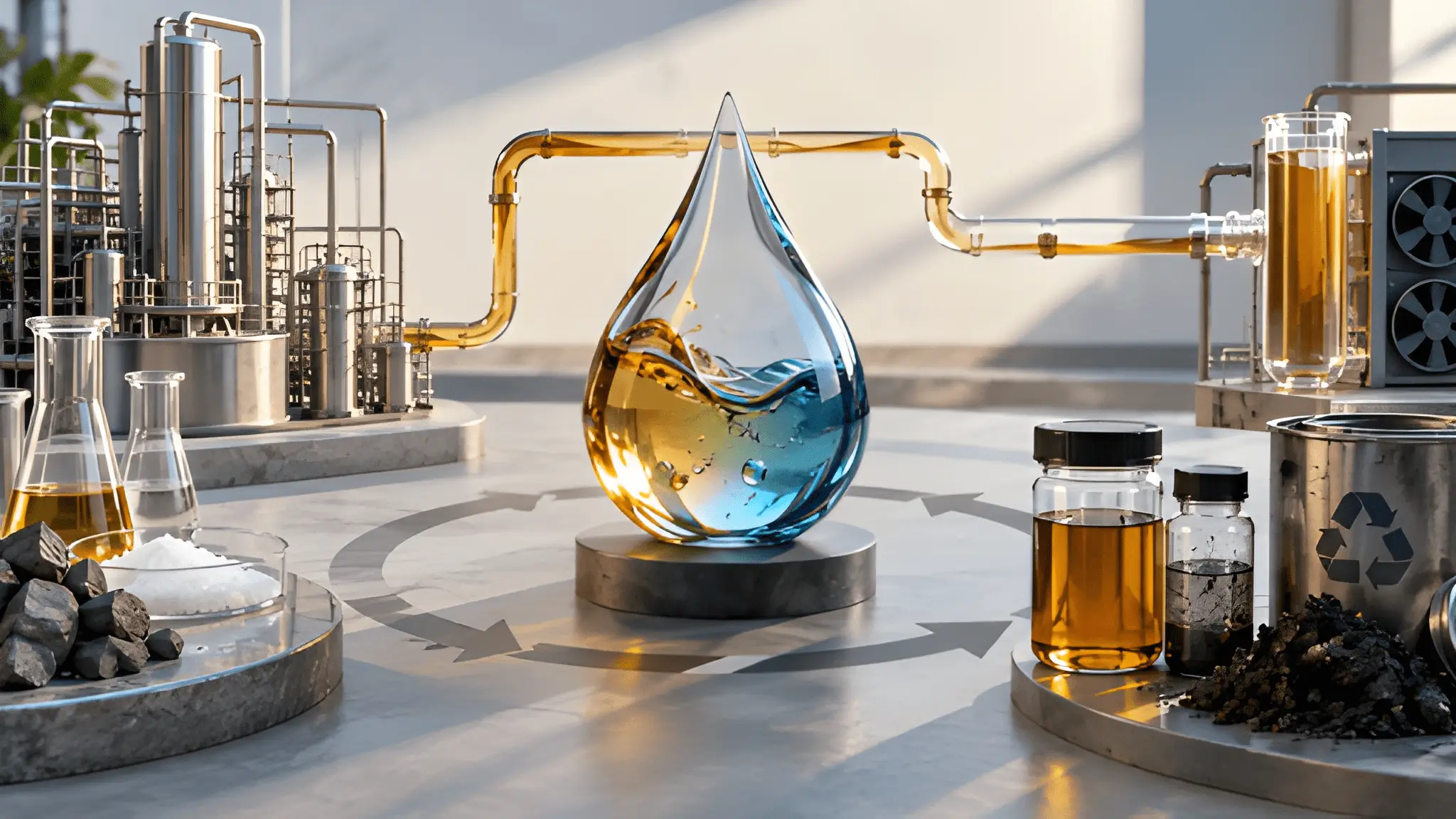
A cooling system can look stable from the outside while its most chemically important material keeps moving through a much less visible lifecycle. The fluid arrives as a manufactured product, enters a cooling loop or immersion environment, interacts with metals and polymers, undergoes thermal and chemical stress, and eventually leaves the site through recovery, replacement, reclamation, or disposal. Each stage changes the environmental accounting question because the fluid is not simply a passive medium that sits between a heat source and a heat rejection system. Its chemistry influences how it is produced, how it behaves during service, and how its recoverability and end-of-life pathway may change under different operating and contamination conditions. For a data center that tracks Scope 3 emissions, those characteristics can matter even when the fluid never becomes a visible line item in the facility’s environmental inventory.

The accounting problem begins with a category that is broader than the physical act of filling a cooling system. Upstream emissions associated with purchased goods generally cover the emissions embedded in producing those goods before they reach the reporting company’s operation, while transportation and other lifecycle stages can fall into different accounting categories depending on the activity and organizational boundary. A cooling fluid therefore enters the reporting conversation through its status as a purchased material, rather than through the narrow question of whether it creates emissions while circulating inside the cooling equipment. The lifecycle view becomes more important when the operator replaces fluid, sends contaminated material for treatment, or relies on a recovery pathway that changes the quantity of virgin material required later.
Embodied Carbon Starts at Synthesis, Not Fill
The first environmental burden attached to cooling fluid exists before a technician opens a container at the site. Feedstocks must be extracted or produced, transported, transformed through chemical processes, purified, blended where applicable, packaged, and moved through the supply chain before the fluid becomes a usable thermal material. The chemistry determines the nature of that upstream chain because different molecular structures require different precursor materials, reaction pathways, purification steps, and process conditions. A generic label such as dielectric coolant therefore says very little about embodied carbon unless the underlying formulation and production pathway are known. A proprietary formulation can carry a complex upstream burden even when its operational behavior reduces replacement frequency, while a simpler generic formulation can appear easier to procure without necessarily having a lower lifecycle footprint.
Feedstock chemistry sets the first carbon boundary
Feedstock selection establishes the first meaningful boundary around the embodied emissions of a cooling fluid because chemical manufacturing begins with materials that already carry an upstream history. Hydrocarbon-based fluids, synthetic hydrocarbons, fluorinated chemistries, and other dielectric formulations can follow very different production routes, so their environmental profiles cannot be inferred from their use as thermal media alone. The molecular structure also affects purification requirements, process controls, solvent use, reaction conditions, and the degree of chemical processing needed to achieve the required purity. Those requirements can become relevant to lifecycle accounting because the energy and materials used to manufacture a finished fluid belong to the product’s upstream story rather than the site’s operating story.

The manufacturing stage also explains why a purchase-based Scope 3 calculation can become misleading when procurement data lacks product-level information. Spend-based estimates can provide a practical starting point, but they do not reveal the chemical composition, production pathway, recycled content, manufacturing energy profile, or recovery characteristics of a particular fluid. Supplier-specific information can provide a more granular basis when the supplier can substantiate the relevant product data and the reporting company can align that information with its accounting methodology. Product-level lifecycle accounting can examine raw materials, manufacturing, transportation, storage, use, and disposal, creating a broader lens than the invoice value of the fluid itself. For a C-level review, that means procurement records should not become the only evidence used to understand the environmental significance of a cooling material.
The first fill is only the opening transaction
The initial fill often receives disproportionate attention because it is easy to document, easy to purchase, and easy to connect with a commissioning event. The more important accounting question can emerge later, when the cooling system requires top-up material, fluid conditioning, replacement, or a complete change of chemistry. Every additional purchase can create another upstream emissions burden, although the accounting treatment depends on the reporting period, inventory boundary, and methodology used by the reporting company. A fluid that remains serviceable for a long operating period can therefore produce a different lifecycle profile from a fluid that requires repeated replacement, even when both systems begin with similar initial volumes. The environmental ledger follows material flows over time rather than stopping at the moment the first container leaves the receiving dock.
This is where proprietary and generic fluids can diverge without either category being inherently superior. A proprietary formulation may be engineered around a defined application and accompanied by testing or service guidance that supports controlled use, while a generic material may offer broader sourcing options and potentially simpler replacement logistics. Those characteristics can influence the likelihood of contamination, compatibility problems, degradation, and premature replacement, but they cannot be assumed from the commercial classification alone. Technical documentation for dielectric cooling products commonly identifies properties such as oxidation resistance, material compatibility, electrical behavior, thermal stability, and fluid handling requirements because these properties affect whether the material remains suitable in service. The lifecycle consequence follows from actual operating behavior, not from whether the fluid carries a proprietary name or a generic description.
Beyond Leakage: Unaccounted Fluid Attrition
Fluid loss does not always look like a conventional leak, and that creates a difficult boundary for environmental accounting. A visible leak produces a recognizable event, while smaller losses can occur during filling, draining, filtration, maintenance, sampling, equipment opening, container transfer, cleanup, or recovery operations. Two-phase systems introduce additional behavior because a working fluid can move between liquid and vapor phases as part of normal thermal operation, making containment and recovery design important to the material balance. Single-phase systems avoid that phase-change mechanism but still depend on seals, connections, maintenance practices, and handling procedures to retain the working fluid. A complete lifecycle inventory therefore needs to distinguish between accidental release, operational loss, recoverable material, and material intentionally removed from service.
Vapor carryover changes the material balance
Vapor behavior deserves separate treatment because a fluid designed to boil within a cooling cycle behaves differently from a high-boiling single-phase coolant. A two-phase architecture deliberately uses evaporation and condensation to move heat, so the system needs a controlled path for vapor containment and condensation rather than assuming that all fluid remains in a liquid reservoir. The physical properties of the fluid, including vapor pressure and boiling behavior, influence how the material moves through the system and how recovery equipment must operate. Any material that escapes the intended recovery boundary becomes relevant to the site’s broader material balance, although its greenhouse-gas accounting treatment depends on the chemistry and applicable reporting methodology. The engineering objective remains straightforward: keep the working fluid inside the designed process and maintain sufficient recovery capability to prevent avoidable material loss.
A similar issue appears during service work when fluid leaves equipment through drains, filters, hoses, pumps, containers, or contaminated components. Maintenance teams may focus on restoring thermal performance and electrical cleanliness, while environmental accounting may focus on how much purchased material entered the system during the reporting period. Those two records can diverge when recovered material moves into temporary storage, when contaminated fluid becomes unsuitable for direct reuse, or when small quantities remain trapped inside components removed from service. Documentation for dielectric coolant handling shows that contamination can determine whether used fluid can enter a recycling process or requires another treatment pathway. The resulting material trail matters because the environmental outcome depends not only on how much fluid was purchased but also on whether removed material retains a viable route back into productive use.
Service drag-out belongs in the lifecycle conversation
Service drag-out occurs when fluid leaves the intended cooling environment attached to equipment, components, tools, filters, containers, absorbent materials, or other items involved in maintenance and recovery. The quantity may be difficult to isolate because the fluid can remain distributed across surfaces or trapped within equipment rather than appearing as a discrete discharge. That behavior creates a practical difference between a system’s theoretical fluid requirement and the material actually consumed over its operating life. The distinction matters for lifecycle analysis because repeated replacement of material lost during service can create upstream emissions that would not appear in a model based only on the initial system fill. A material accounting approach that records maintenance-related additions and removals can therefore reveal lifecycle effects that a basic procurement review would miss.
The response does not require treating every gram of fluid as an emissions event or assigning unsupported environmental penalties to routine maintenance. It requires the operator to understand which losses are unavoidable characteristics of the technology and which losses arise from handling practices that the site can control. Closed transfer equipment, compatible containers, disciplined draining procedures, appropriate filtration, and recovery-oriented maintenance can reduce the amount of usable coolant that becomes mixed with waste streams. Technical guidance for dielectric cooling materials also emphasizes spill planning, containment, testing, and appropriate handling because fluid can encounter energized equipment, other chemicals, and a wide range of materials during service. Those controls have an environmental dimension because keeping the fluid clean and recoverable can preserve material value and reduce the need for virgin replacement.
Formulation Determines Lifecycle, Not Just Performance
A cooling fluid’s lifecycle does not end when it reaches its specified operating temperature, because the chemistry continues to determine how the material behaves under heat, contamination, mechanical circulation, and repeated maintenance. Molecular stability can influence whether the fluid remains within its intended specification or gradually develops properties that require conditioning, filtration, replacement, or disposal. The relationship becomes especially important for immersion cooling because the fluid directly surrounds electronic hardware and can interact with metals, polymers, seals, coatings, and contaminants introduced during maintenance. A lifecycle assessment therefore needs to consider the fluid’s behavior during service rather than treating the use phase as chemically neutral. Recent lifecycle research into data center cooling explicitly modeled production and end-of-life impacts for different cooling fluids while also identifying gaps in available fluid lifecycle data.
Stability changes the replacement equation
A fluid that retains its required physical and electrical characteristics for longer can reduce the need to introduce replacement material, but that relationship needs to be demonstrated through application-specific evidence rather than assumed from a product label. Oxidation resistance, thermal stability, compatibility with system materials, and tolerance to contamination can all influence whether a fluid remains suitable for continued operation. The chemistry also determines which degradation products can emerge and whether filtration or purification can restore the fluid without changing its fundamental composition. In that sense, lifecycle performance begins to connect chemical engineering with environmental accounting because every avoidable replacement purchase represents another upstream material flow. A credible Scope 3 assessment can therefore benefit from maintenance records that show why fluid was removed and whether the removed material could return to productive use.
The same logic applies when comparing proprietary and generic formulations, although neither category should receive an automatic environmental advantage. A proprietary fluid may have tightly controlled formulation parameters and application-specific compatibility data, while a generic formulation may offer broader availability and potentially more interchangeable sourcing. Those commercial characteristics become environmentally relevant only when they change the quantity of material consumed, the frequency of replacement, the feasibility of recovery, or the quality of the end-of-life pathway. Lifecycle accounting should therefore connect formulation data with observed operating behavior instead of assigning a lower footprint simply because a fluid lasts longer on paper. The strongest evidence comes from documented service histories, fluid analysis, recovery records, and supplier information that can support the assumptions used in the inventory.
Generic availability does not guarantee lifecycle efficiency
Generic fluids can appear attractive because replacement sourcing may be straightforward, but procurement flexibility does not automatically translate into lower lifecycle emissions. A readily available fluid still carries the environmental burden associated with its feedstocks, synthesis, purification, packaging, transportation, and eventual treatment. If its operating characteristics lead to more frequent replacement or greater contamination sensitivity, the additional material flow can change the lifecycle result. Conversely, a proprietary chemistry can create supply-chain concentration or limited recovery options that introduce different risks even when its service behavior proves stable. The correct comparison therefore starts with the complete material pathway rather than the purchase price or the apparent simplicity of the fluid specification.
The technical record becomes particularly important where a fluid manufacturer does not publicly disclose the complete formulation. Lifecycle researchers have encountered this limitation directly, with published work noting that some fluid production and end-of-life information was supplied confidentially by manufacturers while other fluid impacts required proxy datasets because suitable public data were unavailable. That constraint does not invalidate lifecycle assessment, but it does change the confidence that analysts can place in individual assumptions. A C-level environmental review should therefore distinguish measured product information from modeled proxies and supplier estimates when evaluating the credibility of a cooling fluid footprint. Better primary data can materially improve the quality of future comparisons between cooling architectures and fluid chemistries.
End of Life Is Where Fluids Diverge
The final stage of a cooling fluid’s life can expose differences that remain invisible during normal operation. Two fluids can perform similar thermal functions while following very different pathways after removal from a cooling system because their chemistry, contamination profile, recoverability, and available processing routes may not be the same. Some materials can enter reclamation or re-refining processes, while others may require controlled treatment or disposal because contamination changes their physical or chemical characteristics. The environmental accounting therefore cannot stop at the moment the fluid leaves the cooling loop. End-of-life assumptions need to reflect what actually happens to the material after removal and whether recovery displaces the need for virgin material.
Reclamation changes the material pathway
Reclamation can preserve material value when a used cooling fluid can be cleaned, separated, purified, and returned to a usable specification. Published technical work on dielectric-fluid recovery describes processes involving filtration, distillation, condensation, and further filtration to remove different contaminant classes from used immersion fluids. Those processes demonstrate that recovery is technically possible for some cooling chemistries, although the feasibility depends on the fluid and the contaminants present. Recovery also requires suitable collection, storage, transportation, testing, and processing arrangements, meaning that the environmental benefit cannot be established from the word “recyclable” alone. A credible lifecycle model needs to account for the actual recovery pathway and the material displaced by the recovered product.
Contamination can become the decisive factor because a cooling fluid does not operate in chemical isolation from the equipment around it. Solid particles, dissolved materials, partially soluble contaminants, degradation products, and other liquids can complicate separation and may affect the physical and electrical properties required for continued immersion cooling. Technical descriptions of dielectric-fluid recovery specifically identify dissolved and partially dissolved contaminants as challenging because separation can become more difficult when different substances interact during processing. That means a fluid with strong theoretical recyclability can still face a less favorable end-of-life route if the operating environment introduces contaminants that the recovery process cannot economically or technically remove. The lifecycle record should therefore distinguish between the theoretical recyclability of unused material and the actual recoverability of material removed from service.
Disposal is a chemistry question
Disposal becomes more consequential when recovery cannot preserve the material’s useful properties or when contamination makes reclamation impractical. The correct pathway can depend on chemical composition, contamination, applicable regulations, and the capabilities of the receiving waste processor. A cooling operator therefore cannot assume that every removed fluid can enter an ordinary waste-oil stream or that every dielectric formulation can follow the same treatment route. Published recycling guidance for dielectric coolants explicitly notes that used material may require testing before recycling or disposal because contact with electrical equipment, other chemicals, and different materials can change the treatment requirements. The end-of-life decision consequently belongs in the fluid’s original lifecycle design rather than being left entirely to the final maintenance event.
The environmental significance of disposal also depends on the chemistry involved because different fluids can carry different concerns around persistence, toxicity, volatility, and greenhouse-gas behavior. Recent lifecycle research on cooling systems highlights the need to evaluate these characteristics alongside energy and water impacts rather than treating cooling fluids as interchangeable thermal materials. Fluorinated fluids, hydrocarbon fluids, and water-based mixtures can have very different environmental profiles, and those profiles can change the appropriate handling and end-of-life approach. The presence of regulatory scrutiny around some fluorinated chemistries further demonstrates why fluid selection needs to include a forward-looking assessment of material management. Lifecycle analysis provides a structured way to compare those factors without reducing the decision to one environmental attribute.
Fluid Integrity Degrades In Service
A new cooling fluid enters a controlled environment, but the operating system itself becomes part of that environment over time. Heat, oxygen exposure, moisture, particulate contamination, metal surfaces, elastomers, coatings, maintenance chemicals, and other materials can gradually influence fluid condition depending on the chemistry and cooling architecture. The result does not necessarily mean that a fluid immediately becomes unsuitable, but it can alter properties that matter for heat transfer, dielectric performance, corrosion control, cleanliness, and recoverability. Fluid analysis can reveal these changes before they become visible through a major system problem. For lifecycle accounting, the same information can explain why material remained in service, why it required treatment, or why it ultimately left the system.
Oxidation creates a lifecycle signal
Oxidation is one pathway through which fluid chemistry can change during service, although its significance varies with formulation and operating conditions. Exposure to oxygen, heat, catalytic surfaces, and contaminants can contribute to chemical changes that affect fluid condition and may produce compounds that require filtration, treatment, or replacement. The engineering response depends on the chemistry because not every fluid responds to oxidation in the same way and not every degradation pathway produces the same operational consequences. A lifecycle model should therefore avoid assigning a universal service-life assumption to all cooling fluids. Instead, it should connect fluid condition monitoring with actual replacement decisions and the corresponding material flows.
Contamination can produce another pathway because even a chemically stable fluid can become unsuitable when foreign material enters the loop or immersion environment. Technical recovery literature describes solid contaminants, liquid contaminants, partially soluble materials, and dissolved substances as potential challenges to fluid purification. Those contaminants can affect properties such as electrical resistivity and optical characteristics, which can matter for dielectric cooling performance and recovery. The environmental consequence arises when contamination turns otherwise reusable material into a treatment stream or forces premature replacement with virgin product. Better contamination control can therefore support both equipment reliability and material retention without requiring the operator to claim that every maintenance intervention has an emissions benefit.
Monitoring protects more than thermal performance
Fluid monitoring is usually associated with maintaining equipment reliability, but it can also create the evidence needed to understand material consumption. Testing can establish whether a fluid remains within its intended operating range, whether contaminants are accumulating, and whether treatment can restore useful properties. Those records can help distinguish planned replacement from premature replacement and can provide evidence for the assumptions used in a lifecycle assessment. The value does not come from collecting every possible laboratory measurement, but from retaining the information that explains material decisions over the life of the cooling system. Such records can become particularly useful when sustainability teams need to reconcile procurement data with maintenance and waste records.
The strongest operating model treats fluid condition as a controlled variable with implications across the entire material lifecycle. Procurement establishes the chemistry, commissioning establishes the initial material state, operations preserve that condition, maintenance records changes, and recovery determines what value remains when the material leaves service. Each stage produces information that can support the next stage, allowing the site to maintain continuity even when personnel, contractors, equipment, or ownership changes. That continuity becomes increasingly important when cooling systems use specialized fluids whose formulations, recovery requirements, or environmental attributes cannot be inferred from a generic category name. A lifecycle-oriented record therefore turns fluid management from an isolated maintenance task into a traceable material process.
Handling Discipline Is an Emissions Variable
The same cooling fluid can follow different lifecycle pathways depending on how the site handles it. Transfer equipment, filtration, storage containers, sampling procedures, seals, maintenance connections, and recovery practices all influence whether the material remains clean and recoverable or becomes mixed with waste. The chemistry still establishes the fundamental behavior, but handling determines how much of that potential the site preserves during operation. A well-designed cooling system can therefore lose lifecycle value through poor material practices even when the underlying fluid has favorable technical characteristics. environmental accounting should recognize this operational layer without confusing avoidable material loss with direct greenhouse-gas emissions.
Filtration can preserve material value
Filtration can play a role in maintaining fluid quality when particulate contamination threatens the required operating characteristics. Recovery systems described in technical literature use staged filtration to remove different classes of contaminants before and after additional purification processes. That architecture demonstrates an important principle: keeping contaminants out of the fluid can simplify later recovery because the material remains closer to its original specification. Filtration therefore has a lifecycle role when it prevents a recoverable fluid from becoming a more difficult waste stream. The environmental result depends on the actual process, energy requirements, filter materials, maintenance frequency, and recovered-fluid outcome, so the benefit should be documented rather than assumed.
Transfer procedures also influence the material balance because fluid can remain inside hoses, filters, pumps, components, or temporary containers after a maintenance activity ends. A recovery-oriented procedure aims to return usable material to the appropriate storage or cooling loop instead of treating every residual quantity as waste. That objective requires compatible equipment and clear segregation because mixing different fluids can make later recovery substantially harder. The site should also retain records showing what material moved between the cooling system, maintenance equipment, storage, and recovery channels. Those records provide a more complete basis for calculating material consumption and evaluating whether procurement volumes reflect genuine system demand or avoidable handling losses.
Sealing and storage influence the lifecycle outcome
Containment starts with the physical design of the cooling system but continues through every maintenance interface. Seals, connections, access points, tanks, containers, and transfer lines all become potential points where material can escape or contamination can enter. Two-phase systems introduce additional vapor-management considerations because the fluid intentionally changes phase during heat transfer, while single-phase systems still require containment across pumps, reservoirs, service connections, and maintenance operations. Recent lifecycle research specifically identifies fluid-loss control, containment, vapor monitoring, and recovery measures as relevant considerations for immersion cooling. That evidence reinforces the need to treat containment as part of lifecycle design rather than as a narrow spill-response function.
Handling discipline also determines the quality of evidence available for environmental reporting. A site that records fluid additions without recording recovered quantities can calculate procurement activity but cannot easily explain the full material balance. A site that records both movements can identify whether fluid remains in service, moved into storage, entered recovery, or left the site through another pathway. This information can then support a more precise lifecycle assessment and reduce dependence on generic assumptions. The reporting value comes from the consistency of the record across engineering, procurement, maintenance, and waste-management functions.
Accounting for What Evaporates
Cooling fluid deserves a place in lifecycle planning because it behaves more like an engineered material than an ordinary consumable. Its environmental profile begins with feedstocks and synthesis, continues through transportation and installation, changes during thermal and chemical exposure, and ends with recovery, treatment, reuse, or disposal. The path can differ substantially between formulations even when the fluids perform the same broad cooling function. A lifecycle approach therefore asks a more useful question than whether a fluid has a low or high environmental footprint in isolation. It asks how the selected chemistry behaves across the entire operating life of the cooling system and what material pathway remains when that life ends.
A material passport should follow the fluid
A material passport for cooling fluid can begin with information that already exists across procurement and engineering records. The record can identify the fluid formulation or product designation, supplier information, relevant technical specifications, manufacturing information where available, compatibility requirements, handling requirements, and documented lifecycle data. During operation, the same record can capture additions, removals, testing, filtration, contamination events, recovery activity, and changes in material status. At end of life, it can document the destination, treatment route, recovered quantity, and whether the material returned to productive use. This creates continuity between engineering decisions and Scope 3 reporting without requiring the sustainability team to reconstruct the fluid’s history after the fact.
The concept also changes how procurement should evaluate cooling fluids because the lowest initial material requirement does not necessarily produce the lowest lifecycle burden. Procurement can ask whether the fluid has credible product-level lifecycle information, whether the formulation supports recovery, what contamination controls it requires, how used material can be processed, and whether the supplier can support end-of-life documentation. Engineering can then connect those answers with expected service conditions, compatibility, maintenance practices, and fluid monitoring. Sustainability teams can use the resulting evidence to determine how the material enters the Scope 3 inventory and how replacement and end-of-life activity should be treated. The decision becomes a lifecycle comparison supported by evidence rather than a sustainability label attached to a cooling product.
Accounting for what evaporates
The hardest part of cooling-fluid accounting may not be the fluid that remains visible in a tank or reservoir, but the material that changes status during service. Vapor can move through a two-phase cooling cycle, maintenance can remove fluid from equipment, contamination can move material into a treatment stream, and recovery can return some material to productive use. Each movement creates a different lifecycle question, even when the physical quantity appears small within the wider cooling system. The reporting model should therefore distinguish material retained in service, material intentionally removed, material recovered, material lost, and material sent to treatment or disposal. That material-flow discipline provides the foundation for determining which activities belong in the relevant Scope 3 categories and which require separate treatment under the company’s accounting methodology.
The final objective is not to make cooling-fluid accounting more complicated for its own sake, but to make the environmental record correspond more closely with the physical reality of the cooling system. A fluid enters the site with an embodied history, performs a technical function, interacts with its operating environment, and eventually follows a recovery or disposal pathway. That lifecycle can be documented through procurement records, fluid condition data, maintenance logs, recovery documentation, supplier information, and end-of-life records. When those sources connect, the cooling fluid stops being an invisible assumption inside the environmental inventory and becomes a traceable material within the site’s infrastructure. Scope 3 accounting then has a stronger foundation because the emissions story follows the fluid rather than ending when the initial purchase is recorded.











