
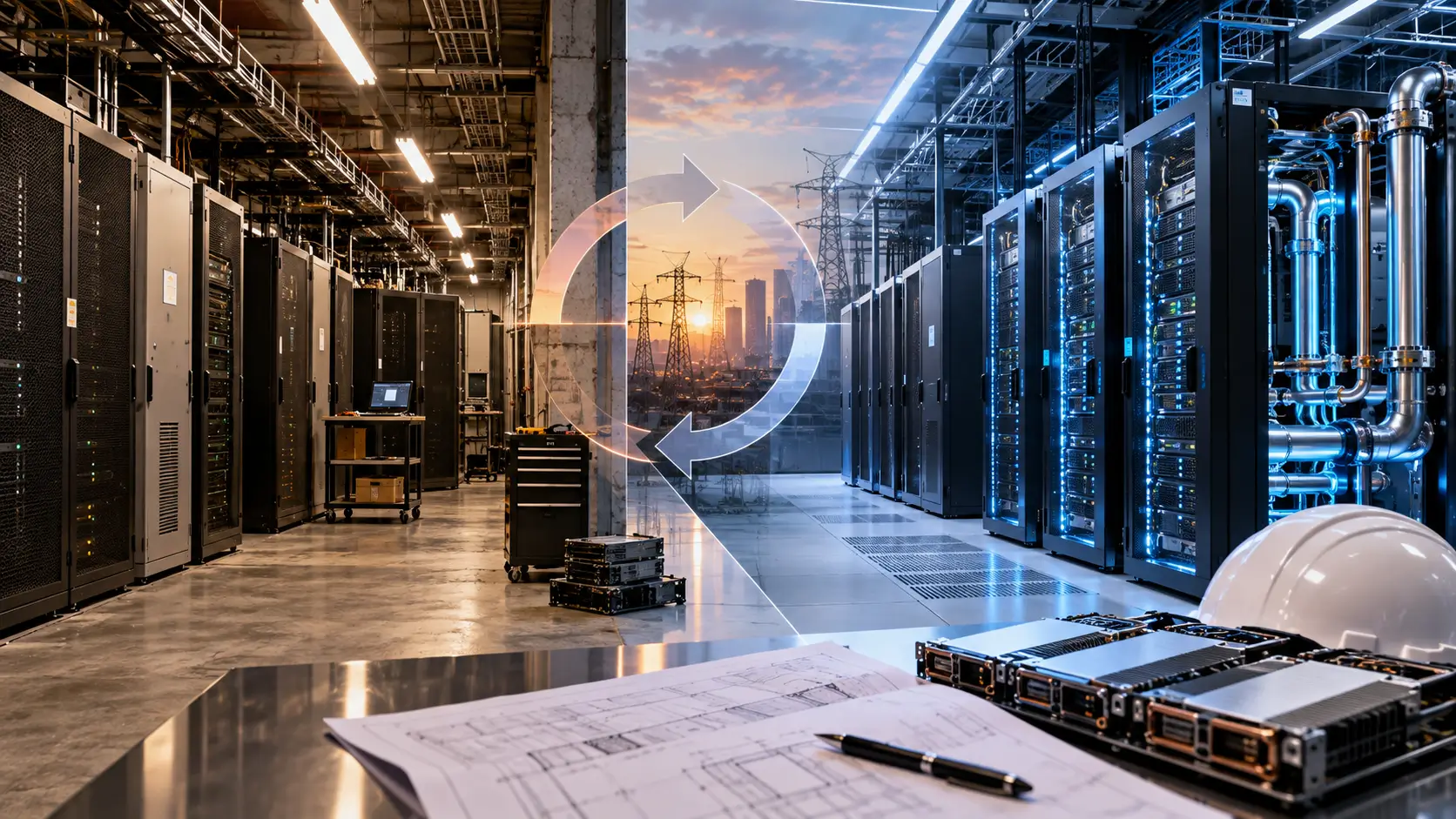
A new facility can offer efficient cooling, dense compute halls, updated electrical systems, and infrastructure designed for accelerated computing. That combination attracts organizations planning large AI deployments, particularly when existing sites face power or cooling constraints. Yet a newer building does not automatically create the lowest-impact infrastructure choice across a workload’s entire life. Construction requires materials, equipment, transportation, electrical infrastructure, cooling systems, and grid capacity before useful compute begins. Existing facilities may already contain valuable assets that can support another hardware generation after targeted upgrades. AI buyers should therefore compare rebuilding, retrofitting, and extending capacity across performance, energy demand, resource use, cost, and operating life.

Sustainability Starts Before the First Server Runs
Procurement teams can measure operating electricity once servers enter production, but construction impacts occur much earlier. Concrete structures, electrical rooms, switchgear, cooling equipment, cabling, generators, and batteries require resources before accelerators process workloads. Replacing usable infrastructure can shift environmental burdens toward construction and equipment manufacturing rather than eliminating them. This distinction matters because data centers depend on wider energy systems that must deliver electricity at specific locations. The International Energy Agency estimated global data center electricity consumption at around 415 TWh in 2024. That represented roughly 1.5% of worldwide electricity consumption, giving buyers another reason to examine infrastructure and operations together.
Existing infrastructure changes the calculation because some required physical investment has already occurred. A suitable building may retain its shell, electrical routes, security systems, fiber access, utility connection, or mechanical equipment. Reuse does not make every older site preferable, since inefficient systems can weaken the case for extending its life. However, examining individual assets provides more information than using construction date as a proxy for environmental performance. Building-sector research also identifies renovation as one route for reducing new construction where existing assets remain useful. AI infrastructure decisions can apply similar lifecycle thinking while accounting for the demanding power and thermal requirements of accelerated computing.
Operational Efficiency Still Carries Enormous Weight
Keeping an existing facility makes little sense when operational penalties outweigh the benefits of retaining its infrastructure. Cooling design, electrical losses, airflow management, server efficiency, utilization, and power sources can influence environmental performance over time. The IEA says cooling and environmental control can represent about 7% of electricity use in efficient hyperscale facilities. That share can exceed 30% in less-efficient enterprise facilities, creating a substantial difference between operating environments. Those ranges show why building age alone reveals little about how efficiently a facility supports useful computing. Buyers need measured operating data instead of assumptions based on commissioning dates, architectural appearance, or marketing descriptions.

Utilization deserves similar attention because infrastructure creates limited value when expensive computing resources remain poorly used. AI buyers often focus on accelerator specifications, but those accelerators depend on networking, storage, cooling, power conversion, and backup systems. Improving useful computation from installed hardware can influence how much additional infrastructure an organization needs. Hardware and software efficiency gains can also alter future electricity requirements and complicate long-term capacity planning. IEA analysis reports substantial improvements in energy consumed per AI task, while more energy-intensive applications continue expanding. Procurement teams should examine useful workload output alongside facility consumption when comparing upgraded infrastructure with replacement capacity.
Retrofit Potential Depends on Physical Constraints
Available rack space does not automatically mean a data center can absorb high-density AI hardware. Accelerated servers can increase demands on power distribution, cooling, networking, structural capacity, water systems, and heat-rejection equipment. A facility may have floor space but lack sufficient electrical capacity or cooling distribution at the rack. Such constraints can turn a straightforward retrofit into a complex engineering project involving additional cost, materials, and possible downtime. Buyers should identify these limitations before comparing existing sites with purpose-built capacity. A detailed assessment can distinguish valuable infrastructure from systems that require replacement before newer hardware can operate reliably.
Strong retrofit candidates allow operators to preserve major assets while replacing systems that restrict new computing configurations. Electrical distribution may require reinforcement, while cooling systems may need redesign for higher rack densities. Meanwhile, phased upgrades can sometimes align infrastructure spending with hardware deployment instead of installing future capacity immediately. This approach can reduce exposure to unused capacity if workload forecasts, hardware roadmaps, or customer requirements change. It can also reveal dependencies that broad measures such as megawatts and rack counts may conceal. End users should request clear evidence about retained systems, planned upgrades, and the operating envelope available after those changes.
Electricity Supply Can Change the Entire Comparison
Facility efficiency represents only one part of the environmental equation because electricity supply also affects operational emissions. Similar facilities can produce different operating footprints when local power systems rely on different generation sources. The IEA estimates renewables supplied about 27% of electricity physically consumed by data centers globally in 2024. Natural gas supplied 26%, nuclear provided 15%, and coal accounted for roughly 30%. These global shares vary across regions, making location an important consideration when buyers compare infrastructure options. A highly efficient new facility may not automatically outperform an upgraded site if their electricity supply profiles differ significantly.
Power availability also affects whether reuse remains practical as AI deployments demand larger electrical connections. The IEA expects global data center electricity consumption to rise substantially through 2030. Accelerated servers account for a significant portion of the expected growth, increasing pressure in some concentrated markets. An older site with an established grid connection may hold strategic value when that connection can support upgraded equipment. Conversely, retaining a building offers little advantage when its electrical supply cannot reliably support the required workload. Buyers should treat available power as an infrastructure asset with technical, economic, scheduling, and environmental dimensions.
The Procurement Question Should Be Lifecycle Value
C-level buyers need comparisons that go beyond whether a facility is new, old, efficient, or marketed as environmentally advanced. Decisions should consider retained assets, replacement needs, utilization, electricity, cooling performance, energy sourcing, upgrade cycles, and expected operating life. New construction may make sense when existing sites cannot support required density, cooling, reliability, or expansion economically. An upgrade may produce a lower lifecycle environmental impact when major physical assets remain serviceable and targeted improvements support intended loads. A project-specific lifecycle assessment must also demonstrate an advantage over new construction before buyers can support that conclusion. Construction age alone can hide both the value inside existing infrastructure and the technical limitations that genuinely justify replacement.
This issue becomes more important as organizations make infrastructure commitments that can shape their physical footprint for years. The IEA reported global data center investment of about half a trillion dollars in 2024, nearly double the 2022 level. Those investments determine how much infrastructure gets constructed, powered, cooled, maintained, upgraded, and eventually retired. Procurement teams can improve decisions by comparing what each option builds, preserves, replaces, consumes, and enables. New construction remains necessary where demand, density, location, or technical requirements exceed the practical capabilities of existing sites. The better strategy is the one that delivers required computing capability while accounting for physical and operational consequences across its service life.











