
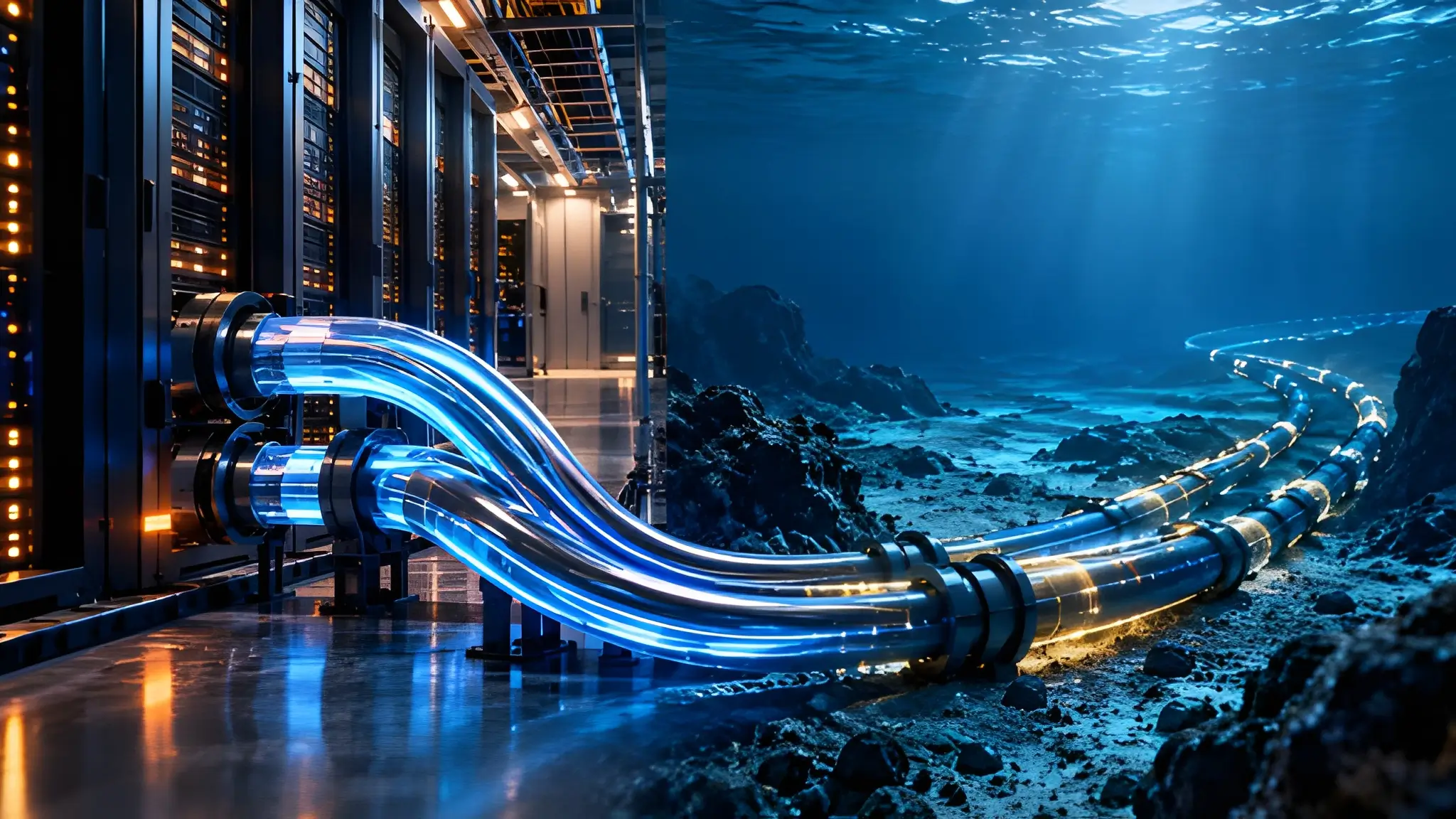
The next change in subsea infrastructure may increasingly follow the facilities and regions where digital capacity expands. Cable landing stations traditionally provide the physical transition between submarine fiber and terrestrial networks, yet rising compute requirements are making that boundary less meaningful. A more consequential model is emerging in which the location, scale and expansion schedule of compute infrastructure can influence how operators plan international connectivity. The question therefore shifts from whether a landing station remains commercially useful to whether subsea connectivity can become structurally embedded in compute architecture. That possibility matters because connectivity can influence infrastructure decisions when data-center operators select and expand sites.

Instead, latency requirements, interconnection density, cloud access and international traffic paths can help determine where operators should expand capacity. Recent deployments already show a tighter physical relationship, with some subsea systems connecting directly into data-center environments rather than maintaining a conventional separation between cable infrastructure and compute facilities. If this model expands, operators could increasingly view a submarine cable as more than a transport path carrying information toward a destination.
Compute Starts Influencing the Geography of Connectivity
A compute-led subsea network could alter part of the conventional planning sequence by allowing expected compute demand to influence the connectivity architecture that serves it. A new high-density compute cluster needs more than electrical capacity, cooling and physical space because many workloads also depend on efficient data exchange with users, cloud environments, other facilities and distributed systems. That requirement can influence the economics of where a cable lands, how much terrestrial fiber follows it and how many interconnection points a landing location can support. In practical terms, a site with strong power availability but weak international connectivity may become less attractive for certain workloads than a similarly powered location with direct subsea access and dense interconnection.
India offers a useful illustration of how closely these variables can already interact, with most existing data-center capacity concentrated in Mumbai, Chennai, Delhi-NCR and Bengaluru, while established markets benefit from undersea cable infrastructure and terrestrial fiber networks. The country is also commissioning and planning additional submarine systems at locations including Mumbai, Chennai and Raigad as data-center capacity expands. Those developments do not prove that compute dictates cable construction, but they show why operators increasingly need to evaluate connectivity and compute capacity as connected infrastructure decisions rather than isolated investments. The emerging opportunity lies in designing that relationship before equipment arrives, rather than adding connectivity after a compute cluster establishes its location.

The Data-Center Site Becomes a network Decision
This changes what infrastructure leaders may need to evaluate when selecting a site for future compute expansion. A site can have sufficient electrical capacity while still facing network constraints if international traffic requires additional terrestrial routing before reaching major cable infrastructure. The reverse can also occur, where a highly connected location can become strategically valuable because subsea access can shorten the physical path between external networks and systems consuming that bandwidth. Direct subsea connectivity into data-center facilities has already moved beyond theory, with deployments linking submarine systems directly into data-center environments and providing access to multiple onward networks.
For end users, the consequence is less about knowing where a cable lands and more about whether the applications they depend on can reach compute resources without unnecessary network layers. Financial systems, AI inference, cloud applications and other latency-sensitive workloads can attach different economic value to milliseconds, route diversity and predictable network performance. A compute-led model therefore makes network topology part of the site-selection equation alongside power, land, cooling and expansion capacity. It could also encourage infrastructure planners to consider physical pathways and interconnection capacity before demand reaches the point where expansion becomes more difficult or costly. The site can function as more than a container for servers, becoming one physical coordinate within a broader compute-and-connectivity system.
Landing Capacity Could Become Compute Capacity
The more provocative implication is that the commercial value of a cable landing location could increasingly reflect the compute ecosystem surrounding it. A landing station with limited interconnection density may still terminate major international cables, but its value to compute operators depends on what can happen to that traffic after it reaches shore. A nearby data-center environment can provide a place for networks, cloud connections, content platforms and compute resources to meet without requiring every connection to travel deeper into a metropolitan network. Existing infrastructure already demonstrates variations of this model, including facilities where cable landing stations and data-center operations occupy closely integrated environments. That arrangement can change the economic logic of subsea infrastructure by adding interconnection, colocation and proximity to compute to the ways connectivity capacity can support commercial activity.
The commercial question could consequently include how much compute and network activity a cable can reach from its landing point, alongside how much capacity the cable can carry. This could make interconnection density one of the metrics developers consider when comparing prospective cable routes. It could also encourage cable planners to examine planned or emerging compute clusters when evaluating landing strategies, particularly in markets where AI infrastructure is expanding. In that environment, the cable landing station could increasingly function as an access layer connecting subsea capacity with compute and terrestrial networks rather than serving only as a termination point.
Route Planning Could Follow Workload Geography
Subsea cable routes have traditionally responded to geography, traffic demand, resilience requirements, commercial relationships and the availability of landing infrastructure. A compute-led model could introduce another variable: where high-value workloads are expected to originate, terminate or exchange data. That does not mean cables would simply be routed toward the nearest data center because subsea engineering, marine conditions, regulatory requirements and route diversity still impose fundamental constraints. It does mean that the expected location of large compute clusters could become an additional input into the business case for a particular landing point or terrestrial extension.
Recent network announcements already connect subsea investments with planned data-center and cloud-region expansion, demonstrating how operators can coordinate connectivity and compute footprints within the same regional strategy. The significance is not that every future cable will serve one compute campus, but that network planners may evaluate cables partly according to the compute ecosystems they can reach. This could introduce additional competition among sites that already compete on power, real estate and access to existing fiber. It could also increase the potential value of underused landing locations if they sit close to emerging compute demand and can support additional interconnection. The result could be a subsea market increasingly influenced by the geography of computation alongside conventional data-movement requirements.
The User Eventually Feels the Change at the Application Layer
For end users, this infrastructure shift will rarely appear as a visible change in the cable itself. The measurable effect could instead appear through application responsiveness, cloud-region proximity, international traffic paths, service availability and the ability to place compute closer to workloads that require low-latency or high-capacity connections. A more tightly integrated subsea-and-compute architecture could reduce some network movement for applications whose compute resources sit close to the cable entry point. It could also create additional connectivity options for enterprises that distribute workloads across regions and can benefit from shorter terrestrial paths. India’s expanding data-center market illustrates why this matters, as industry research connects major data-center hubs with submarine cable landing infrastructure and fiber availability.
The user’s experience ultimately depends on what happens between an application request and the infrastructure processing it, not on whether the underlying bandwidth originates on land or beneath the sea. That makes the physical arrangement of cables, landing equipment, interconnection facilities and compute capacity increasingly relevant to application performance. The industry therefore has an opportunity to treat network architecture as part of compute planning rather than only as an external service connecting completed facilities. If that approach scales, the next generation of digital infrastructure could increasingly be planned around workload requirements, with connectivity considered alongside the locations where computation is expected to occur.
The Subsea Network Becomes Part of the Compute Stack
The larger shift is conceptual but has practical consequences: subsea infrastructure could become one of the physical layers considered when compute capacity is planned and connected. That would not eliminate conventional cable landing stations, terrestrial networks or independent telecommunications infrastructure because each still performs functions that compute facilities cannot replace. Instead, it could create a tighter architecture in which cable routes, landing capacity, interconnection density and compute expansion are considered together during infrastructure planning. An additional investment question may consequently become what computational ecosystem a particular landing location can reach, alongside where a cable can land. For infrastructure leaders, that can mean assessing a site not only by the power it can secure or the servers it can host, but also by the international networks it can directly access and the workloads those networks can reach.











