 Skip to content
The grid connection may no longer tell the whole story
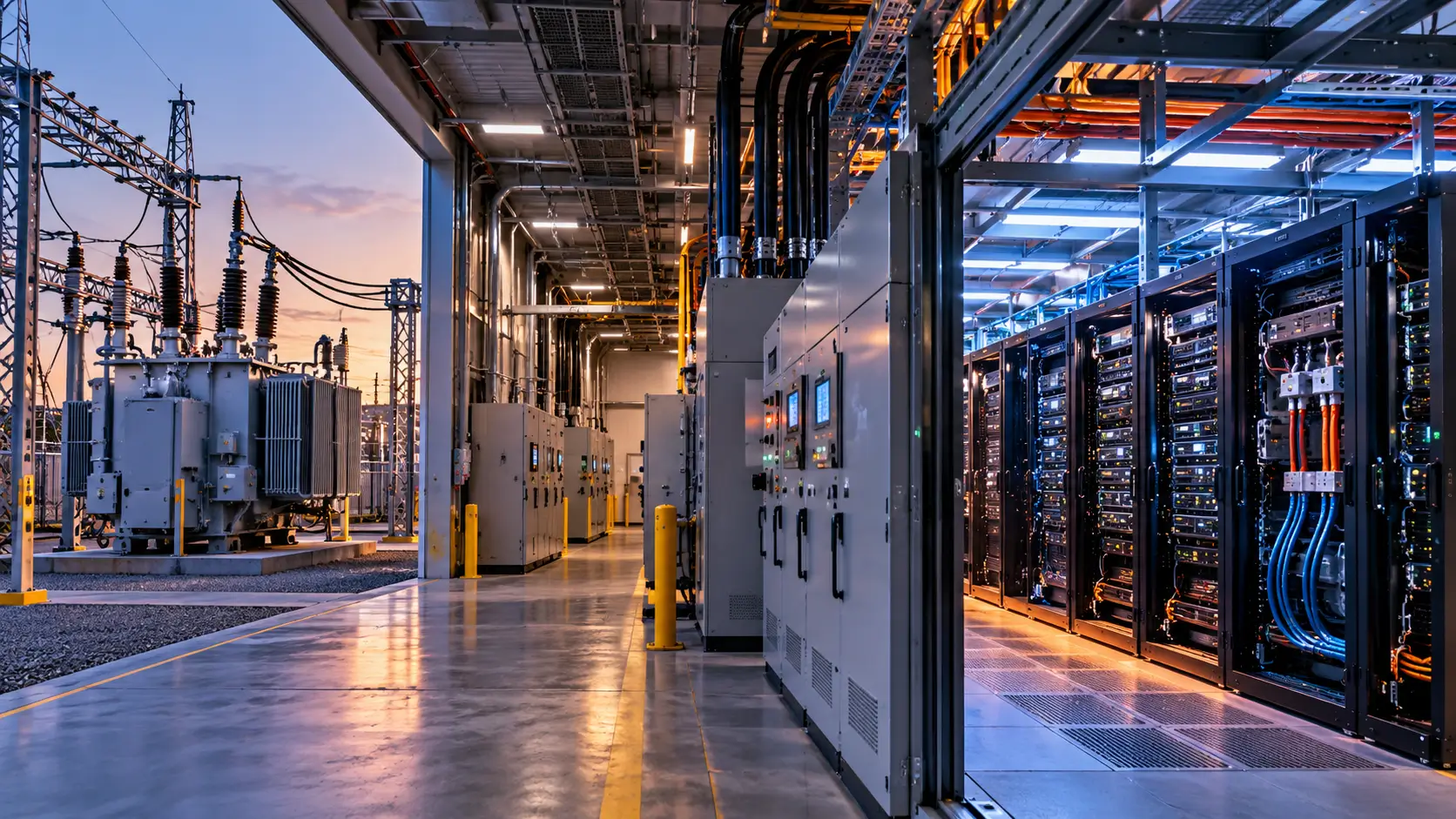
A customer can hear that an AI facility has secured power and still know surprisingly little about usable compute. The utility connection represents only one part of the electrical path between the grid and a working GPU cluster. Once electricity crosses the utility meter, the facility must transform, distribute and protect that power before servers can consume it. Transformers, switchgear, busways, backup systems and rack-level distribution all sit somewhere in that chain. Cooling equipment also consumes electricity, so the entire facility load cannot simply become IT capacity. That distinction matters more as operators deploy hardware with greater rack-level power requirements. A site can have substantial utility capacity while facing practical limits deeper inside its electrical architecture. Customers evaluating usable capacity must therefore examine the electrical and thermal infrastructure serving the intended compute environment.

The constraint can move inside the facility
Utility power remains critical because additional grid connections and upgrades can require substantial planning and infrastructure work. Yet removing that gate does not automatically remove every constraint that follows it. Electrical equipment has defined ratings, configurations and operating requirements that determine how much load the distribution system can support. The path may include medium-voltage equipment, transformers, switchboards, uninterruptible power supplies and rack-level distribution systems. Each stage must support the electrical characteristics of the deployed equipment, not merely the site’s aggregate megawatt figure. Higher-density deployments can expose limitations that remained less visible when workloads consumed less power per rack. However, those limitations do not necessarily mean the facility lacks total electrical capacity. Available capacity may simply be unable to reach a particular hall, row or rack in the configuration a customer requires.
A megawatt is becoming an incomplete capacity description
Utility megawatts establish an important deployment boundary, but they do not describe how much power reaches a specific compute environment. The number becomes less informative when it stands alone. Two facilities with comparable utility allocations can offer different conditions because their internal electrical and thermal designs may differ. One may concentrate substantial power across fewer dense racks, while another may distribute capacity across a larger floor area. Neither arrangement is inherently superior because workload requirements determine whether the architecture fits the deployment. Facility-level power is not automatically available at the rack because downstream electrical infrastructure determines how capacity reaches IT equipment. AI buyers evaluating deployable capacity need to understand the electrical and thermal path between incoming service and their equipment. Capacity procurement can therefore involve validating that infrastructure chain instead of relying on a facility-level megawatt figure alone.
Power density changes what customers are actually buying
The physical concentration of compute matters because GPUs do not consume power at the property boundary. They consume it inside servers, racks and clusters, where electrical delivery and heat removal must work together. A facility may have enough aggregate power while lacking the distribution configuration needed to concentrate it around the hardware. Upgrading that path can involve much more than adding another piece of equipment beside the rack. Operators may need changes to distribution components, protection schemes, cabling or busway arrangements. Those changes must also work with the facility’s broader electrical design. Exact requirements depend heavily on the existing architecture, so customers should not assume that every site needs identical upgrades. For deployments with defined rack-density requirements, deliverable rack power can affect infrastructure planning and commercial capacity commitments.

Cooling can turn electrical capacity into a coupled constraint
The electrical path cannot be evaluated independently from cooling as compute density climbs. Every watt consumed by computing equipment ultimately contributes heat that the facility must manage. However, cooling architectures and heat-removal paths can vary considerably between deployments. High-density AI systems can require different cooling arrangements from those supporting conventional lower-density racks. Liquid cooling can move heat efficiently from dense equipment, but it also introduces supporting facility infrastructure. Depending on the design, that infrastructure can include pumps, coolant distribution equipment, heat exchangers and controls. Those systems bring their own electrical, mechanical and operational requirements. Customers validating only rack power could therefore overlook another boundary between installed infrastructure and usable compute capacity.
The shortage may appear as fragmentation rather than scarcity
Those conditions can create a capacity constraint even when the underlying problem is not a simple lack of utility power. Capacity may exist across a campus while remaining difficult to concentrate where a dense AI deployment needs it. One building could have electrical headroom while another faces distribution limits. Likewise, one data hall could support greater rack density while another requires infrastructure modifications. Cooling capability can create another layer of segmentation across the same site. From the operator’s perspective, the campus may still contain unused infrastructure capacity. For customers, that capacity may offer little practical value if it cannot support their requested hardware configuration. As a result, headline megawatt availability can coexist with a shortage of deployment-ready capacity.
Contracts may need to describe deliverability more precisely
AI infrastructure contracts could benefit from describing deliverability through both electrical and thermal readiness. A reservation based mainly on compute quantity or facility capacity can leave important infrastructure questions unanswered. The same applies when an expected delivery date becomes the primary measure of readiness. Customers may need clearer specifications for rack power, redundancy expectations, cooling configuration and operational availability. They may also want milestones tied to electrical and mechanical readiness rather than facility completion alone. That does not require customers to become electrical engineers. Procurement teams instead need to distinguish available facility capacity from capacity capable of supporting contracted hardware. Documentation showing where and under what conditions capacity becomes usable can provide additional information for deployment planning.
Customers should follow the power path
The next capacity bottleneck may not announce itself through a rejected utility application or delayed grid connection. It could appear after power reaches the site, when a deployment encounters distribution, rack-density or cooling limits. That possibility gives AI buyers another set of infrastructure conditions to examine before treating capacity as deployment-ready. They need to know whether available power can reach their equipment under the required operating conditions. They also need to understand whether cooling infrastructure can remove the resulting heat at the planned density. Ultimately, useful AI infrastructure is not simply electricity sitting behind a meter or GPUs waiting for deployment. It requires compute, electrical delivery and thermal capacity to operate together under the intended workload. From the customer’s perspective, capacity becomes constrained when those components cannot become operational together.













