
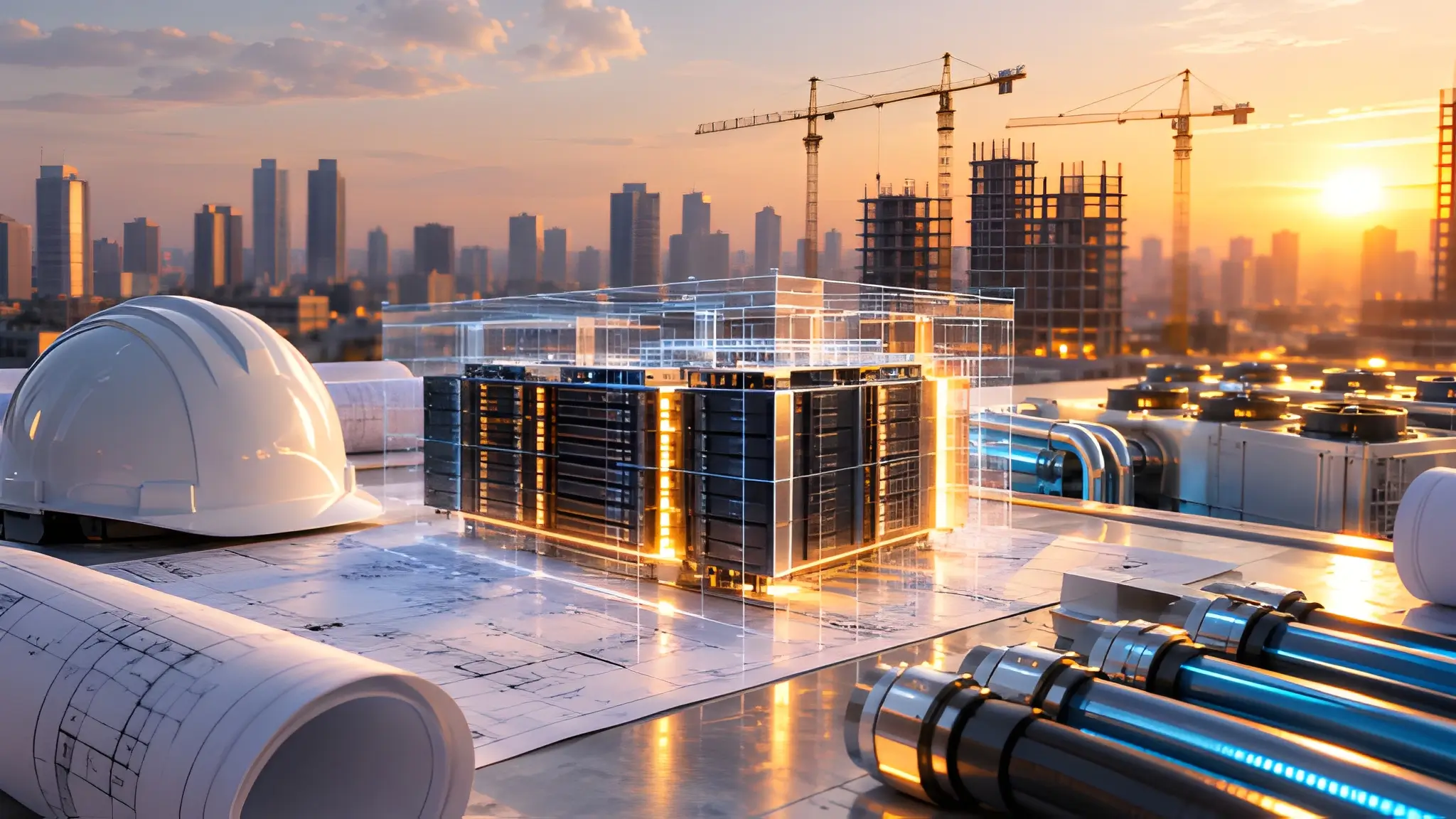
Colt Data Centre Services (Colt DCS) and RMZ have started construction of Mumbai 3, a 64-megawatt (MW) AI-ready data center at their Navi Mumbai campus, as demand for high-density computing infrastructure accelerates across India. The project marks the third facility in their Mumbai portfolio and follows the signing of its first hyperscale customer, securing contracted demand before construction advances. The companies are developing the facility through their joint venture, announced in 2024, which committed $1.7 billion to India’s data center market. With the project fully pre-let, the partners are building capacity against identified customer requirements rather than relying on speculative demand for future AI infrastructure.

Mumbai 3 Adds 64MW of AI-Ready Data Center Capacity
Mumbai 3 will deliver 64MW of secured contracted power when complete, expanding the partners’ ability to accommodate hyperscale deployments, neo-cloud providers and increasingly intensive AI workloads. Ground preparation began in December 2025, and construction has moved forward following the signing of the first hyperscale customer. The development represents a significant milestone for the joint venture, which has progressed from its announcement to construction within approximately 18 months. Its fully pre-let status also underscores the commercial importance of securing large-scale customer commitments before bringing new capacity online.
The facility responds to a structural shift in data center demand, as AI infrastructure requires more power per rack, more sophisticated thermal management and greater capacity within individual deployments. Conventional enterprise and cloud workloads remain important to the market, but AI training and high-performance computing introduce different requirements for power delivery, cooling and operational resilience. Mumbai 3 addresses these needs through a design that combines traditional air cooling with direct liquid-to-chip cooling. This hybrid architecture gives customers a pathway to deploy higher-density computing systems without relying exclusively on conventional cooling infrastructure.
Colt DCS and RMZ Target Hyperscale and Neo-Cloud Demand
The partnership brings together Colt DCS’s international data center operating experience and RMZ’s more than two decades of experience developing, owning and operating infrastructure in India. Their joint venture plans to develop 250MW of data centre capacity across Mumbai and Chennai, establishing a broader platform for serving India’s expanding digital infrastructure market. Mumbai 3 advances that strategy by adding a large, customer-secured facility to an existing campus rather than establishing an entirely new development footprint. The project also gives the partners a larger base from which to pursue customers whose computing requirements may increase as AI adoption expands.

“The nature of data center demand is evolving rapidly, with customers requiring larger deployments, higher rack densities and infrastructure capable of supporting increasingly intensive AI workloads. Mumbai 3 is designed to address these needs, further strengthening our Navi Mumbai Campus as a scalable and future-ready digital infrastructure platform. Built with AI readiness at its core, the facility incorporates advanced cooling capabilities, including liquid cooling and enhanced power infrastructure to support high-density deployments. This enables customers to efficiently scale next-generation AI and high-performance computing workloads while maintaining operational resilience and efficiency,” said Pratap Mane, Country Head DCS, India.
Mane’s remarks point to a broader shift in how operators compete for AI infrastructure customers. Capacity alone no longer defines a compelling data centre proposition; operators must also demonstrate that their facilities can accommodate demanding power and cooling requirements while maintaining dependable operations. For hyperscalers and neo-cloud providers, these capabilities can influence deployment timelines and the economics of scaling compute capacity. Mumbai 3’s pre-let status suggests that the partners have aligned the development with an identified customer requirement before completion.
RMZ Emphasises Scale, Resilience and Speed to Market
RMZ views the development as part of a wider effort to build infrastructure capable of accommodating changing computing requirements. The combination of secured demand, campus-level power infrastructure and AI-oriented cooling gives the project a role within the partners’ broader strategy to serve large digital infrastructure customers. As deployments grow in size and complexity, operators must coordinate power, cooling, connectivity and expansion planning well before customers install their computing equipment. The Navi Mumbai development brings these elements together within an established campus.
“The next wave of digital growth will be driven by infrastructure that brings together scale, resilience, and speed to market. At Mumbai 3, we are developing a future-ready campus designed to enable hyperscalers and neo-cloud providers to scale seamlessly as their capacity and computing needs evolve. This investment reinforces our commitment to building advanced data center and AI infrastructure that meets global standards and supports the rapidly evolving demands of the digital economy,” said Deepak Chhabria, President, RMZ Digital Infrastructure.
The emphasis on speed to market carries particular weight as AI infrastructure providers compete to bring additional computing capacity online. Securing power, integrating cooling systems and establishing reliable connectivity can all affect how quickly a facility becomes operational. A pre-let project can reduce uncertainty around initial demand, although construction schedules, commissioning and power availability still determine when customers can use the capacity. For Colt DCS and RMZ, the next milestone will be translating the project’s contracted demand and engineering design into operational infrastructure.
Navi Mumbai Campus Could Reach 148MW
Mumbai 3 will join Mumbai 1 and Mumbai 2 at the Navi Mumbai campus, which already supports large enterprise and cloud workloads. The campus has the potential to deliver up to 148MW of capacity at full development, while Mumbai 3’s completion will increase the site’s operational capacity to 86MW, according to the companies. These figures distinguish the capacity expected to become operational following the new facility’s completion from the larger potential capacity of the fully developed campus. The distinction matters as customers evaluate not only the amount of power available today but also the potential for additional deployments over time.
The development also illustrates the growing importance of campus-based expansion in markets where customers need substantial power capacity and room to scale. An established campus can provide a foundation for shared infrastructure, network access and coordinated development, although each expansion still requires adequate electrical capacity and operational readiness. For Mumbai, the addition of another large AI-ready facility strengthens the region’s position as a destination for hyperscale and cloud infrastructure investment. The joint venture’s parallel commitment to Mumbai and Chennai further broadens its footprint across two important Indian digital infrastructure markets.









