 Skip to content

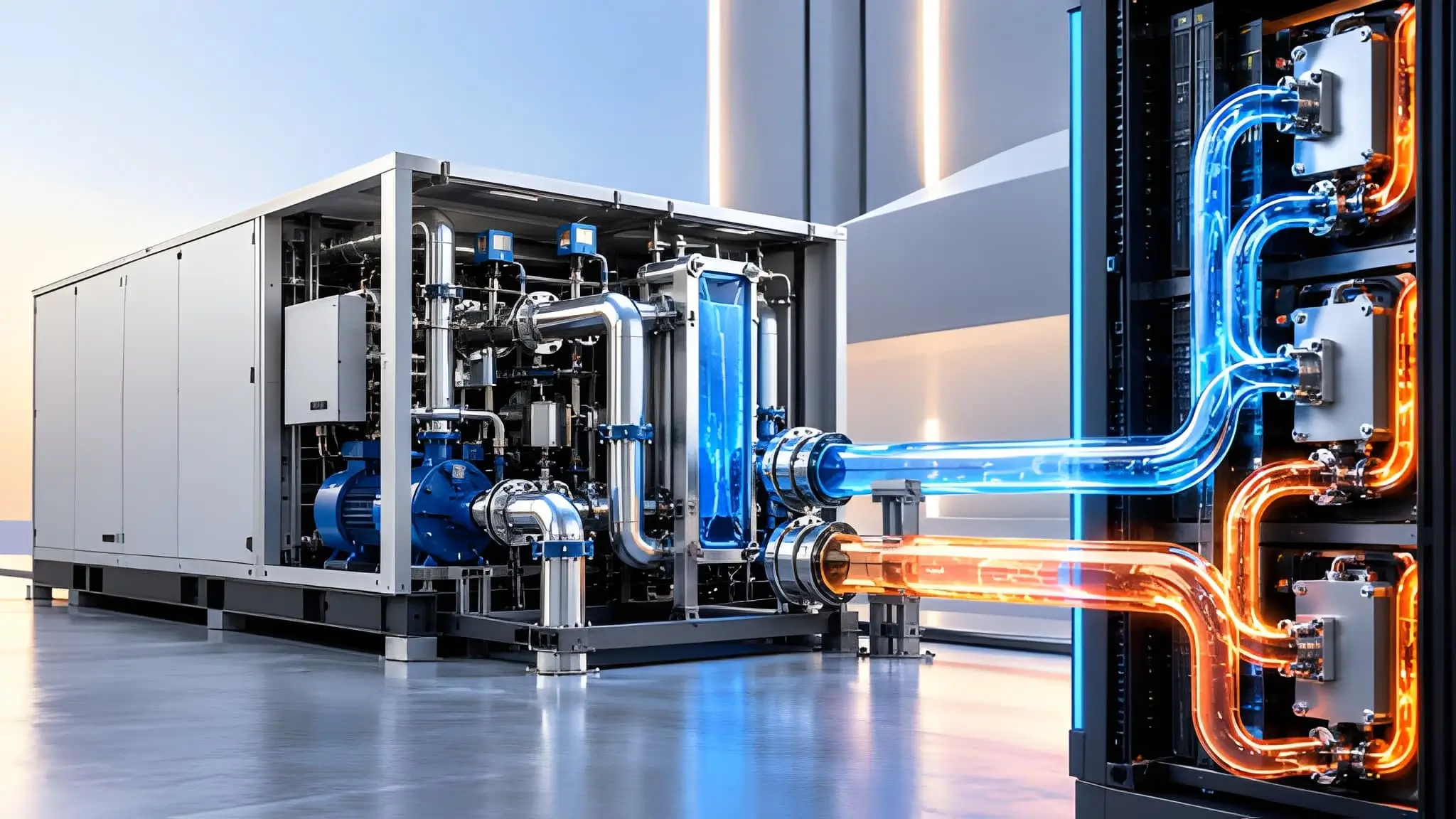
Daikin has unveiled a new range of coolant distribution units (CDUs) designed to support the rising cooling requirements of AI data centers, with individual units offering capacities of up to 2.5 megawatts. The company introduced the systems at the Datacloud Global Congress in Cannes, positioning the range for high-density computing environments that need more scalable thermal management infrastructure. Daikin plans to make the new CDUs available from November 1, 2026, giving data center operators another option as AI accelerators and high-performance computing workloads push rack power densities beyond the practical limits of conventional air cooling. The announcement also highlights a broader infrastructure challenge for the AI industry: operators must scale computing capacity without allowing heat removal, equipment reliability, and cooling-system footprint to become constraints on deployment.

Daikin Builds Reliability Into Its 2.5MW CDU Range
Daikin says its new CDU range targets mission-critical digital infrastructure, where cooling interruptions can affect equipment performance and operational continuity. The systems incorporate redundant pumps, duplicated pressure and temperature sensors, integrated leak detection, and alarm management to support monitoring and reliability. These features address several operational requirements associated with liquid cooling, including the need to identify abnormal conditions, monitor hydraulic performance, and maintain cooling delivery when individual components encounter problems. For operators evaluating liquid cooling at scale, the design places equipment resilience alongside capacity as a core consideration.
The hydraulic circuit uses AISI 316L stainless steel, a material selected for its corrosion resistance in demanding operating environments. Daikin has also adopted grooved mechanical couplings instead of welded connections, which the company says can simplify installation and maintenance while improving corrosion resistance. This approach has practical implications for projects where installation schedules, maintenance access, and the ability to service hydraulic infrastructure influence deployment decisions. It also reflects the importance of mechanical design in liquid cooling, where the reliability of connections and fluid circuits matters alongside the performance of pumps, sensors, and controls.
Modular Capacities Give Operators More Deployment Flexibility
Daikin’s new range offers capacities in increments of approximately 200 kW, extending to a maximum of 2.5 MW per unit. The range allows project teams to select equipment according to the cooling capacity required rather than committing every deployment to a single standard configuration. That flexibility could prove useful for operators building AI capacity in phases, particularly when initial installations must accommodate later increases in IT load. Instead of treating cooling as a fixed facility-level specification, developers can consider how individual units fit into a wider expansion strategy.

The 2.5MW ceiling also gives the product a clear position in the high-density cooling market. Larger-capacity equipment can help operators consolidate cooling delivery within technical areas, and Daikin says its units are designed to reduce the footprint required for these installations. However, the actual space savings will depend on the wider system design, including piping, redundancy requirements, service clearances, and the arrangement of supporting infrastructure. Capacity alone does not determine how efficiently a cooling plant fits into a facility, but a range that combines multiple sizing options with high per-unit capacity gives engineering teams more parameters to work with.
What Daikin’s Announcement Means for AI Infrastructure
Daikin’s launch comes as data center operators reassess the infrastructure required to support increasingly dense AI computing environments. The new range combines capacities of up to 2.5 MW, modular sizing, redundant components, leak detection, and corrosion-resistant hydraulic construction in a product family aimed at mission-critical facilities. Together, these elements address several practical considerations that shape liquid cooling deployment, from equipment reliability and maintenance to the space needed for supporting systems. The planned November 1, 2026, availability date gives prospective customers a defined timeline for evaluating the range in future infrastructure projects.
The wider strategic question is how quickly cooling infrastructure can adapt as computing requirements evolve. AI developers and cloud operators need systems that can accommodate rising thermal loads without forcing every expansion to begin with a fundamental redesign of the cooling architecture. Scalable CDUs can form one part of that response, although their effectiveness will depend on how operators integrate them with facility-level heat rejection, distribution networks, monitoring systems, and IT equipment.
Daikin’s announcement does not establish a universal solution for every AI data center, but it adds another high-capacity option to the liquid cooling market. As operators plan facilities around denser racks and larger computing deployments, the ability to match cooling capacity to actual project requirements will remain central to infrastructure planning. The next measure of success will be how these systems perform in operational environments, where reliability, maintenance demands, energy consumption, and expansion flexibility matter as much as headline capacity.










