Skip to content


A cooling system can perform exactly as its designers intended and still become a liability for the site that depends on it, particularly when the surrounding community sees the water entering the system as a resource that should remain available for households, farms, businesses, and ecosystems. That tension has changed the way evaporative cooling must be evaluated because the engineering case for removing heat no longer settles the local debate about how that heat should be removed. Evaporative systems transfer heat by allowing water to change from liquid to vapor, a process that can reduce the energy required for heat rejection under suitable operating conditions. The water that leaves through evaporation, however, does not return immediately to the local supply system, and its loss matters differently in a water-stressed watershed than in a region with reliable supplies and effective replenishment.

A credible return for water-cooled infrastructure begins when operators stop treating community acceptance as a communications exercise that follows engineering decisions. The sourcing plan, the cooling configuration, the treatment requirements, and the arrangements for wastewater discharge all shape the eventual public response, so those choices need to develop together rather than in separate approval processes. Reclaimed water can change the resource equation, but only where a dependable supply exists, the treatment process suits the intended use, and the new demand does not undermine other users who already depend on the reclaimed supply. Detailed reporting can make these conditions visible, although a disclosure cannot compensate for a design that places unacceptable pressure on a vulnerable water source. Community partnerships can add tangible value, yet they must deliver benefits that residents can verify rather than promises that depend on future investment or discretionary funding.
Why Efficiency Numbers Stopped Working in Town Halls
The energy case for evaporative cooling becomes difficult to communicate when a community hears an efficiency claim but cannot see how the claim addresses its immediate concern about water availability. Engineers evaluate cooling systems through heat loads, ambient conditions, equipment performance, operating costs, and reliability, whereas residents may focus on a municipal supply that already faces competing demands or restrictions. Both perspectives can be reasonable because a system can reduce electrical consumption while increasing the amount of water that leaves the local supply cycle through evaporation. A presentation that highlights only the energy benefit leaves that trade-off unexplained and can make a technically accurate claim sound incomplete. The resulting disagreement does not necessarily indicate that the audience misunderstands cooling technology; it may indicate that the explanation excludes the resource consequence the audience considers most important.
The Limits of an Energy-First Explanation
The technical argument for evaporative cooling rests on a real physical process, but its value depends on the system boundary used to evaluate it. When water evaporates, it carries heat away from the cooling process, which can help reduce the work required from other heat-rejection equipment under suitable conditions. A closed-loop liquid circuit can recirculate coolant without routinely consuming that coolant, but the site’s total water use depends on how the system rejects heat, whether it incorporates evaporative equipment, and how operators account for water used by supporting systems. Comparing the two arrangements only through electricity consumption leaves out the source and destination of the water, the consequences of treatment, and the effect of seasonal demand on local supplies.

A strong energy-performance claim also needs to reflect actual operating conditions rather than an idealized comparison that hides the variables affecting each design. Ambient temperature, humidity, equipment loading, heat-exchanger performance, water chemistry, and control strategy can change the relative performance of competing cooling arrangements. A design that performs well in one climate may require a different operating strategy in another, while a site with constrained water access may need to accept additional electrical demand to reduce reliance on evaporative heat rejection. The relationship between water and energy also extends beyond the cooling equipment because electricity generation itself can carry a water footprint, depending on the generation sources and their operating requirements. That wider footprint does not make direct water consumption unimportant, nor does it automatically favor evaporative systems; it demonstrates why technical comparisons need consistent boundaries and explicit assumptions.
Replacing a Single Efficiency Claim With an Operating Case
An operating case gives decision-makers a clearer picture of how the cooling system will behave across the conditions that matter to the site and its neighbors. Rather than presenting one efficiency result as a complete verdict, the operator can document the expected water source, the conditions that change demand, the controls used to limit unnecessary consumption, and the procedures that apply when supply quality or availability changes. The analysis should identify how water treatment affects the cooling process because dissolved minerals, suspended material, and other constituents can influence scaling, corrosion, biological control, and the management of circulating water. It should also account for blowdown, the portion of circulating water discharged to control the buildup of dissolved solids, since evaporative losses do not represent the only water-management concern.
A defensible comparison must also acknowledge that the most suitable cooling arrangement can change as computing equipment, site conditions, and water infrastructure evolve. A design selected for an initial computing load may encounter different heat densities, control requirements, and maintenance demands as operators deploy new hardware or alter workload patterns. A water source considered dependable during planning may become less attractive if the local utility changes its allocation policy, the treatment plant experiences interruptions, or drought reduces the availability of reclaimed supply. A closed-loop system can reduce dependence on evaporative water losses, but the operator still needs to evaluate heat rejection, electrical demand, reliability, and the resource implications of the complete installation. An evaporative system can remain a viable option when its source and operating conditions support it, although the decision requires evidence rather than an assumption that reclaimed water or efficient equipment automatically resolves every concern.
Reclaimed Water Is Rewriting the Moral Argument
Freshwater and reclaimed wastewater may enter the same cooling system, but their origins can change the consequences of operating that system for a surrounding community. A site that draws potable water from a municipal network competes for a resource that households, businesses, and other users may also need, particularly when the network faces seasonal constraints. Reclaimed wastewater offers another route by converting an existing treatment output into a useful industrial input, provided the water meets the requirements of the intended application. his approach broadens the resource assessment beyond cooling-tower consumption by examining the water source, its existing users, the treatment required, and whether supplying the cooling system reduces pressure on a constrained source without transferring that pressure to another user. It does not eliminate evaporation, remove the need for treatment, or guarantee that a reclaimed supply will remain available under every condition.
Turning Wastewater Into a Cooling Resource
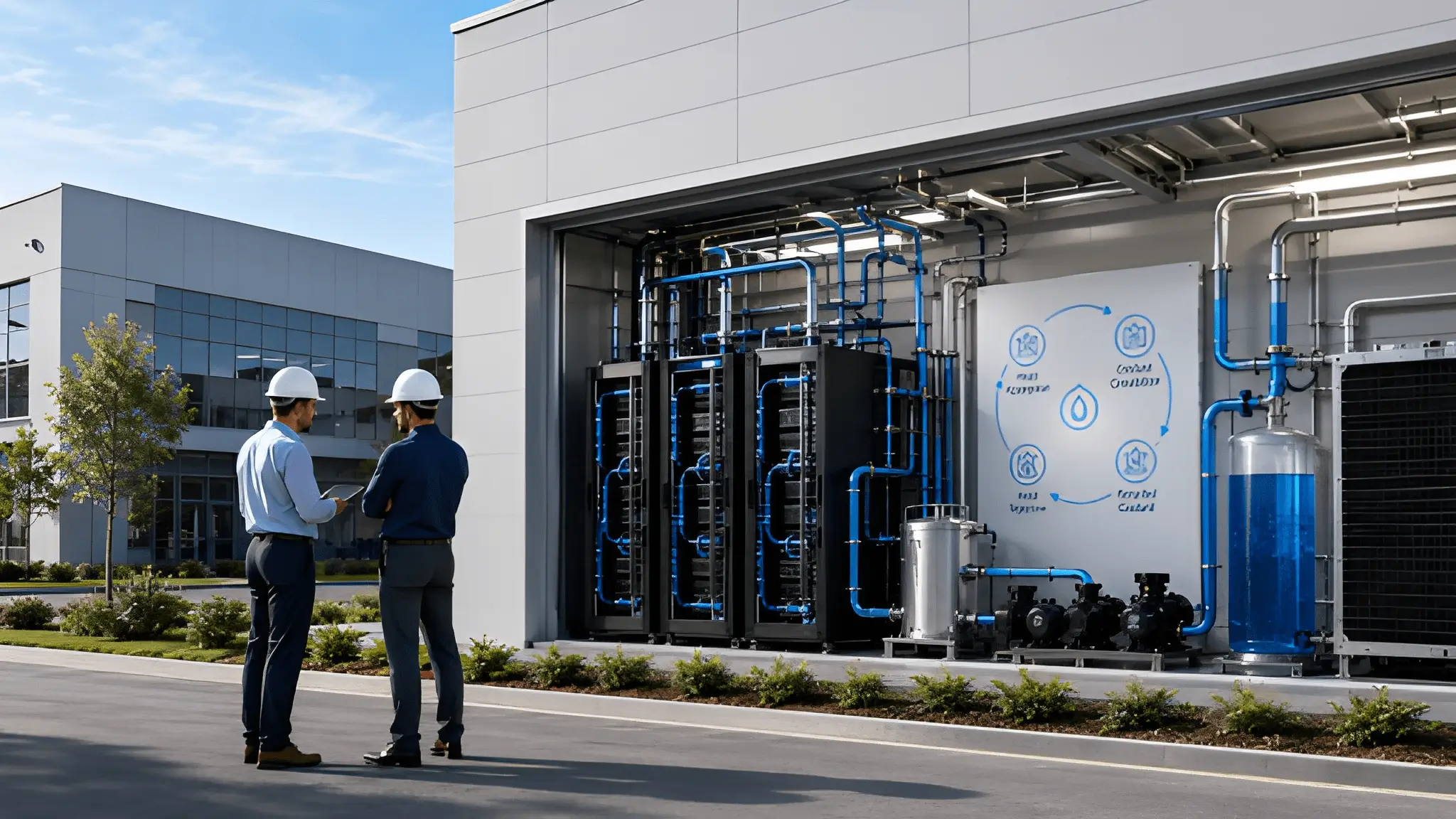
Municipal wastewater contains water that can serve industrial purposes after treatment appropriate to the intended use, and cooling towers can provide a practical destination for a suitably managed reclaimed supply. The process generally begins with wastewater treatment, followed where necessary by additional treatment to control suspended solids, dissolved minerals, organic material, and other constituents that could affect cooling performance. Engineers must then evaluate the resulting water against the operating requirements of the tower, the heat exchangers, the circulating-water chemistry, and the treatment program. Poorly controlled mineral content can encourage scale formation, while unsuitable chemistry can contribute to corrosion or undermine the effectiveness of water-treatment measures. Biological control also remains important because cooling towers create conditions that require careful management of microbial growth and aerosols. Reclaimed water therefore becomes a credible resource through engineering, monitoring, and operating discipline rather than through the simple relabeling of wastewater as sustainable water.
The operational value of reuse becomes clearer when the cooling system and the wastewater-treatment process form part of a coordinated water plan. A reliable reuse arrangement requires clearly allocated responsibilities for supply, treatment, water quality, and interruption management, with the precise obligations of the operator, utility, and treatment provider established in the project’s operating and supply agreements. Storage, pumping, treatment capacity, pipe routing, monitoring equipment, and residuals management all influence whether the arrangement can support continuous cooling. A site may need backup water or an alternative operating mode if the reclaimed supply becomes unavailable, because a wastewater-treatment outage cannot simply be allowed to compromise critical heat rejection. The project must also account for concentrated residual streams and treatment by-products rather than assuming that purification removes every environmental burden.
Why Reuse Changes the Local Value Proposition
Reuse also changes the way residents can evaluate an operator’s relationship with local infrastructure. A project that funds or helps operate a suitable treatment connection may create a shared asset, but the arrangement needs transparent governance, maintenance responsibilities, service expectations, and a clear account of who pays for ongoing operation. The operator should disclose whether the treatment system serves only its cooling demand or supports other industrial or municipal users, because those arrangements create different public benefits and different dependencies. The agreement should also specify how the parties will manage outages, changing treatment requirements, residuals, and future demand growth. These details matter because the apparent benefit of a new water source can diminish if the community inherits an unfunded maintenance obligation or loses flexibility over how it allocates reclaimed water.
Reclaimed water cannot settle every concern about evaporative cooling, and a responsible operator should state those limits before residents discover them through operating data or a supply interruption. Evaporation still removes water from the immediate supply cycle, while blowdown and treatment residuals require appropriate handling based on their composition and the applicable discharge or disposal requirements. Reclaimed water can also carry constituents that demand additional treatment, so the cooling plant may need more sophisticated controls than a system using a different source. The availability of reclaimed supply can depend on the performance of the wastewater network, competing uses, infrastructure connections, and the terms of the supply agreement. Those dependencies should form part of the site’s water-risk assessment, including a plan for periods when the intended source cannot meet demand.
The Transparency Move That Makes Water-Cooled Defensible Again
An annual water-use figure can tell a reader how much water a site consumed over a reporting period, but it cannot explain when that demand occurred, which source supplied it, or how operating conditions changed the result. Those missing details matter when a community experiences seasonal shortages or when a cooling plant shifts between operating modes as temperature, humidity, and computing demand change. A more informative disclosure links water use to its source, destination, intended purpose, and operating conditions, while also explaining the reporting boundary, measurement method, and relevant local supply constraints so readers can assess what the reported figures establish and what they leave unresolved. The reporting boundary also needs to be explicit, because direct water consumed at the site differs from water associated with electricity generation or upstream supply processes.
From Annual Totals to Operational Visibility
Useful water reporting begins with reliable measurement at the points where water enters, circulates through, and leaves the cooling system. A site should distinguish makeup water from circulating water because the tower repeatedly recirculates water while replacing the portion lost through evaporation, drift, blowdown, and other losses. Separate meters and validated operating records can help operators identify unexplained changes in consumption and determine whether those changes reflect weather, equipment performance, maintenance activity, or measurement errors. The reporting system should also identify the source of each supply stream so that potable water, reclaimed wastewater, and other approved sources do not disappear into an undifferentiated site total. Discharge measurements and water-quality records add another layer of accountability by showing how the operator manages the water that does not evaporate.
Real-time monitoring can make those records more useful by connecting flow measurements with the conditions that influence demand. Temperature, humidity, heat load, cooling mode, water quality, and treatment-system status can help explain why makeup-water requirements rise or fall during operation. The value lies not in collecting the largest possible stream of data, but in selecting information that allows the operator to detect abnormal consumption and explain the cause. For example, an unexplained increase in makeup water may indicate a control problem, a leak, an overflow, a change in tower operation, or a sensor that no longer reports accurately. Where appropriate, the operator can publish a public-facing summary of material findings, explaining consumption changes and corrective actions while limiting disclosure of security-sensitive control information and providing enough methodological detail for readers to interpret the results.
Making Disclosure Credible, Comparable, and Useful
Transparency requires more than publishing a dashboard, because readers need to know what the numbers include, how the site collects them, and whether the reporting method has changed. An operator should explain the measurement boundary, identify the water sources included, describe the treatment of estimated or missing data, and disclose material changes in equipment or operating practice. A clear account should distinguish withdrawals from consumption and discharge, since water entering a site does not necessarily equal water permanently removed from the local supply. It should also describe the method used to allocate water between cooling and other site activities, especially when a shared meter serves multiple systems. Independent review can provide additional assurance when its scope, methods, evidence, and limitations are disclosed, although the review establishes only what the procedures actually examine and cannot independently validate environmental impacts outside that scope.
A reporting system becomes more credible when it connects water consumption to a specific source and explains the local significance of that source. The same volume can carry different implications depending on whether it comes from a potable municipal network, a constrained groundwater basin, a reclaimed supply, or a source managed under a separate allocation arrangement. Operators should avoid treating reclaimed water as impact-free because the supply may have existing users, require energy for treatment, or depend on infrastructure that must remain reliable. The report should explain the role of each source and identify any planned substitution, so readers can see whether the site is reducing pressure on a constrained supply or simply changing the point at which demand appears. Where supply arrangements depend on future projects or permits, the operator should describe those dependencies separately from resources already available under current operating conditions.
When a Cooling Tower Becomes a Community Asset
A cooling tower usually enters a community’s awareness when a proposed site needs water, generates concern about local supply, or seeks approval for infrastructure that residents do not fully understand. That relationship can develop differently when the operator connects its cooling requirements to a wider water-management project that delivers a clear and lasting benefit beyond the site boundary. A reclaimed-water connection may require treatment equipment, monitoring systems, pumping capacity, and distribution infrastructure, but its wider community value depends on the project’s design, ownership arrangements, operating responsibilities, and the extent to which the infrastructure serves needs beyond the cooling operation. The value of that arrangement depends on the agreement governing the assets, the users who can access them, and the party responsible for maintaining the system over time. An operator cannot credibly describe infrastructure as a community asset simply because it purchases recycled water or contributes to construction costs.
Building Shared Water Infrastructure Around a Real Need
A community partnership should begin with an assessment of local water infrastructure rather than a predetermined promise that the cooling project will produce a public benefit. Municipal utilities may need additional treatment capacity, alternative supply routes, better monitoring, or improvements to existing systems, but the relevant needs vary by location and cannot be assumed from the presence of a large industrial water user. The operator can work with the utility to identify whether a reclaimed-water connection would address an existing constraint, make productive use of an available treatment output, or require substantial new infrastructure that would otherwise have little value. That assessment should also establish whether the proposed arrangement competes with existing reuse customers or changes the allocation of water during periods of shortage. Engineering studies need to address water quality, delivery reliability, treatment residuals, discharge requirements, and the consequences of an interruption to the supply.
The ownership and operating structure determines whether shared infrastructure remains useful after construction and beyond the initial relationship between the parties. A water utility may own and operate the treatment assets, while the site operator funds a dedicated connection or enters into a supply agreement that supports the project’s economics. Another arrangement may assign responsibility for specific equipment to the industrial user while preserving municipal oversight of water allocation, quality requirements, and relevant discharge conditions. Each model creates different responsibilities for maintenance, emergency response, cost recovery, and future capacity expansion. The agreement should specify how the parties will handle equipment failure, changes in treatment requirements, supply restrictions, and disputes over operating priorities, because these conditions can affect the reliability of both the cooling system and the shared water network.
Extending the Partnership Beyond Water Supply
Heat reuse offers another possible route for connecting a data center’s cooling infrastructure with local needs, although its feasibility depends on the temperature, timing, location, and reliability of the available heat. A computing site releases thermal energy that cooling systems must transfer away from equipment, and some of that energy may suit nearby applications that require low-temperature heat. Potential recipients include buildings or industrial processes with compatible heat requirements, but a viable connection depends on the available temperature, distance, demand profile, required heat-pump or heat-exchanger equipment, and the recipient’s ability to use the recovered heat when it is available. The engineering challenge involves matching the heat source with the recipient’s requirements, because a temperature that works for one application may be inadequate for another without additional equipment.
Heat reuse and water reuse can complement one another, but a project should not combine them in its public claims unless it can explain the relationship between the systems. A reclaimed-water connection may reduce reliance on potable water, while a thermal connection may provide a nearby user with heat that would otherwise require another source of energy. Each benefit has a separate operating boundary, and each needs its own evidence to establish whether the arrangement delivers the intended outcome. A heat customer may require service when the data center’s thermal output is low, or the site may need to reject heat when the recipient cannot accept it. The project therefore needs a backup arrangement and controls that preserve reliable cooling without making the data center dependent on uninterrupted demand from the heat recipient.
The 18-Month Window Where Sentiment Could Flip
An eighteen-month period can provide time to establish a different operating record, but it cannot guarantee a change in public attitudes toward evaporative cooling. The eighteen-month period is best treated as a planning horizon for assessing whether a site can improve water sourcing, reporting, and local engagement, rather than as an established industry timetable for changing public attitudes. Operators may need time to validate meters, establish a reclaimed-water supply, agree on reporting boundaries, obtain approvals, and demonstrate that the cooling plant can operate reliably under the intended conditions. Communities also need opportunities to assess the information, raise concerns, and observe whether the operator responds consistently when the system encounters difficulties. The speed of this process depends on the maturity of local infrastructure, the complexity of the project, and the availability of credible evidence about water use.
Drought Pressure and the Need for Credible Evidence
Drought can change the local assessment of cooling infrastructure because water restrictions, declining supplies, and competing demands make the opportunity cost of industrial consumption more visible. The implications depend on the watershed, the source supplying the site, the legal arrangements governing that source, and the measures available to protect other users. A cooling system supplied by a dependable reclaimed-water arrangement may face different local resource pressures from one that relies on a constrained potable network, but the comparison requires evidence about source reliability, existing users, seasonal availability, and the terms governing allocation. Operators should avoid assuming that a reclaimed supply remains available during a drought simply because wastewater continues to enter the treatment system. Treatment capacity, distribution constraints, competing uses, and emergency allocation decisions can all affect the volume available for industrial cooling.
Drought planning also needs to account for the difference between annual water availability and the conditions that occur during periods of greatest stress. A site may operate within its annual allocation while drawing heavily on the supply during a season when households, agriculture, or other users face tighter constraints. Annual totals alone may not reveal this concentration of demand, especially when cooling requirements rise with weather conditions or when alternative supplies become less reliable. Operators can improve the analysis by examining seasonal demand, identifying periods when water availability may constrain operation, and documenting the controls that will apply during those periods. A reclaimed-water system may reduce reliance on potable supplies, but the operator should document its dependence on treatment capacity, supply availability, and any contractual or regulatory allocation conditions that determine how water is distributed when demand exceeds available supply.
Data Maturity and Familiarity With AI Infrastructure
Reliable operating data can change the quality of local engagement by replacing general claims with information that people can examine over time. A site that publishes consistent records of its water sources, consumption, discharge, and seasonal operating conditions can show whether its actual behavior matches its planning assumptions. The usefulness of those records depends on the measurement system, the reporting boundary, and the operator’s willingness to explain changes that may appear unfavorable. A sudden increase in consumption, for example, requires context about weather, workload, equipment condition, and the accuracy of the underlying measurements before anyone can draw a sound conclusion. The operator should preserve enough historical information to make changes visible and explain whether a revised figure reflects a real operating change or a correction to the measurement method.
Familiarity with AI infrastructure may also change the setting in which communities evaluate new cooling projects, but familiarity alone does not establish trust. Accessible information about computing demand, power requirements, cooling equipment, and local infrastructure can give residents more material with which to evaluate competing design choices, although familiarity alone does not establish how they will interpret that information or whether they will support a particular project. That knowledge can make detailed reporting more useful because people can connect the site’s resource demands with the systems that support its operation. It can also raise expectations for disclosure, especially when operators describe a project as efficient or sustainable without publishing enough evidence to support the claim. Site teams should therefore treat public understanding as a reason to improve the quality of technical explanations, not as an assumption that residents will eventually accept any particular cooling configuration.
This Comeback Will Be Won on Trust, Not Thermodynamics
Evaporative cooling will remain a technical option whose suitability depends on climate, heat load, water availability, equipment design, and operating requirements. Its energy performance can support a strong engineering case, but that case cannot establish whether a particular site should draw on a particular water source under local conditions. Communities need to understand where the water comes from, how the operator measures consumption, what happens to discharged water, and which parties benefit from any reuse arrangement. Reclaimed wastewater can reduce dependence on potable supplies where the source, treatment process, and allocation arrangements support that outcome. Transparent operating records can make the result easier to verify, while well-structured partnerships can connect the site’s resource requirements with documented local needs. These elements give operators a way to evaluate evaporative cooling through evidence about the complete system rather than relying on equipment efficiency as the sole basis for approval.
From Cooling Performance to Water Accountability
The first requirement for a defensible cooling strategy is a water balance that reflects the site’s actual operation and identifies the sources supplying its cooling systems. That balance should distinguish water withdrawals, consumption, recirculation, and discharge so that the operator can explain how each part contributes to the local resource impact. It should also identify the conditions that change demand and the operating procedures used when the supply, water quality, or equipment performance departs from expectations. Where reclaimed water forms part of the plan, the operator needs to demonstrate that the supply can meet the cooling system’s requirements and explain how it will manage interruptions or competing demands. Where the system uses potable or groundwater supplies, the operator should disclose the relevant sourcing arrangements and avoid implying that annual consumption figures alone establish the acceptability of the draw.
Water accountability also requires the operator to explain the trade-offs that remain after it has adopted its preferred design. Reclaimed water still needs treatment, evaporative cooling still loses water to the atmosphere, and shared infrastructure still requires dependable maintenance and clearly assigned responsibilities. Closed-loop cooling can reduce routine evaporative consumption, but its overall performance depends on the heat-rejection equipment and operating conditions selected for the site. These realities make it important to compare complete operating arrangements instead of presenting one cooling technology as universally superior. A transparent evaluation can document the benefits identified by the analysis, disclose the burdens and uncertainties it reveals, and describe the measures proposed to manage them, while making clear which outcomes have been demonstrated and which remain unverified.
What the Next Eighteen Months Can Establish
The coming eighteen months can provide a useful period for operators to test their sourcing plans, improve water measurement, and establish whether local partnerships can deliver the outcomes they promise. The period should not serve as an arbitrary deadline for claiming a political turnaround, because approval processes, infrastructure delivery, and community responses follow different timelines. Some sites may already have access to suitable reclaimed water and reliable monitoring, while others may need substantial upgrades before they can support a credible reuse strategy. Operators can still make progress by identifying the gaps, explaining the constraints, and publishing the steps required to address them. They should also state which improvements depend on decisions outside their control and avoid presenting future capacity as an existing resource. The resulting record can show whether the proposed cooling arrangement is becoming more accountable, even if public acceptance remains unsettled at the end of the period.
The political future of water-cooled infrastructure will therefore depend on whether the operator can make its water strategy understandable, measurable, and accountable beyond the boundaries of the site. Thermodynamics will continue to explain how evaporative systems remove heat, and engineering analysis will continue to determine which configurations can meet the required operating conditions. Neither can establish public confidence without evidence about the source of the water, the consequences of consumption, and the arrangements that protect other users. Reclaimed water can provide a more responsible pathway where the local water balance supports it, while precise reporting can show how the system behaves across changing conditions. Community partnerships can add value when they address documented needs and carry clear responsibilities rather than serving as promotional additions to a development proposal.