
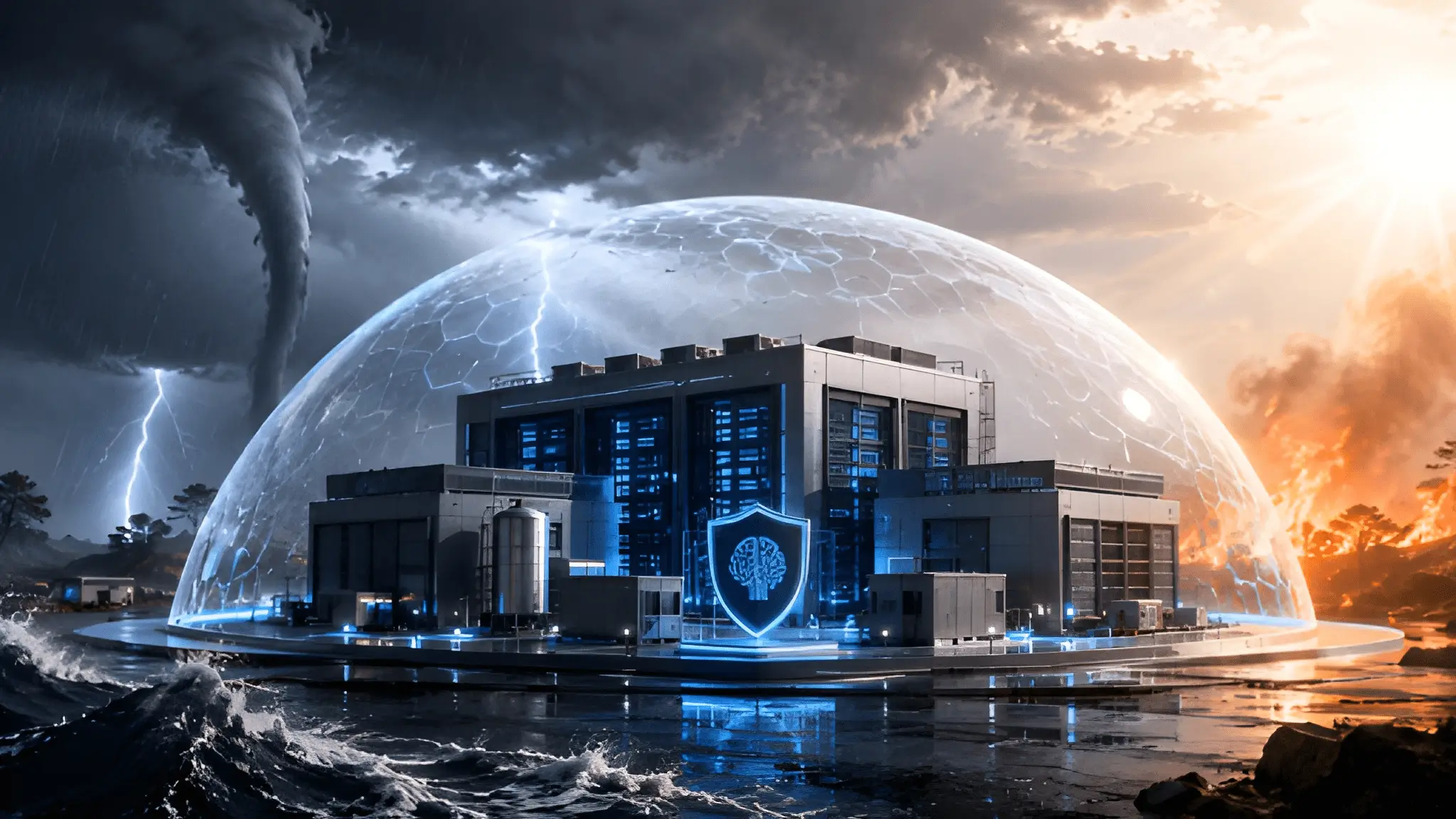
Many recent AI infrastructure announcements have emphasized similar themes.. The headlines celebrate larger GPU clusters, multi-gigawatt campuses, faster deployment schedules and increasingly ambitious investment figures. GPU capacity, power availability and deployment scale have become prominent indicators of competitive positioning across the AI infrastructure market. Yet none of those announcements can negotiate with a heatwave. That uncomfortable reality deserves more attention than another benchmark for model performance. Physical conditions are becoming an increasingly important consideration in how AI infrastructure performs and scales over time.

Compute may scale exponentially, but weather follows its own timetable. The discussion around AI infrastructure still revolves around silicon, electricity and networking. Those remain legitimate priorities. However, climate resilience is becoming a more prominent consideration in infrastructure planning and long-term investment decisions. That shift matters because infrastructure lasts decades, while climate patterns continue to change throughout the same investment horizon. The industry’s biggest assumption may no longer concern demand for AI. It may concern whether yesterday’s environmental conditions remain relevant for tomorrow’s infrastructure.
Speed became the objective. Survivability became the afterthought.
Competitive pressure explains much of today’s expansion strategy. Competitive pressure encourages hyperscalers to expand capacity as demand for AI infrastructure continues to grow. AI demand continues to outpace available infrastructure, encouraging developers to secure power, land and permits wherever opportunities emerge. Regions with available transmission capacity, established fiber routes and favorable economics naturally attract investment. That approach makes commercial sense. It does not automatically maximize long-term resilience.
Many locations experiencing unprecedented AI development also face recurring heat stress, water constraints, wildfire exposure or flood risks. Those risks rarely stop projects from moving forward because immediate deployment often outweighs future uncertainty. That does not suggest poor engineering. It reflects market incentives. Investors often view faster infrastructure deployment as an indicator of execution and future growth potential. Customers demand immediate compute access. Competitive positioning depends on scale. Climate resilience often enters the conversation after site selection rather than before it. The industry has optimized for speed because speed creates revenue. The next decade may reward durability instead.

Weather is becoming an infrastructure variable rather than an operational inconvenience
Extreme weather has long been part of infrastructure risk planning, but its growing frequency and intensity are increasing its operational significance. For many operators, extreme weather is becoming a more frequent operational consideration rather than an occasional contingency. Heat reduces cooling efficiency. Water shortages complicate traditional cooling strategies. Flooding threatens access roads, substations and surrounding utilities. Wildfires affect power reliability and air quality. Hurricanes challenge logistics, transmission networks and recovery timelines. None of those events necessarily shut down modern data centers. That is not the point.
Modern facilities already incorporate redundant power systems, advanced cooling technologies, hardened buildings and multiple layers of operational resilience. Engineering continues to improve because operators recognize growing environmental risks. The more important question concerns cumulative pressure. Repeated environmental disruptions influence maintenance schedules, insurance costs, equipment lifecycles and financing assumptions. They reshape operating expenses long before they threaten catastrophic failure. Investors tend to evaluate AI infrastructure through utilization rates and revenue potential. Climate introduces another financial model. Facilities exposed to recurring environmental stress could face different long-term operating costs and investment considerations than comparable assets in lower-risk locations. The balance sheet eventually notices what the weather has been saying for years.
Climate resilience is becoming part of AI economics
Infrastructure discussions often separate engineering from finance. That distinction is becoming increasingly artificial. Every resilience upgrade carries financial consequences. Hybrid cooling systems require investment. Water-efficient technologies increase upfront costs. Hardened facilities demand additional capital. Distributed infrastructure strategies introduce operational complexity. These expenses rarely generate headline excitement. They also become increasingly difficult to avoid. Organizations increasingly weigh resilience investments alongside compute expansion when allocating infrastructure capital. That creates a strategic question rather than an engineering one.
Should companies maximize immediate deployment, or should they prioritize infrastructure capable of absorbing decades of environmental volatility? The answer will probably differ across organizations. What seems increasingly unlikely is that resilience remains optional. Climate adaptation is gradually becoming part of infrastructure economics rather than a separate sustainability initiative. That distinction changes boardroom conversations. Environmental resilience no longer belongs exclusively to ESG reporting. It begins influencing return on investment.
The industry is already responding, but the pace deserves scrutiny
Major infrastructure operators have not ignored these realities. Large AI campuses increasingly incorporate liquid cooling, water conservation technologies, redundant networking, sophisticated building designs and site-selection models that evaluate future environmental scenarios alongside traditional infrastructure requirements. Those developments represent meaningful progress. They also acknowledge an important shift. Climate resilience has become part of mainstream infrastructure planning instead of remaining a niche sustainability discussion.
A continuing discussion within the industry centers on how quickly resilience measures should evolve alongside AI infrastructure expansion. AI infrastructure deployment continues at a rapid pace across many global markets. Climate adaptation measures often develop on longer planning and investment timelines than new infrastructure deployments. Infrastructure decisions made today may remain operational through the middle of the century. Designers therefore face a difficult challenge: building facilities for environmental conditions that historical records may no longer accurately predict. Engineering can reduce risk, it cannot eliminate uncertainty. That uncertainty deserves greater visibility whenever billion-dollar AI investments become headline news.
The next AI leaders may compete on geography as much as technology
Location has long been an important factor in infrastructure planning and operational performance. AI may amplify that reality.n Regions capable of providing reliable electricity, sustainable water resources, resilient transmission networks and relatively stable environmental conditions could become increasingly attractive destinations for future compute. That evolution extends beyond engineering. Governments, utilities, insurers and financial institutions all influence where infrastructure becomes economically viable.
Climate resilience could become an increasingly important source of competitive advantage beyond advances in cooling technology alone. Reliable infrastructure ecosystems could become as strategically important as GPU availability in future AI deployments. That possibility represents a fundamental shift in how the industry measures strategic advantage. Compute capacity remains essential. Reliable compute capacity under worsening environmental conditions may become considerably more valuable.
The conversation should expand before the climate does it instead
The AI industry excels at solving technical challenges. Its recent history proves that repeatedly. The more difficult challenge may involve changing the questions that receive attention. Public investment announcements often emphasize GPU capacity, power commitments and deployment scale more prominently than long-term resilience costs. Financial models often emphasize deployment speed while treating long-term environmental adaptation as an operational detail. That framing increasingly feels incomplete. Weather no longer operates outside digital infrastructure. It shapes the environment in which digital infrastructure must succeed.
Companies that integrate climate resilience into long-term infrastructure strategy could strengthen their position as AI deployments continue to expand. They may become the organizations that recognize climate resilience as infrastructure strategy rather than infrastructure insurance. That distinction could define the next decade of AI investment. The future of artificial intelligence will certainly depend on better models, more efficient hardware and abundant energy. Long-term success will also depend on whether those systems can operate reliably under increasingly variable environmental conditions.











