 Skip to content
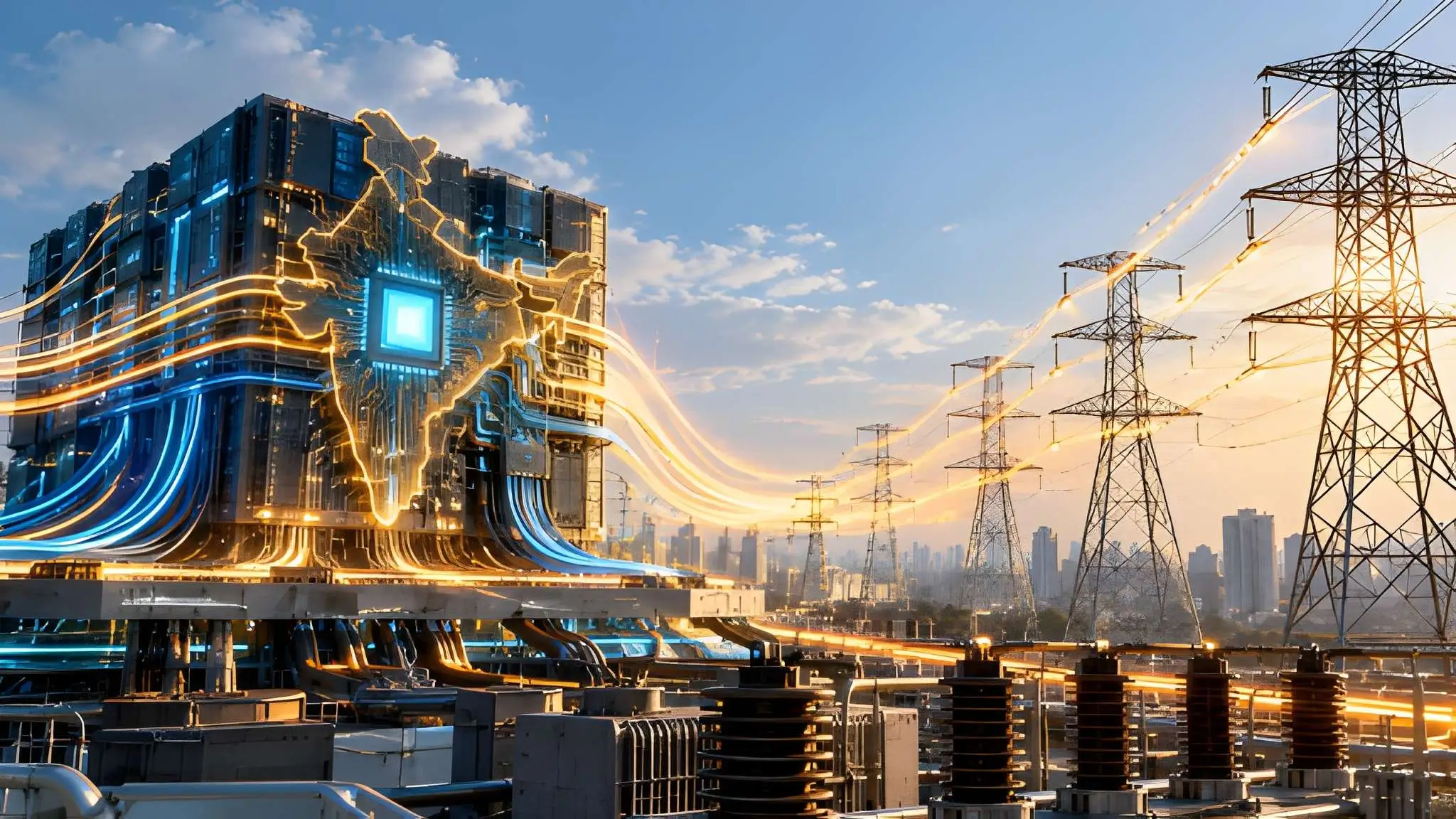
India’s artificial intelligence expansion is beginning to expose a question that sits outside the usual language of chips, models and cloud capacity: how much electricity can a digital economy consume before electricity itself becomes one of its defining industrial inputs? That question matters because the numbers are moving into territory normally associated with major physical industries. Industry reports estimate that electricity consumption from India’s data centers could rise from 10 terawatt-hours in 2025 to 191 TWh by 2040, a roughly 20-fold increase that would represent about 7% of the country’s total electricity demand. The same research projects operational data center capacity to rise from 2.2 gigawatts in 2025 to 12 GW by 2030. Those figures do not simply describe a larger technology sector. They describe a change in the character of electricity demand.

AI Is Turning Compute Into An Industrial Load
India’s digital expansion has increasingly depended on physical infrastructure, including data centers, networks and the electricity systems required to operate them. Data moves through networks, applications sit in clouds, and AI systems increasingly appear as software services. Yet every model-training run, inference request and digital transaction ultimately reaches physical infrastructure that draws electricity continuously. The government has projected that AI data centers could add 26.3 GW of additional power demand by 2031-32, almost twice an earlier estimate of 13.56 GW. The projection reflects a rapidly changing pipeline of proposed AI infrastructure and provides another indication of how quickly planners are having to revise their assumptions.
The 26.3 GW figure and the 191 TWh forecast should not be read as the same measurement. One refers to additional load projected for 2031-32, while the other represents the annual electricity consumption forecast for 2040. But together they reveal something more consequential than either figure alone: AI is creating a concentrated class of electricity consumers large enough to influence generation, transmission, procurement and grid planning. That changes the infrastructure conversation.
The Real Question Is No Longer Whether India Has Enough Power
India’s electricity system is already expanding rapidly. The Central Electricity Authority’s National Electricity Plan projects peak demand of 366.4 GW and electricity requirements of 2,473.8 billion units for 2031-32, alongside substantial additions in generation and storage capacity. The challenge, therefore, is not simply to produce more electrons. AI data centers need electricity at a particular place, at a particular quality and with a high degree of continuity. A large quantity of renewable generation somewhere in the country does not automatically solve a local capacity constraint at the grid node serving a high-density computing facility. Solar generation also does not naturally match every hour of a data center’s operating profile.

The CEA has already identified this broader systems issue in its planning work, noting that renewable capacity can require storage or complementary capacity because solar and wind availability does not always coincide with peak electricity demand. That is where the 191 TWh question becomes more interesting. The debate cannot remain focused on how many gigawatts of generation India can build. It must increasingly ask where those gigawatts will be available, when they will be available, how transmission capacity will connect them to large loads and how much firm power AI infrastructure will require.
The 191 TWh Number Changes The Scale Of The Debate
There is a tendency to describe AI infrastructure through physical objects: GPUs, racks, buildings, substations and cooling systems. Those objects are visible, which makes them easy to discuss. Electricity is different. It is invisible, but the scale of consumption gives it a physical presence in the national economy. If data centers eventually consume 191 TWh annually, the industry will not simply be another fast-growing digital service. It will become a major electricity-consuming category whose demand has to coexist with households, manufacturing, transport, commercial activity and other emerging loads.
That does not mean AI should be framed as competing directly with those sectors. India’s electricity demand is growing, and new generation and grid infrastructure can expand the overall supply base. The more important issue is coordination. AI demand can arrive quickly. Transmission projects, generation assets and storage systems operate on different development timelines. The mismatch between those clocks could become more consequential than the absolute amount of electricity required.
India’s AI Strategy Will Ultimately Be An Energy Strategy
The country’s AI ambitions are therefore tied to a less glamorous but more decisive infrastructure question. India can build computing capacity at remarkable speed. It can attract hyperscale investment, expand domestic cloud infrastructure and increase access to advanced AI systems. But the physical limits of electricity delivery will increasingly shape how quickly that digital expansion can happen. The government’s own planning points toward a larger role for transmission, renewable generation and grid modernization as electricity demand rises. The next stage will require treating those systems as part of AI infrastructure itself. That means the unit of competition may gradually shift. It will not be enough to ask who has the most GPUs or the largest data center pipeline.
The harder question may be who can secure dependable power at the right location, at the right price and with sufficient flexibility to support increasingly variable computing workloads. The significance of 191 TWh is therefore not that India has suddenly discovered an electricity shortage. It is that the country is creating a new industrial demand category whose growth is being driven by computation rather than factories, vehicles or household appliances. AI may still be marketed as a digital revolution, but its physical footprint is increasingly measured in electricity. That is the uncomfortable arithmetic India now has to confront. The country’s AI future will not be determined only by how much intelligence it can generate. It will also depend on whether its electricity system can absorb the machines required to produce it. And once AI becomes large enough to reshape electricity demand itself, the power system stops being background infrastructure. It becomes part of the AI strategy.













