
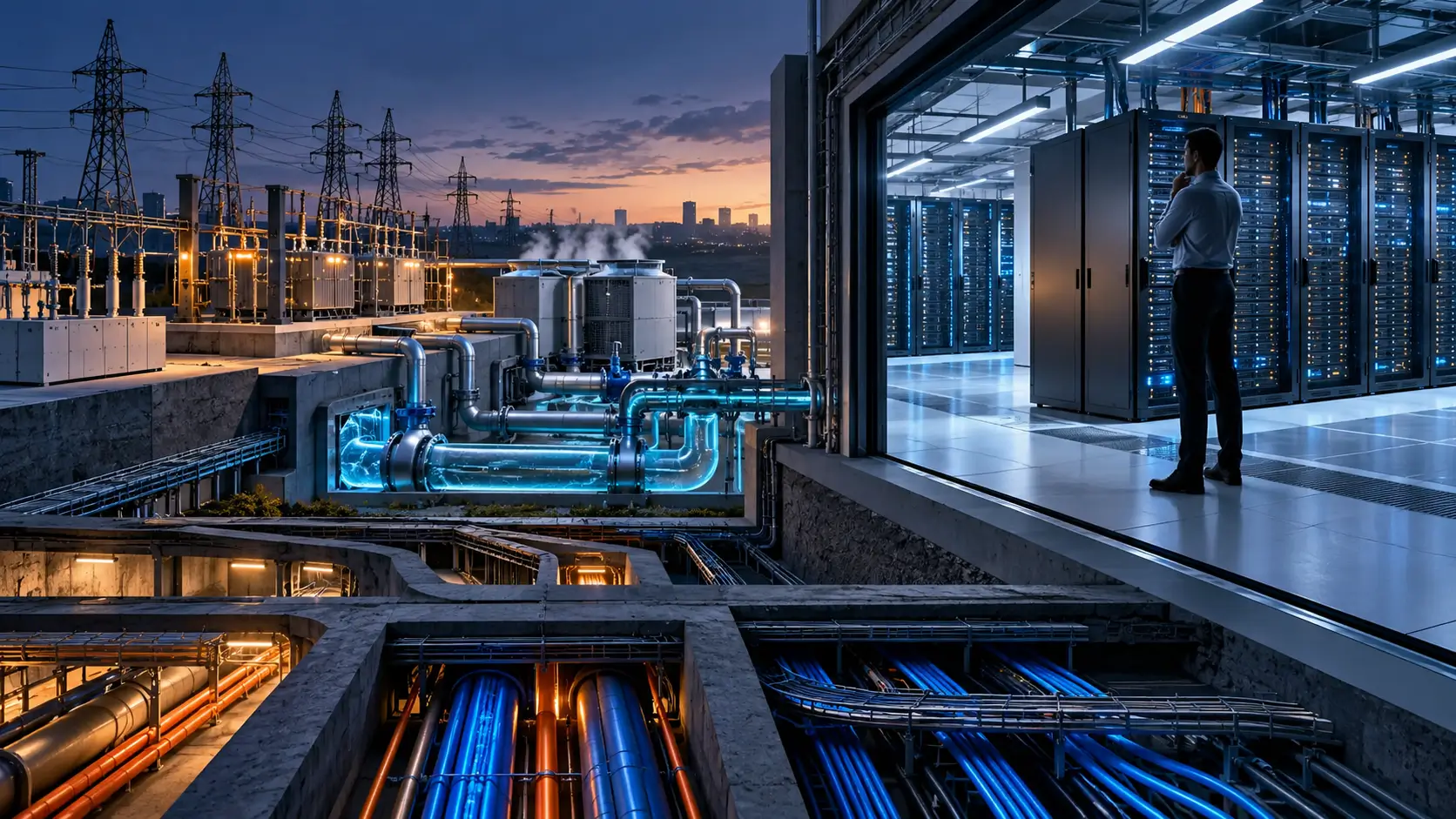
AI capacity can look available long before the surrounding infrastructure is ready
A customer can see empty rack positions, available floor space and a planned GPU deployment and reasonably assume that expansion remains straightforward. The harder constraint may sit somewhere the customer never sees during a data hall tour. Electrical distribution, cooling infrastructure, utility capacity, network paths and heat-rejection systems all influence how much additional computing equipment a site can actually support. That distinction matters because physical room does not automatically equal deployable capacity. A facility may have space for another cluster while still requiring changes elsewhere before operators can support the associated load. For AI buyers, that turns infrastructure diligence into something broader than checking rack density or asking when servers can arrive. They need to understand whether the systems surrounding the hall can absorb the next deployment without creating new operational dependencies. The uncomfortable possibility is that the most important expansion bottleneck may be located beyond the customer’s contracted footprint.

The rack is becoming a poor proxy for expansion readiness
AI procurement still encourages buyers to think in quantities that are easy to purchase and compare. Buyers may count accelerators, racks, clusters, nodes and reserved megawatts, then map those quantities against deployment schedules. Yet the useful question is not simply how much equipment can fit inside a hall. It is whether the complete infrastructure path can support that equipment under the operating conditions the customer expects. Higher-density systems can place additional requirements on electrical distribution and thermal-management infrastructure, while network architecture can affect how clusters connect across a facility. Those dependencies can extend from the rack through cooling loops, power-distribution equipment and external infrastructure. As a result, another row of racks does not necessarily represent another equivalent block of usable AI capacity. Customers that treat physical availability as infrastructure readiness may discover the difference only when an expansion reaches engineering review.
The power path does not stop at the data hall wall
Power has become one of the most visible constraints in data center development, but customers can still view it too narrowly. A contracted capacity figure does not describe every component that electricity must cross before reaching computing equipment. Upstream systems may include utility connections, substations, transformers, switchgear and facility-level distribution equipment, depending on the site design. Each layer forms part of the operating path behind the capacity sold to the customer. Expansion can therefore require more than installing additional rack-level distribution hardware. Operators may need to evaluate whether upstream equipment and supporting systems can accommodate the proposed load. That process can introduce engineering, procurement and commissioning requirements outside the hall itself. AI customers should consequently ask where their expansion path begins to depend on infrastructure they neither control nor directly occupy.
Grid access can separate planned capacity from usable capacity
This distinction becomes sharper when customers plan several expansion phases rather than a single deployment. A provider may have a roadmap for additional buildings or halls, but those plans do not automatically establish when additional power will become operational. Utility interconnection and transmission or distribution constraints can influence the timing of new data center capacity in power-constrained markets. Customers therefore need to separate planned infrastructure from capacity that can support workloads on the required schedule. That does not mean future capacity lacks value; rather, it means the conditions attached to that capacity deserve scrutiny. Buyers should understand which dependencies remain before an expansion block becomes operationally usable. They should also distinguish commitments controlled by their provider from milestones that depend on utilities or other external parties. The expansion conversation becomes more useful when it moves from a headline capacity number toward the sequence of infrastructure dependencies behind that number.

Cooling can move the bottleneck beyond the servers
Liquid-cooled AI systems make this issue particularly visible because thermal capacity depends on a connected system rather than an isolated rack. A server can be technically ready while the supporting cooling path still needs additional infrastructure or commissioning. Depending on the architecture, that path can involve coolant distribution units, facility water systems, pumps, piping and heat-rejection equipment. Changes at one point can require operators to reassess available thermal capacity elsewhere in a connected cooling system. Customers should therefore avoid treating liquid-cooling readiness as a binary feature attached to a hall. They need to know what thermal conditions their reserved capacity assumes and whether those assumptions remain valid as rack densities change. A future accelerator generation could alter the cooling requirements of an expansion even when the customer intends to occupy the same physical footprint. The commercial value of reserved space can consequently depend on infrastructure located far beyond the servers that generate the heat.
Heat rejection deserves a place in the capacity conversation
The industry often discusses cooling closest to the chip because that is where thermal engineering becomes tangible to the AI buyer. Yet heat eventually has to move away from computing equipment and through the facility’s broader thermal system. The precise path varies by design, climate, operating strategy and cooling architecture. That makes it risky to assume that support for one high-density deployment automatically guarantees identical conditions for every later expansion. Operators may have to assess pumps, piping, heat exchangers or heat-rejection equipment when thermal loads change materially. Customers do not need to design those systems themselves, but they do need visibility into the constraints that can affect contracted capacity. A useful capacity discussion should explain which thermal resources are available today and which depend on future work. Without that distinction, buyers can mistake nominal cooling capability for guaranteed expansion headroom.
Network architecture can create another invisible boundary
Compute expansion also loses value when new accelerators cannot connect to the rest of the environment in the way a workload requires. Large AI deployments can depend on high-bandwidth network fabrics inside clusters as well as external connectivity between infrastructure locations and other services. Adding servers therefore solves only one part of the scaling problem. Network ports, switching capacity, optical connectivity, fiber routes and supporting equipment can become part of the expansion plan. The exact constraint depends heavily on topology and workload, so customers should resist simplistic assumptions about network capacity. A provider may be able to house additional compute without offering the same connectivity characteristics as the original deployment. That difference can affect how a customer architects distributed training, data movement or other network-intensive operations. Infrastructure buyers should ask whether expansion preserves the network characteristics their workloads actually require rather than assuming physical adjacency guarantees equivalent connectivity.
Capacity fragmentation can become an architecture problem
When one infrastructure layer reaches its practical limit, one option is to place incremental compute elsewhere rather than expand the constrained environment. That location could sit in another hall, another building or a different site, depending on available capacity and provider architecture. Such an arrangement is not automatically problematic, but it can change the engineering assumptions behind the workload. Network topology, operational procedures and data placement may need to adapt to a more distributed footprint. Customers that expected expansion to behave like an extension of an existing cluster may instead face a new architecture decision. The key commercial question is therefore not only whether more compute can be supplied. Buyers should also ask where that compute will operate and which infrastructure characteristics remain consistent after the move. Expansion capacity has different practical value when using it requires redesigning the workload around a new physical boundary.
AI buyers need an infrastructure dependency map, not another capacity headline
The purchasing process can improve if customers treat expansion as a chain of dependencies rather than a single reservation number. The starting point should be the workload and the operating conditions it will require across successive deployment phases. Buyers can then map those requirements against power delivery, thermal systems, network architecture and any external infrastructure that affects availability. This approach does not require customers to become data center engineers. It requires contracts and technical discussions to expose the assumptions that sit behind a provider’s expansion commitments. A reservation becomes more meaningful when the buyer understands what infrastructure already exists and what still needs to change. The same principle applies when capacity depends on utility work, additional cooling equipment or network expansion. In that sense, infrastructure transparency becomes part of the product that an AI customer is buying.
Expansion rights matter only when the infrastructure can support them
Commercial discussions around AI capacity can focus on how much capacity a customer can obtain and when that capacity becomes available. AI infrastructure procurement increasingly needs another layer of questioning around the technical conditions attached to those rights. A buyer may want to know whether future capacity assumes a particular rack density, cooling configuration, power profile or network topology. It may also need clarity on what happens if future hardware changes those assumptions. That does not require every infrastructure variable to become a rigid contractual guarantee. It does require both parties to identify the dependencies capable of materially changing deployment timing or usable capacity. The objective is not to eliminate infrastructure uncertainty, which would be unrealistic. The objective is to prevent an expansion right from being mistaken for immediately usable AI capacity when important technical dependencies remain unresolved.
The next AI capacity shortage may be hidden in plain sight
The data hall provides a visible representation of AI infrastructure because customers can see racks, servers and cooling connections taking shape. Yet visibility should not determine where buyers concentrate their diligence. The systems outside that room can decide whether another cluster arrives on schedule, requires additional engineering or needs to operate somewhere else. Power delivery, thermal infrastructure, heat rejection and network connectivity form part of the same capacity product even when customers purchase them indirectly. That makes expansion planning a systems problem rather than a real estate problem. The strongest procurement questions may therefore concern infrastructure that never appears in a server specification or GPU quotation. AI buyers should understand how far their capacity rights extend through the physical systems required to make those rights usable. The real expansion limit may ultimately sit outside the data hall, within infrastructure that customers do not necessarily control or directly occupy.











