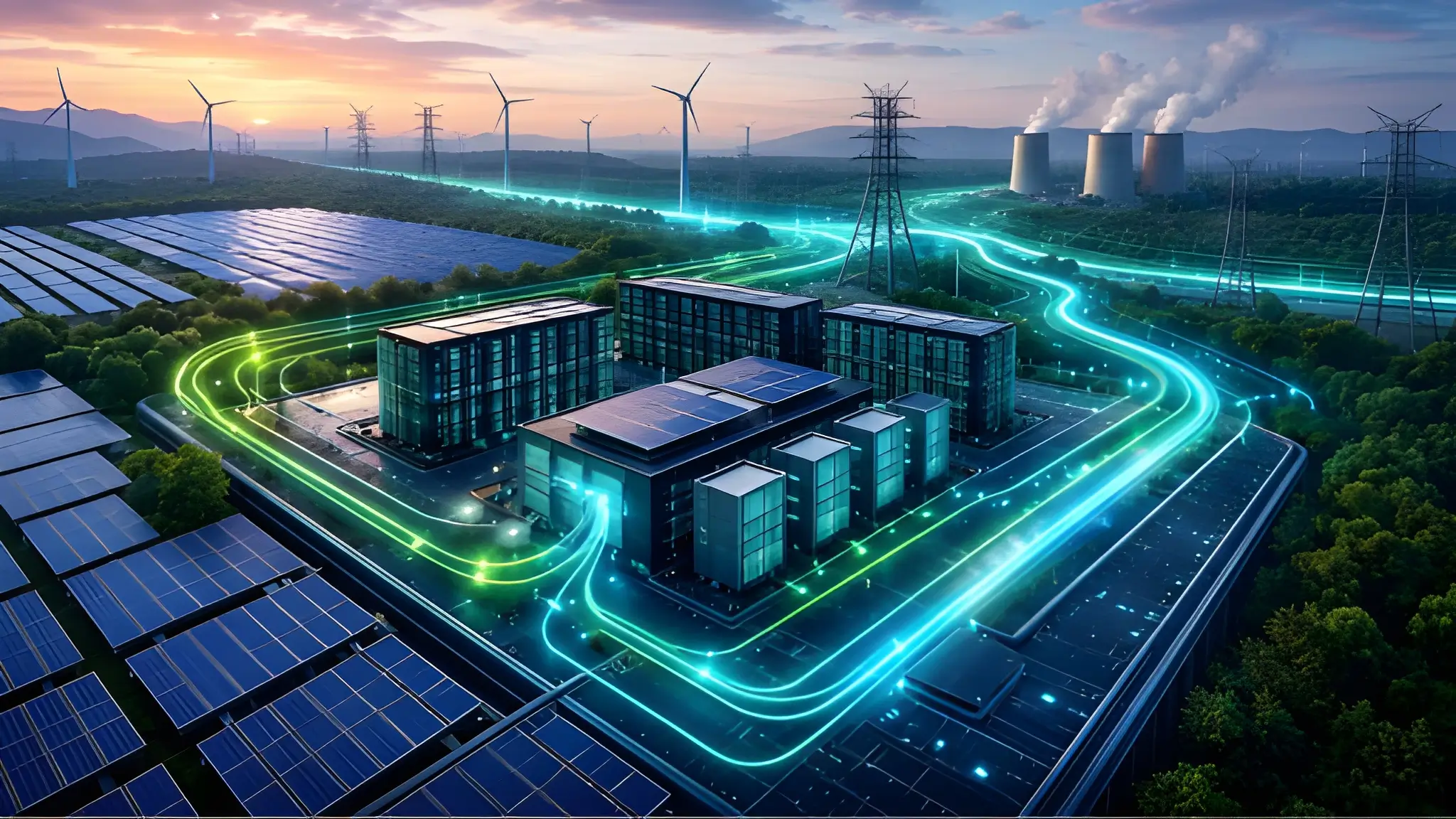
The illusion of endless power for AI
The narrative surrounding artificial intelligence infrastructure has long assumed that electricity would scale alongside compute. That assumption is now visibly breaking down. What the latest developments around Emerald AI make clear is not that power is scarce, but that access to it is increasingly conditional.
The AI boom is colliding with a grid that was never designed for synchronized, high-density demand spikes. Interconnection queues are lengthening, not because utilities cannot generate enough electricity in aggregate, but because they cannot guarantee delivery during peak stress periods. This distinction matters. It reframes the issue from one of supply expansion to one of demand discipline.
Emerald AI’s emergence and its rapid backing from players like Nvidia, is best understood as a response to this structural imbalance. It is not offering more power. It is offering a way to qualify for it.
Flexibility is no longer optional—it is transactional
At the heart of Emerald AI’s proposition is a simple but disruptive idea: data centers should adjust their behavior to match grid conditions. This includes reducing or shifting consumption during extreme demand periods without compromising core AI operations.
This is being positioned as a “flexible-load fast track”, a mechanism through which developers can accelerate grid interconnection by proving they will not behave like inflexible, always-on loads. The comparison to a priority lane is not accidental. It reflects a deeper shift in how infrastructure access is being negotiated.
In practical terms, this means that reliability, historically defined as uninterrupted consumption is being reinterpreted. The industry’s “five nines” standard is not being abandoned, but it is being complemented by a new expectation: responsiveness.
This is a significant change. It suggests that access to the grid will increasingly depend not just on how much power a facility needs, but on how intelligently it can use it.
The peak-demand problem is finally being acknowledged
The commentary from energy executives supporting this model underscores a critical point: the grid’s challenge is not total capacity, but peak load management. This aligns with Emerald AI’s core thesis that flexibility during a small number of high-stress hours each year can unlock disproportionate value.
If data centers can temporarily reduce or shift workloads during those periods, they effectively create additional capacity within the existing system. The claim that such strategies could unlock up to 100 gigawatts of usable power in the U.S. grid is not just ambitious, it is revealing. It highlights how much inefficiency is embedded in current consumption patterns.
This is where Emerald AI’s approach gains traction. By coordinating computational workloads, on-site resources like batteries and generators, and grid signals, its platform attempts to convert rigid demand into adjustable demand. The promise is precise, real-time responsiveness without degrading performance.
Nvidia’s role signals a broader strategic shift
The involvement of Nvidia is not incidental. Through NVentures, its investment arm, the company is backing not just compute infrastructure, but the energy logic that underpins it. This reflects a growing recognition that AI scaling is now constrained as much by electrons as by chips.
The partnership between Emerald AI and Nvidia extends beyond capital. It includes pilot programs with major U.S. power producers such as AES Corporation, Invenergy, NextEra Energy, Vistra Corp. These collaborations indicate that the concept of grid-flexible AI is being tested not in isolation, but within the operational realities of the power sector.
The planned launch of a 96-megawatt AI factory research center in Virginia later this year further reinforces this point. It is not just a facility, it is a proof of concept for a new kind of infrastructure, one that is designed to negotiate with the grid rather than simply draw from it.
“AI for AI” is more than a slogan
Emerald AI’s characterization of its platform as “AI for AI” captures an important nuance. The system is not merely automating energy management; it is applying intelligence to balance computational demand with physical constraints.
This includes identifying which workloads can tolerate slight delays, which can be geographically shifted, and how on-site resources can be deployed to smooth consumption. The idea that “bits” can move to where “electrons” are available represents a reversal of traditional infrastructure logic.
Historically, energy systems have been built to serve fixed loads. Now, loads are being designed to adapt to energy systems.
This inversion has profound implications. It suggests that future competitiveness in AI may depend as much on operational flexibility as on raw computational power.
Investment momentum reflects urgency, not experimentation
The $25 million funding round announced on March 31, bringing Emerald AI’s total to $68 million in just 16 months is notable not only for its size, but for its composition. Backers include industrial, technological, and strategic investors such as GE Vernova, Siemens, Samsung, Salesforce, and IQT.
This is not a speculative bet on a distant future. It is a coordinated response to an immediate bottleneck.
The parallel funding of companies like ThinkLabs, which aims to compress grid interconnection studies from years to minutes, further illustrates this urgency. The ecosystem is forming rapidly, with multiple approaches converging on the same problem: how to align AI growth with grid realities.
The uncomfortable implication for data center operators
What this model ultimately implies is that data center operators can no longer assume unconditional access to power. The era of passive consumption is ending.
To remain competitive, operators may need to demonstrate flexibility as a core capability. This could involve redesigning workloads, investing in on-site energy assets, and adopting software platforms that enable real-time responsiveness.
For some, this will represent a shift in mindset as much as in technology. It challenges the long-standing belief that reliability requires rigidity. Instead, it suggests that resilience may come from adaptability.
Access will be earned, not assumed
The rise of grid-flexible AI infrastructure does not solve the power challenge outright. It does, however, redefine the terms under which that challenge is addressed.
Emerald AI’s model makes one thing clear: in an era of accelerating AI demand, access to electricity will increasingly be conditional on behavior. Those who can align with grid needs by reducing, shifting, or optimizing their consumption will move faster. Those who cannot may find themselves waiting.
This is not a temporary adjustment. It is a structural shift in how energy and computation intersect. The AI industry has spent years optimizing how machines think. It is now being forced to rethink how they consume.