
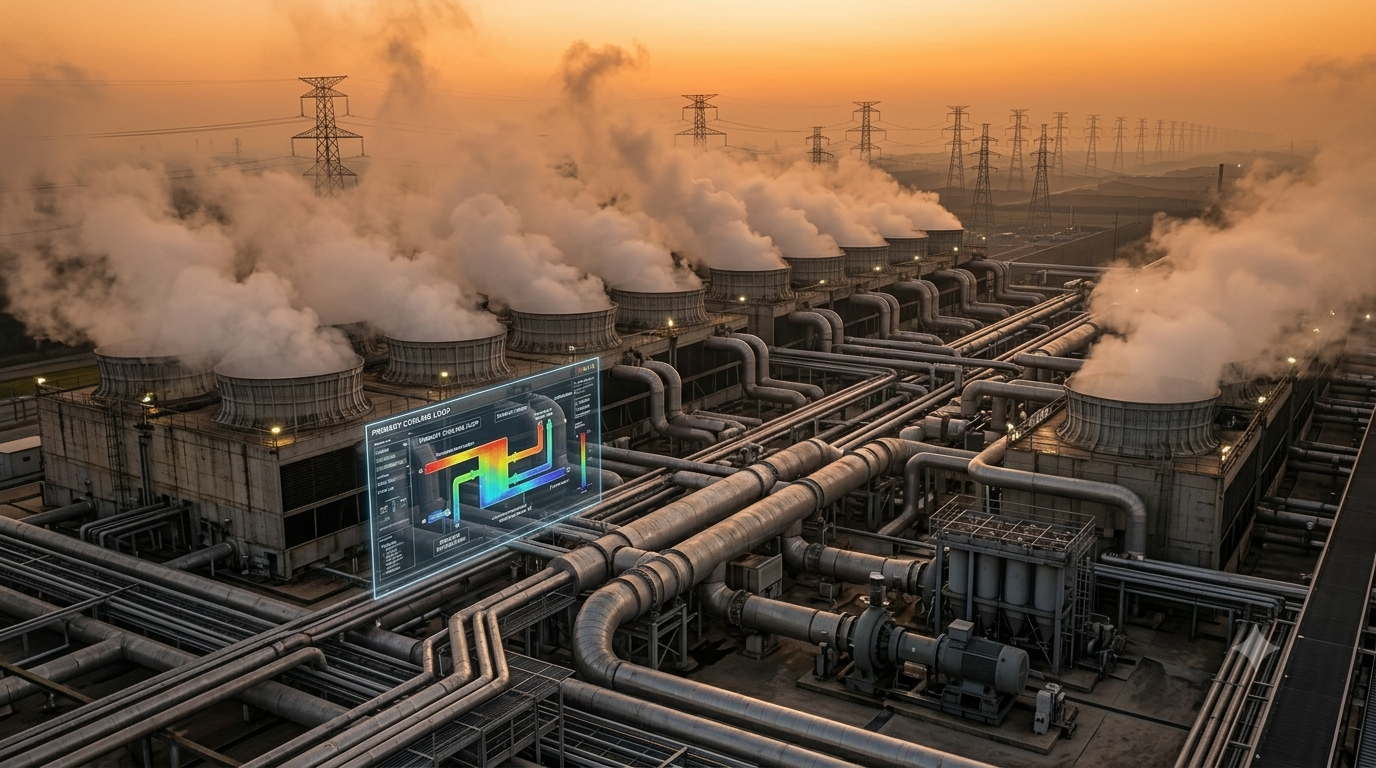
Governments across three continents have spent the past two years debating what artificial intelligence can say, what data it can access, and which risks it may pose to democratic institutions. That conversation produced the EU AI Act, executive orders, safety summits, and a growing class of AI governance professionals. What it did not produce and what no major jurisdiction has yet delivered is a binding framework for what AI physically does to the earth, to water tables, and to the grids that keep hospitals and households powered. The omission is not incidental. It reflects a structural bias in how policymakers frame AI risk: as a software problem, not an infrastructure one.

The Governance Architecture Misses the Physical Layer
When legislators drafted AI regulations, they focused on outputs what a model generates, who it surveils, and whether its decisions discriminate. That framing made sense in the context of consumer harm and civil liberties. It made considerably less sense as a comprehensive governance strategy for a technology that requires, at industrial scale, the thermal management equivalent of small industrial facilities. The International Energy Agency projects that global data center electricity consumption will more than double between 2022 and 2026, reaching roughly 1,000 TWh annually — a figure approaching Japan’s total national electricity draw. Because the majority of that electricity converts directly to waste heat requiring active rejection, the cooling infrastructure problem scales in direct proportion to the AI build-out. Regulators wrote rules for the outputs of that build-out. They did not write rules for the heat it produces on the way.
A 2024 study from researchers at the University of California, Riverside estimated that training a single large-scale AI model consumed approximately 700,000 liters of water for cooling. Inference at scale compounds that figure. Billions of daily queries across major AI platforms generate aggregate cooling water demand measured in hundreds of millions of gallons per day. The United States now hosts more than 4,000 data centers — 37 percent of the global total. Not one federal statute currently mandates uniform thermal efficiency standards or water consumption disclosure for AI workloads specifically.
Disclosure Without Enforcement Is Not Governance
Some jurisdictions have moved on reporting. The EU’s Energy Efficiency Directive requires data center operators to disclose energy and water consumption data from 2024. Singapore’s Green Data Center Roadmap targets a Power Usage Effectiveness ratio of 1.3 by 2034. Japan’s 2022 Energy Conservation Act sets a PUE target of 1.4 by 2030. Australia links government procurement to a five-star NABERS rating with equivalent efficiency thresholds. These measures represent genuine incremental progress. They do not constitute a coherent regulatory response to AI’s thermal footprint. A 2026 analysis published in ScienceDirect noted that the absence of binding efficiency and renewable energy targets at the EU level remains a significant limitation that data centers can continue consuming vast quantities of energy and water without meaningful consequence under current frameworks. Disclosure obligations with no enforcement teeth do not alter operational calculus for hyperscale operators running on tight deployment timelines.
The U.S. Congress introduced the Liquid Cooling for AI Act in September 2025, which directs the Government Accountability Office to review cooling technologies, survey waste heat reuse opportunities, and issue best-practice recommendations. The legislation is noteworthy for acknowledging the physical problem. It is not a binding standard. It does not establish a thermal efficiency floor, cap water withdrawals, or require public disclosure of site-specific consumption data.
Communities Absorb Costs That Regulators Did Not Assign
The regulatory gap does not exist in an abstract policy vacuum. It materializes in specific geographies where data center clusters draw against shared water resources and push grid infrastructure toward capacity limits. In Northern Virginia — which processes approximately 70 percent of global internet traffic Dominion Energy projects a 70 percent increase in summer peak load between 2022 and 2045, driven almost entirely by data center demand. Ireland presents a comparable case: data centers now consume a larger share of national electricity than all urban households combined, creating documented concerns around future grid capacity. In water-stressed regions, a Bloomberg investigation published in May 2025 documented AI infrastructure drawing cooling water from areas facing supply constraints a spatial conflict that no algorithmic safety framework addresses.

A United Nations University Institute for Water, Environment and Health report released in mid-2026 concluded that public discussion has focused too narrowly on carbon emissions while overlooking the broader physical pressures associated with AI’s expansion. The researchers recommended greater public disclosure of resource use, incorporation of AI facilities into long-term energy and water planning, and more deliberate consideration of where new compute infrastructure gets sited. Those recommendations are sensible. They remain recommendations.
The Policy Asymmetry Has a Cost
The disconnect between AI governance ambition and physical-layer oversight is not simply a regulatory gap it represents a misallocation of policy attention that compounds over time. Every quarter spent debating algorithmic transparency while data centers expand into water-scarce regions without binding thermal constraints is a quarter in which the infrastructure lock-in deepens. Researchers at the European Commission’s science communication unit published findings in March 2026 demonstrating that, with advanced cooling and intelligent heat management, data centers could transition from net carbon producers and water consumers to carbon-negative, water-positive operations returning purified water and captured CO₂ as byproducts of compute cycles. The pathway exists. The regulatory incentive structure to accelerate its adoption does not.
Policymakers built AI governance infrastructure for the digital layer. The physical layer thermal output, water draw, grid stress, localized community impact continues to operate under frameworks designed for a pre-AI era of data center density. Correcting that asymmetry requires more than best-practice surveys. It requires enforceable standards, mandatory disclosure at the site level, and integration of compute infrastructure into long-term water and energy planning cycles. The heat produced by AI does not stay inside the server rack. Neither does the regulatory gap.











