...
NVIDIA H200 shipments delayed to Q3  · BREAKING: Microsoft confirms 3GW data centre expansion in Asia-Pacific ·  AWS announces new sovereign cloud regions in India and UAE  · Arm-based servers now 24% of hyperscale deployments ·  EU AI Act enforcement enters phase two  · Global data centre investment hits $612B in 2026 ·  TSMC Arizona yields improve to 68% on 3nm process  · OpenAI valuation reaches $400B after latest funding round ·  NVIDIA H200 shipments delayed to Q3  · BREAKING: Microsoft confirms 3GW data centre expansion in Asia-Pacific ·  AWS announces new sovereign cloud regions in India and UAE  · Arm-based servers now 24% of hyperscale deployments ·  EU AI Act enforcement enters phase two  · Global data centre investment hits $612B in 2026

AI’s Most Expensive Upgrade May Happen After Silicon

The most consequential upgrade in an AI system may not arrive inside the accelerator package. It may arrive beside it,

Share
AI infrastructure upgrade

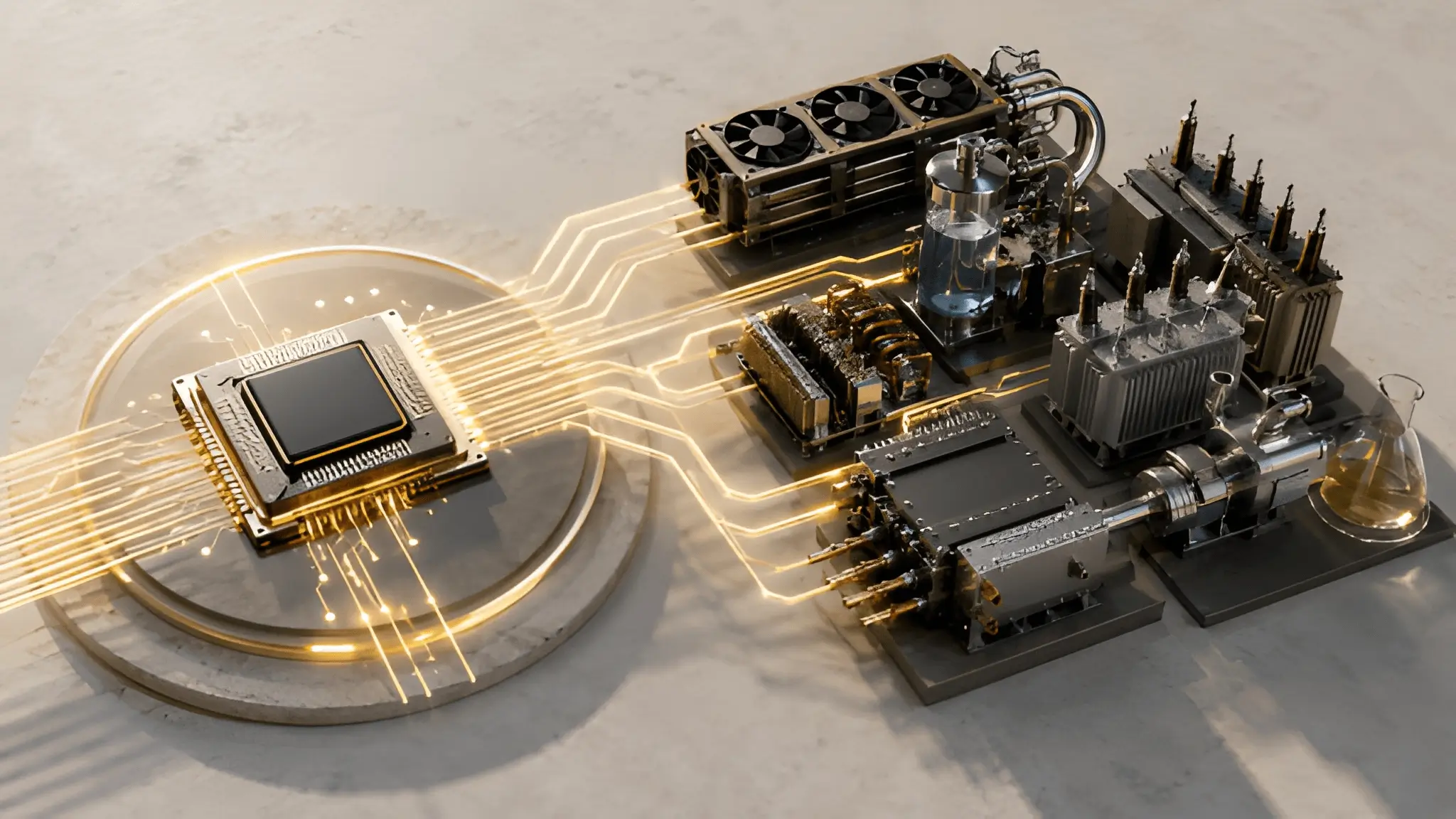
The most consequential upgrade in an AI system may not arrive inside the accelerator package. It may arrive beside it, underneath it or somewhere farther down the infrastructure chain. That shift matters because AI performance increasingly depends on whether surrounding systems can sustain the operating conditions that modern accelerators demand. More compute per rack means more electrical capacity, faster heat removal, tighter thermal tolerances and increasingly sophisticated packaging. The accelerator still sits at the center of the system, but the economic perimeter around it is expanding.

The industry is already providing evidence of that change. SK hynix is pursuing the same problem from another direction. Its iHBM solution integrates cooling elements directly into the HBM package, with the company reporting a 30% reduction in thermal resistance. Its HBM4E samples also use packaging technology aimed at reducing heat resistance. Those developments reveal an important change in semiconductor engineering. Memory can no longer be treated simply as a component that supplies data to a processor. Thermal behavior has become part of the performance equation.

The more interesting development is happening outside the semiconductor industry. AI’s density requirements are creating a common engineering problem across businesses that historically operated in very different markets. A memory manufacturer worries about heat moving through stacked packages. A cooling company worries about extracting heat from increasingly dense racks. A power-infrastructure supplier worries about delivering and managing volatile electrical loads. A chemicals or energy company can now find a commercial opportunity in the fluid circulating around the hardware.

Heat Is Becoming a Design Constraint, Not an Operating Detail

The traditional mental model of computing separates the processor from the facility around it. The chip performs computation, while the data center provides power and cooling as supporting services. High-density AI weakens that distinction. A GPU cannot deliver its theoretical performance if thermal constraints force it to reduce operating intensity. A memory stack cannot maintain its intended behavior if heat accumulates faster than the package can dissipate it. A rack cannot scale simply because more accelerators fit inside it if the power distribution and cooling architecture cannot handle the resulting load.

That makes thermal engineering increasingly inseparable from compute architecture. Research published in 2026 reflects the same direction. One study examining direct-to-chip liquid cooling for the NVIDIA GB200 Grace Blackwell platform found that redesigned cooling-channel geometries could materially reduce both average and peak temperatures compared with a baseline design. The implication extends beyond any single cooling technology. AI infrastructure is becoming a tightly coupled thermal, electrical and computational system.

Even Oil and Chemicals Have Found a Place in the AI Stack

Few developments illustrate this physical turn better than the emergence of specialized cooling fluids. Castrol, through its Castrol ON business, now markets dielectric fluids for direct-to-chip and immersion cooling in data centers. Its portfolio includes single-phase immersion fluids designed to transfer heat while providing electrical insulation. In May 2026, the company also announced Open Compute Project recognition for one of its direct-liquid-cooling fluids. The significance is larger than the product itself.

A technology industry that once treated software, processors and networking as the primary sources of competitive differentiation now increasingly depends on fluid properties, material compatibility, pumping characteristics, heat exchangers and thermal stability. That does not mean oil companies or chemical businesses will suddenly become AI companies. It means AI has created enough physical demand for capabilities from those industries to become strategically relevant to computing. The supply chain is therefore becoming more interdisciplinary because the underlying engineering problem has become more interdisciplinary.

The Next AI Bottleneck May Not Look Like a Chip

This creates a different way to think about AI infrastructure economics. The obvious question remains how quickly the industry can produce more advanced accelerators. The less obvious question is whether the surrounding industrial system can evolve at the same pace. Memory has to move data efficiently without creating unacceptable thermal penalties. Packages have to move heat. Power systems have to respond to increasingly dynamic loads. Cooling systems have to remove that heat without consuming excessive energy or introducing new operational constraints. Fluids have to remain stable and compatible with increasingly complex hardware environments.

Each layer can become a bottleneck. That changes where investors, operators and infrastructure planners should look for the next constraint. A shortage of accelerators is visible because the product has a recognizable name and a measurable specification. A thermal bottleneck can emerge through dozens of interacting components, from cold plates and pumps to electrical distribution and heat rejection. The most expensive upgrade, in other words, may not be the one that increases compute. It may be the one that allows the compute already being purchased to operate at full capacity.

AI Is Making Computing More Physical Again

The irony is difficult to miss. AI has accelerated the industry’s pursuit of abstraction. Models increasingly generate software, automate decisions and turn complex tasks into computational services. Yet the infrastructure required to run those systems at scale is moving in the opposite direction. More advanced AI requires more physical coordination among silicon, memory, packaging, electricity, cooling equipment, materials and industrial fluids. That does not make AI less technological. It makes the technology harder to separate from the industrial systems that sustain it. The next phase of AI competition may therefore belong not only to whoever builds the fastest accelerator, but also to whoever solves the physical conditions that let thousands of those accelerators operate together. The chip remains the engine. But the infrastructure around it is becoming a machine.

[simple-author-box]

More from AI Infrastructure

The scale of Meta’s latest community investment looks unusual beside the cost of modern

AI infrastructure is changing the thermal assumptions behind data center design. The shift is

The most consequential number in an AI infrastructure deal may not be the number

COMPUTE WEEKLY

The briefing that 40,000+ tech leaders read every Monday. Sharp, fast, essential.

Great! We’ve received your information.

Building an AI Startup Without Owning GPUs

Not owning GPUs has become the default, deliberate strategy for building an AI company — not a compromise founders accept reluctantly. H100 rental rates fell 64-75% in fifteen months, a dense ecosystem of neoclouds and inference-as-a-service providers now lets startups skip infrastructure entirely, and credit programs can fund a company’s first year before a founder writes a check
Most Read

AI infrastructure now affects capital planning, operating costs, asset values, and business growth. A

AI workloads can expose infrastructure constraints. They place new demands on compute, storage, networking,

Selecting a power distribution topology rarely feels like a seven-year commitment on the day

AI projects now begin with conversations that would have seemed unusual only a few

Network resilience often appears stronger in planning documents than it proves during an actual

Disruptor Spotlight

Cerebras Systems

The chip that makes Nvidia nervous. Cerebras’ Wafer Scale Engine is rewriting the rules of AI inference at scale.
Faster
0 x
YoY Revenue
0 x
Transistors
0 T
Market Pulse
MSFT
+1.02%
NVDA
+0.66%
AMZN
-0.078%
AMD
-6.95%
TSMC
-2.98%
Indicative only · Not financial advice
Upcoming Events
SEP
The AI Infrastructure Race (India)
WEBINAR · ONLINE
The AI Infrastructure Race: Won on Power, Land and Trust — Not Capital
MAY
0
AI Infrastructure Summit
DUBAI · IN PERSON
MEA’s premier AI infrastructure event.
JUN
0 0
Compute Forecast Summit
SINGAPORE · IN PERSON
Our flagship APAC event. Early bird open.
Latest Moves
Live
ecolab
Ecolab Deepens Cooling Strategy With $4.75B CoolIT Acquisition
Ecolab is making one of its biggest moves yet into AI infrastructure after completing its $4.75 billion acquisition of liquid cooling specialist CoolIT Systems
Pure DC AVK Europe data center microgrid Dublin 110MW AI infrastructure Ireland 2026
Pure DC and AVK Deploy Europe’s First 110 MW Data Center Microgrid in Dublin
The Pure DC Dublin microgrid has made history as Europe’s first large-scale on-site data center microgrid, launched in partnership with power solutions provider AVK at Pure DC’s campus in Ireland.
Pace Digitek
Pace Digitek Partners With MEGMEET to Expand AI Data Center Power Business
India’s AI infrastructure ecosystem continues to mature as domestic technology manufacturers move beyond traditional telecommunications and industrial markets toward high-growth digital infrastructure opportunities
Follow Compute Forecast
11K followers
1200 followers
Companies to Watch
CW
CoreWeave
Neo Cloud · $19B · IPO Watch
CB
Cerebras Systems
AI Hardware · $4.25B · Pre-IPO
G42
G42
Sovereign AI · Abu Dhabi
H
Humain
Saudi AI · $40B Fund
Latest Podcast
AI Capex, Cloud Margins & the Nuclear Bet
48 MIN · 25 APR 2026

AI’s Most Expensive Upgrade May Happen After Silicon

The most consequential upgrade in an AI system may not arrive inside the accelerator package. It may arrive beside it,

Share
AI infrastructure upgrade
1
847 SHARES

0
SHARES

[simple-author-box]

More from AI Infrastructure

AI infrastructure now affects capital planning, operating costs, asset values, and business growth. A

AI workloads can expose infrastructure constraints. They place new demands on compute, storage, networking,

Selecting a power distribution topology rarely feels like a seven-year commitment on the day

AI projects now begin with conversations that would have seemed unusual only a few

COMPUTE WEEKLY

The briefing that 40,000+ tech leaders read every Monday. Sharp, fast, essential.

Great! We’ve received your information.

Global AI Infrastructure Outlook 2026

The briefing that 40,000+ tech leaders read every Monday. Sharp, fast, essential.
Download Free
Most Read

AI infrastructure now affects capital planning, operating costs, asset values, and business growth. A

AI workloads can expose infrastructure constraints. They place new demands on compute, storage, networking,

Selecting a power distribution topology rarely feels like a seven-year commitment on the day

AI projects now begin with conversations that would have seemed unusual only a few

Network resilience often appears stronger in planning documents than it proves during an actual

Disruptor Spotlight

Cerebras Systems

The chip that makes Nvidia nervous. Cerebras’ Wafer Scale Engine is rewriting the rules of AI inference at scale.
Faster
0 x
YoY Revenue
0 x
Transistors
0 T
Market Pulse
NVDA
$924.60
+2.4%
MSFT
$421.30
+1.1%
AMZN
$192.80
-0.6%
NVDA
$924.60
+2.4%
NVDA
$924.60
+2.4%
Indicative only · Not financial advice
Upcoming Events
MAY
0 0
DCD Global — London
LONDON · IN PERSON
World’s largest DC event. CF is media partner.
MAY
0
AI Infrastructure Summit
DUBAI · IN PERSON
MEA’s premier AI infrastructure event.
JUN
0 0

Compute Forecast Summit

SINGAPORE · IN PERSON
Our flagship APAC event. Early bird open.
Latest Moves
  • Live
Sam Altman
OpenAI appoints new Chief Infrastructure Officer to lead $100B DC programme
27 APR · OPENAI
Sam Altman
OpenAI appoints new Chief Infrastructure Officer to lead $100B DC programme
27 APR · OPENAI
Sam Altman
OpenAI appoints new Chief Infrastructure Officer to lead $100B DC programme
27 APR · OPENAI
Follow Compute Forecast
18.4K followers
12.1K followers
9.3K subscribers
41 episodes
Companies to Watch
CW
CoreWeave
Neo Cloud · $19B · IPO Watch
CB
Cerebras Systems
AI Hardware · $4.25B · Pre-IPO
G42
G42
Sovereign AI · Abu Dhabi
CW
Humain
Saudi AI · $40B Fund
Latest Podcast
AI Capex, Cloud Margins & the Nuclear Bet
48 MIN · 25 APR 2026
Scroll to Top
Seraphinite AcceleratorOptimized by Seraphinite Accelerator
Turns on site high speed to be attractive for people and search engines.