...
.Nscale Locks $3.5 Billion Figure Robotics Compute Deal  ·Qatar’s Meeza Lands Major Hyperscaler Deal for 8MW ·Qualcomm Strikes Amazon AI Chip Deal, Opens Door to $4 Billion Stock ·Hitachi Energy Bets $300M on China Grid Manufacturing Corvex Builds Toward 8MW Cloud Infrastructure Footprint LITEON Bets $176 Million on DCX Liquid Cooling EdgeConneX Backs Singapore’s AI-Ready Tropical Data Center Testbed

AI’s Sustainability Story Gets Complicated Inside Data Centers

The most difficult question surrounding AI’s environmental impact is no longer whether the technology can reduce emissions. It clearly can,

Share
AI sustainability

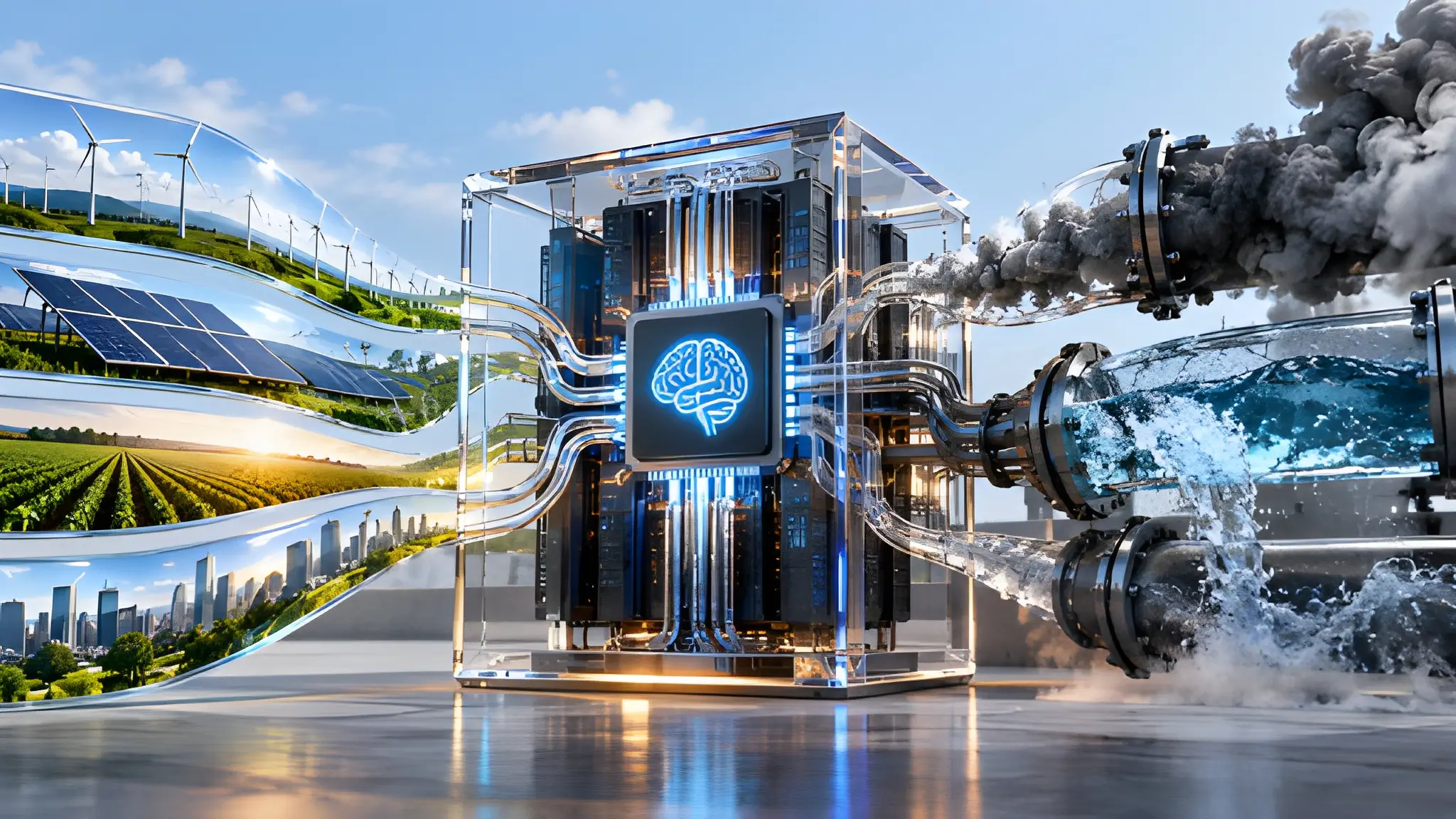
The most difficult question surrounding AI’s environmental impact is no longer whether the technology can reduce emissions. It clearly can, at least in specific applications. The harder question is whether those reductions will arrive soon enough, widely enough and at sufficient scale to offset the physical resources required to build and operate the computing systems behind them. On one side are potential gains that depend on adoption. Better forecasting can help electricity networks balance supply and demand. Algorithms can reduce wasted energy in buildings, improve industrial processes, optimize transport and help identify leaks or inefficiencies across resource-intensive systems. Those benefits can become significant when organizations integrate them into everyday operations.

Service Public Policy Newsletter Leaderboard 970x118 1

On the other side is the infrastructure required to make those capabilities available. Electricity consumption begins when servers run. Cooling systems can add significant energy and, depending on the cooling design and operating conditions, water demand when high-density computing begins operating. Power infrastructure may need to accommodate new loads before the promised efficiency gains elsewhere have necessarily appeared. That creates an uncomfortable timing problem for the AI industry. The environmental dividend is often described in terms of what AI could enable over the coming years. The infrastructure investment and associated resource requirements can begin well before the full environmental benefits of those applications are realized.

The climate equation is becoming a question of timing

Global data center electricity consumption reached an estimated 415 terawatt-hours in 2024, or about 1.5% of global electricity use. Current projections put that figure at roughly 945 TWh by 2030, with AI representing the most important driver of the increase. Those numbers do not mean AI is automatically a climate liability. Data centers still represent a relatively small share of global electricity consumption, and the electricity system itself continues to change. The more important issue is concentration and speed. Data centers can place substantial new loads on particular power systems, while AI infrastructure can scale faster than electricity networks can add generation, transmission and grid capacity.

The physical system therefore has to respond to AI demand before the broader economy has necessarily captured the efficiency gains that AI promises to deliver. That sequencing creates a gap between environmental expenditure and environmental return. A new computing facility does not wait for a building-management algorithm to save energy somewhere else before consuming electricity. A cooling system does not wait for an AI model to improve agricultural yields before requiring water or power. The infrastructure footprint exists first. The climate benefit comes later, if adoption occurs and if the application actually produces a net reduction.

Service Advisory Services Leaderboard 970x118 1

AI’s potential benefits are real, but they are not automatic

The strongest case for AI’s sustainability value comes from optimization. Energy systems contain enormous amounts of operational complexity. Buildings continuously balance temperature, occupancy and energy consumption. Industrial facilities manage thousands of interacting variables. Transport networks respond to changing demand. Agriculture must make decisions around weather, water, soil and crop conditions. AI can process those variables at a scale that traditional systems may struggle to match.

That potential has already moved beyond theory in some applications. Energy optimization, building controls, industrial efficiency, transport routing and emissions monitoring are among the areas where AI can support measurable operational improvements. One recent assessment estimated that widespread adoption of existing AI applications across end-use sectors could potentially deliver substantial emissions reductions by 2035. But the same assessment stressed that adoption barriers and rebound effects could materially reduce those gains. That caveat is central to the sustainability debate.

Potential emissions reductions are not the same as realized emissions reductions. An AI system may identify a more efficient operating pattern, but the operator still has to deploy it. Data must be available. Infrastructure must support the system. Employees must use its recommendations. The financial incentive must justify implementation. Regulations and operational practices must allow the change. The environmental benefit therefore depends on a chain of decisions that can take years. The data center, by contrast, begins consuming resources as soon as the workload arrives.

Efficiency cannot become an excuse for unlimited demand

There is also a deeper risk in relying on efficiency alone. If every improvement in computing efficiency enables substantially more computing, the resource savings from each unit of performance can be overwhelmed by the growth in total demand. Better hardware can reduce energy per computation while the number of computations expands even faster. The risk is familiar in technology: efficiency can improve while absolute resource consumption continues to rise if demand grows faster than efficiency gains.

That makes the sustainability question increasingly dependent on deployment discipline. The objective cannot simply be to make each AI workload more efficient. It must also be to determine where AI creates enough environmental or economic value to justify the resources required to run it. That changes the question from How efficiently can AI operate? to Which AI workloads create enough measurable value to justify their physical footprint? That is a much harder question, but it is also the one that matters.

The real sustainability test will arrive before the promised payoff

AI does not need to have a negative environmental balance to face a sustainability problem. It only needs its infrastructure footprint to grow faster than the measurable environmental gains generated by its applications. That is the timing problem now emerging beneath the industry’s sustainability narrative. Electricity demand begins when AI workloads run. Cooling systems begin managing the resulting heat, while water demand depends on the facility’s cooling design, climate and operating conditions. The transmission infrastructure is being planned today. The environmental gains may arrive later.

The industry should therefore resist the temptation to treat AI’s potential climate benefits as a standing credit against its expanding infrastructure footprint. Those benefits deserve to be counted, but they should be counted when they are demonstrated, scaled and sustained. The sustainability story of AI will ultimately depend less on how impressive its environmental potential looks on paper and more on whether the real-world benefits arrive before the physical costs become structurally embedded. That is the uncomfortable measure the industry will eventually have to confront.

Service Podcast Leaderboard 970x118 1
[simple-author-box]

More from AI Infrastructure

AI Data-Center Deals Need Less Secrecy, More Disclosure

A data-center deal can look straightforward from the outside, with a site, a power

Can Data Centers Ever Become Good Architecture?

A data center can be one of the most technically sophisticated buildings in a

Liquid Cooling Could Change How AI Capacity Gets Reserved

AI customers may soon discover that reserving GPUs and reserving usable AI capacity are

COMPUTE WEEKLY

The briefing that 40,000+ tech leaders read every Monday. Sharp, fast, essential.

Building an AI Startup Without Owning GPUs

Not owning GPUs has become the default, deliberate strategy for building an AI company — not a compromise founders accept reluctantly. H100 rental rates fell 64-75% in fifteen months, a dense ecosystem of neoclouds and inference-as-a-service providers now lets startups skip infrastructure entirely, and credit programs can fund a company’s first year before a founder writes a check
Most Read

Ireland’s experience with data-center expansion became less about stopping construction than about changing the

A data hall can meet its opening-day layout and still contain a future expansion

A data center budget can remain numerically intact while its economic position deteriorates around

A data center schedule can begin moving well before major site construction starts, because

A compute node sitting behind a garage door can perform the same basic computational

Disruptor Spotlight

Cerebras Systems

The chip that makes Nvidia nervous. Cerebras’ Wafer Scale Engine is rewriting the rules of AI inference at scale.
Faster
0 x
YoY Revenue
0 x
Transistors
0 T
Market Pulse
MSFT
+1.02%
NVDA
+0.66%
AMZN
-0.078%
AMD
-6.95%
TSMC
-2.98%
Indicative only · Not financial advice
Upcoming Events

TBC

The AI Infrastructure Race

WEBINAR · ONLINE
The AI Infrastructure Race: Won on Power, Land and Trust — Not Capital
MAY
0
AI Infrastructure Summit
DUBAI · IN PERSON
MEA’s premier AI infrastructure event.
JUN
0 0
Compute Forecast Summit
SINGAPORE · IN PERSON
Our flagship APAC event. Early bird open.
Latest Moves
Live
ecolab
Ecolab Deepens Cooling Strategy With $4.75B CoolIT Acquisition
Ecolab is making one of its biggest moves yet into AI infrastructure after completing its $4.75 billion acquisition of liquid cooling specialist CoolIT Systems
Pure DC AVK Europe data center microgrid Dublin 110MW AI infrastructure Ireland 2026
Pure DC and AVK Deploy Europe’s First 110 MW Data Center Microgrid in Dublin
The Pure DC Dublin microgrid has made history as Europe’s first large-scale on-site data center microgrid, launched in partnership with power solutions provider AVK at Pure DC’s campus in Ireland.
Pace Digitek
Pace Digitek Partners With MEGMEET to Expand AI Data Center Power Business
India’s AI infrastructure ecosystem continues to mature as domestic technology manufacturers move beyond traditional telecommunications and industrial markets toward high-growth digital infrastructure opportunities
Follow Compute Forecast
11K followers
1200 followers
Companies to Watch
CW
CoreWeave
Neo Cloud · $19B · IPO Watch
CB
Cerebras Systems
AI Hardware · $4.25B · Pre-IPO
G42
G42
Sovereign AI · Abu Dhabi
H
Humain
Saudi AI · $40B Fund
Latest Podcast
AI Capex, Cloud Margins & the Nuclear Bet
48 MIN · 25 APR 2026

AI’s Sustainability Story Gets Complicated Inside Data Centers

The most difficult question surrounding AI’s environmental impact is no longer whether the technology can reduce emissions. It clearly can,

Share
AI sustainability
0
847 SHARES

0
SHARES

[simple-author-box]

More from AI Infrastructure

Ireland’s experience with data-center expansion became less about stopping construction than about changing the

A data hall can meet its opening-day layout and still contain a future expansion

A data center budget can remain numerically intact while its economic position deteriorates around

A data center schedule can begin moving well before major site construction starts, because

COMPUTE WEEKLY

The briefing that 40,000+ tech leaders read every Monday. Sharp, fast, essential.

Great! We’ve received your information.

Global AI Infrastructure Outlook 2026

The briefing that 40,000+ tech leaders read every Monday. Sharp, fast, essential.
Download Free
Most Read

Ireland’s experience with data-center expansion became less about stopping construction than about changing the

A data hall can meet its opening-day layout and still contain a future expansion

A data center budget can remain numerically intact while its economic position deteriorates around

A data center schedule can begin moving well before major site construction starts, because

A compute node sitting behind a garage door can perform the same basic computational

Disruptor Spotlight

Cerebras Systems

The chip that makes Nvidia nervous. Cerebras’ Wafer Scale Engine is rewriting the rules of AI inference at scale.
Faster
0 x
YoY Revenue
0 x
Transistors
0 T
Market Pulse
NVDA
$924.60
+2.4%
MSFT
$421.30
+1.1%
AMZN
$192.80
-0.6%
NVDA
$924.60
+2.4%
NVDA
$924.60
+2.4%
Indicative only · Not financial advice
Upcoming Events
MAY
0 0
DCD Global — London
LONDON · IN PERSON
World’s largest DC event. CF is media partner.
MAY
0
AI Infrastructure Summit
DUBAI · IN PERSON
MEA’s premier AI infrastructure event.
JUN
0 0

Compute Forecast Summit

SINGAPORE · IN PERSON
Our flagship APAC event. Early bird open.
Latest Moves
  • Live
Sam Altman
OpenAI appoints new Chief Infrastructure Officer to lead $100B DC programme
27 APR · OPENAI
Sam Altman
OpenAI appoints new Chief Infrastructure Officer to lead $100B DC programme
27 APR · OPENAI
Sam Altman
OpenAI appoints new Chief Infrastructure Officer to lead $100B DC programme
27 APR · OPENAI
Follow Compute Forecast
18.4K followers
12.1K followers
9.3K subscribers
41 episodes
Companies to Watch
CW
CoreWeave
Neo Cloud · $19B · IPO Watch
CB
Cerebras Systems
AI Hardware · $4.25B · Pre-IPO
G42
G42
Sovereign AI · Abu Dhabi
CW
Humain
Saudi AI · $40B Fund
Latest Podcast
AI Capex, Cloud Margins & the Nuclear Bet
48 MIN · 25 APR 2026
Scroll to Top
Seraphinite AcceleratorOptimized by Seraphinite Accelerator
Turns on site high speed to be attractive for people and search engines.