NVIDIA H200 shipments delayed to Q3  · BREAKING: Microsoft confirms 3GW data centre expansion in Asia-Pacific ·  AWS announces new sovereign cloud regions in India and UAE  · Arm-based servers now 24% of hyperscale deployments ·  EU AI Act enforcement enters phase two  · Global data centre investment hits $612B in 2026 ·  TSMC Arizona yields improve to 68% on 3nm process  · OpenAI valuation reaches $400B after latest funding round ·  NVIDIA H200 shipments delayed to Q3  · BREAKING: Microsoft confirms 3GW data centre expansion in Asia-Pacific ·  AWS announces new sovereign cloud regions in India and UAE  · Arm-based servers now 24% of hyperscale deployments ·  EU AI Act enforcement enters phase two  · Global data centre investment hits $612B in 2026

The Anti-Data Center Backlash Has Gone Too Far

Community opposition to AI infrastructure is not new. Residents near proposed data center sites have raised concerns about power costs,

Share
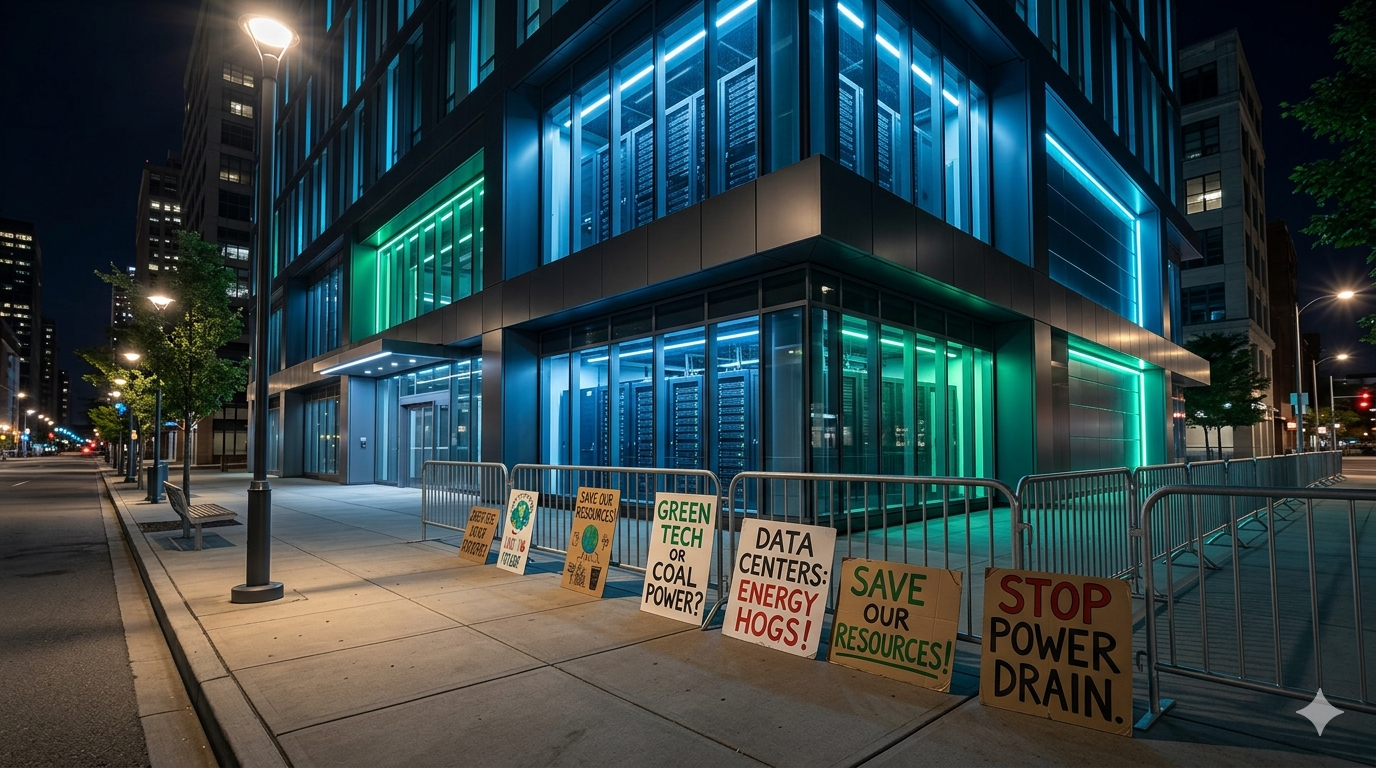
Anti data center backlash community opposition AI infrastructure Indianapolis 2026

Community opposition to AI infrastructure is not new. Residents near proposed data center sites have raised concerns about power costs, water use, noise, and land use for years. Those concerns are real, and some of them are legitimate. The industry has not always handled them well. In too many cases, it has treated public opposition as a communications problem rather than a substantive one.

Last week in Indianapolis, however, the backlash turned violent. A city councilmember who supported a proposed data center in his district woke before dawn to 13 bullet holes in his home and a note on his doorstep that read “No Data Centers.” His eight-year-old son was inside. This is not opposition. It is intimidation, and it changes the terms of the conversation entirely.

Legitimate Concerns Deserve Legitimate Responses

The community concerns driving opposition to data center development are not imaginary. Power costs are rising in markets where data center concentration is high. Water consumption at scale creates real pressure on local resources in water-stressed regions. Moreover, the job creation argument that developers lead with does not always hold up. Data centers employ relatively few permanent workers for their infrastructure scale, and communities promised economic transformation sometimes find themselves with a large building, higher electricity bills, and not much else.

The industry has known for some time that its community relationships needed serious work. Announcing projects and then managing opposition reactively has not served developers, communities, or the broader infrastructure buildout well. Communities that feel bypassed rather than included respond with opposition. That is not irrational. It is predictable, and the industry could have anticipated it years ago. Consequently, the failure to build genuine community engagement into project development from the start is a strategic error the industry is now paying for.

The Scale of Opposition Is Real and Growing

A Harvard and MIT poll found that roughly 40 percent of respondents supported building a data center in their area, while 32 percent opposed it. That gap is narrowing. A separate survey showed stronger opposition, with a majority of Americans against data centers in their communities. Energy costs remain a central concern, with roughly two thirds of respondents worried that data centers would drive up local electricity prices. Notably, quality of life concerns, including noise, traffic, and the industrial character of large facilities in residential settings, ranked even higher than electricity costs as drivers of opposition.

These numbers reflect a real shift in public sentiment. The industry built its early footprint in established data center corridors where zoning, infrastructure, and community acceptance were already in place. The current buildout is pushing into new markets, smaller cities, and communities with no prior experience of large-scale digital infrastructure. Those communities did not sign up for this. As a result, they are making that known through every channel available, from local planning boards to state legislatures to the streets outside city hall.

The Moratorium Movement Is Policy, Not Crisis

Senator Bernie Sanders and Representative Alexandria Ocasio-Cortez have proposed legislation for a moratorium on new data center construction. Wisconsin and Maine are considering their own restrictions, while Illinois lawmakers are debating regulatory guardrails. These are legitimate policy positions in a democratic system. Furthermore, the appropriate industry response is engagement, transparency, and a genuine willingness to address the concerns driving those proposals.

The debate over who pays for the grid costs that data center expansion generates is a real and unresolved question. Hyperscalers that have signed voluntary pledges to fund new generation resources without passing costs to ratepayers are moving in the right direction. However, voluntary pledges without enforcement mechanisms are not a substitute for clear regulatory frameworks. The industry would be better served by supporting those frameworks than by resisting them. In short, the moratorium proposals are a symptom of the industry’s failure to get ahead of these questions when it had the chance.

Violence Closes the Door on Productive Conversation

What happened in Indianapolis cannot be folded into the legitimate opposition narrative. Firing bullets into a family home because a councilmember supports a rezoning vote is not protest. It is criminal intimidation. It puts a child at risk, targets an elected official for doing his job, and damages every community group and concerned resident who has engaged in this debate through legitimate means.

The anti-data center movement has built real momentum by raising valid questions about power, water, and community impact. That momentum depends entirely on credibility. An act of political violence poisons that credibility and hands the industry a narrative that deflects from the substantive concerns driving opposition. It allows developers and hyperscalers to position themselves as victims of extremism rather than as actors who have repeatedly failed to engage meaningfully with the communities they are disrupting.

Communities that want better engagement from data center developers need that conversation to stay in the realm of policy, planning, and public accountability. They need elected officials to feel safe supporting or opposing development based on the merits. They also need local governments to make zoning decisions without fear of retaliation. Violence does not advance any of those goals. Ultimately, it sets them back, and the people it hurts most are the communities whose concerns were legitimate all along.


[simple-author-box]

More from AI Infrastructure

Every major AI announcement tends to emphasize graphics processors, cloud capacity, or multi-billion-dollar data

The conversation surrounding every major power disruption follows a familiar pattern. Engineers examine protective

Singapore rarely enters energy conversations as a country defined by what exists beneath its

COMPUTE WEEKLY

The briefing that 40,000+ tech leaders read every Monday. Sharp, fast, essential.

Great! We’ve received your information.

We couldn’t process your submission. Please retry

Building an AI Startup Without Owning GPUs

Not owning GPUs has become the default, deliberate strategy for building an AI company — not a compromise founders accept reluctantly. H100 rental rates fell 64-75% in fifteen months, a dense ecosystem of neoclouds and inference-as-a-service providers now lets startups skip infrastructure entirely, and credit programs can fund a company’s first year before a founder writes a check
Most Read

Infrastructure planning discussions often prioritize engineering, construction, and utility considerations before examining how end

AI infrastructure deployment schedules depend on coordinated progress across hardware availability, electrical infrastructure, cooling

Artificial intelligence has transformed the economics of digital infrastructure. Every new AI model requires

Data centers do not visibly smoke. They have no smokestacks, no visible exhaust, and

Artificial intelligence has transformed the economics of digital infrastructure. Companies once competed by acquiring

Disruptor Spotlight

Cerebras Systems

The chip that makes Nvidia nervous. Cerebras’ Wafer Scale Engine is rewriting the rules of AI inference at scale.
Faster
0 x
YoY Revenue
0 x
Transistors
0 T
Market Pulse
NVDA
$924.60
-2.11%
MSFT
$421.30
-2.94%
AMZN
$192.80
-4.87%
AMD
$924.60
-2.40%
TSMC
$924.60
-2.32%
Indicative only · Not financial advice
Upcoming Events
SEP
The AI Infrastructure Race (India)
WEBINAR · ONLINE
The AI Infrastructure Race: Won on Power, Land and Trust — Not Capital
MAY
0
AI Infrastructure Summit
DUBAI · IN PERSON
MEA’s premier AI infrastructure event.
JUN
0 0
Compute Forecast Summit
SINGAPORE · IN PERSON
Our flagship APAC event. Early bird open.
Latest Moves
Live
ecolab
Ecolab Deepens Cooling Strategy With $4.75B CoolIT Acquisition
Ecolab is making one of its biggest moves yet into AI infrastructure after completing its $4.75 billion acquisition of liquid cooling specialist CoolIT Systems
Pure DC AVK Europe data center microgrid Dublin 110MW AI infrastructure Ireland 2026
Pure DC and AVK Deploy Europe’s First 110 MW Data Center Microgrid in Dublin
The Pure DC Dublin microgrid has made history as Europe’s first large-scale on-site data center microgrid, launched in partnership with power solutions provider AVK at Pure DC’s campus in Ireland.
Pace Digitek
Pace Digitek Partners With MEGMEET to Expand AI Data Center Power Business
India’s AI infrastructure ecosystem continues to mature as domestic technology manufacturers move beyond traditional telecommunications and industrial markets toward high-growth digital infrastructure opportunities
Follow Compute Forecast
11K followers
1200 followers
Companies to Watch
CW
CoreWeave
Neo Cloud · $19B · IPO Watch
CB
Cerebras Systems
AI Hardware · $4.25B · Pre-IPO
G42
G42
Sovereign AI · Abu Dhabi
H
Humain
Saudi AI · $40B Fund
Latest Podcast
AI Capex, Cloud Margins & the Nuclear Bet
48 MIN · 25 APR 2026

The Anti-Data Center Backlash Has Gone Too Far

Community opposition to AI infrastructure is not new. Residents near proposed data center sites have raised concerns about power costs,

Share
Anti data center backlash community opposition AI infrastructure Indianapolis 2026
12
847 SHARES

0
SHARES

[simple-author-box]

More from AI Infrastructure

Infrastructure planning discussions often prioritize engineering, construction, and utility considerations before examining how end

AI infrastructure deployment schedules depend on coordinated progress across hardware availability, electrical infrastructure, cooling

Artificial intelligence has transformed the economics of digital infrastructure. Every new AI model requires

Data centers do not visibly smoke. They have no smokestacks, no visible exhaust, and

COMPUTE WEEKLY

The briefing that 40,000+ tech leaders read every Monday. Sharp, fast, essential.

Great! We’ve received your information.

We couldn’t process your submission. Please retry

Global AI Infrastructure Outlook 2026

The briefing that 40,000+ tech leaders read every Monday. Sharp, fast, essential.
Download Free
Most Read

Infrastructure planning discussions often prioritize engineering, construction, and utility considerations before examining how end

AI infrastructure deployment schedules depend on coordinated progress across hardware availability, electrical infrastructure, cooling

Artificial intelligence has transformed the economics of digital infrastructure. Every new AI model requires

Data centers do not visibly smoke. They have no smokestacks, no visible exhaust, and

Artificial intelligence has transformed the economics of digital infrastructure. Companies once competed by acquiring

Disruptor Spotlight

Cerebras Systems

The chip that makes Nvidia nervous. Cerebras’ Wafer Scale Engine is rewriting the rules of AI inference at scale.
Faster
0 x
YoY Revenue
0 x
Transistors
0 T
Market Pulse
NVDA
$924.60
+2.4%
MSFT
$421.30
+1.1%
AMZN
$192.80
-0.6%
NVDA
$924.60
+2.4%
NVDA
$924.60
+2.4%
Indicative only · Not financial advice
Upcoming Events
MAY
0 0
DCD Global — London
LONDON · IN PERSON
World’s largest DC event. CF is media partner.
MAY
0
AI Infrastructure Summit
DUBAI · IN PERSON
MEA’s premier AI infrastructure event.
JUN
0 0

Compute Forecast Summit

SINGAPORE · IN PERSON
Our flagship APAC event. Early bird open.
Latest Moves
  • Live
Sam Altman
OpenAI appoints new Chief Infrastructure Officer to lead $100B DC programme
27 APR · OPENAI
Sam Altman
OpenAI appoints new Chief Infrastructure Officer to lead $100B DC programme
27 APR · OPENAI
Sam Altman
OpenAI appoints new Chief Infrastructure Officer to lead $100B DC programme
27 APR · OPENAI
Follow Compute Forecast
18.4K followers
12.1K followers
9.3K subscribers
41 episodes
Companies to Watch
CW
CoreWeave
Neo Cloud · $19B · IPO Watch
CB
Cerebras Systems
AI Hardware · $4.25B · Pre-IPO
G42
G42
Sovereign AI · Abu Dhabi
CW
Humain
Saudi AI · $40B Fund
Latest Podcast
AI Capex, Cloud Margins & the Nuclear Bet
48 MIN · 25 APR 2026
Scroll to Top