A Market Reshaped by Policy, Not Just Performance
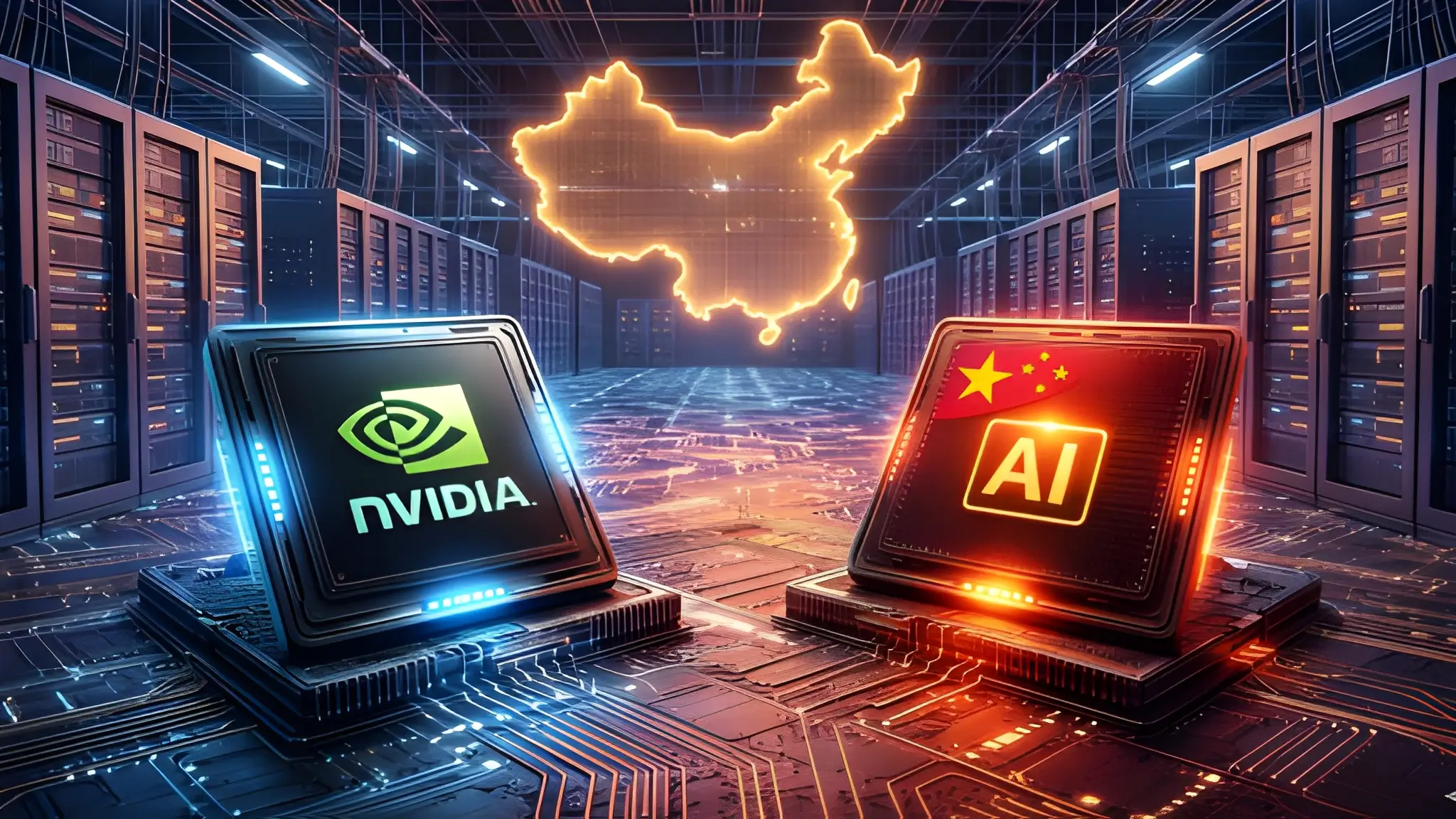
China’s AI chip market is entering a new phase, one defined less by technological hierarchy and more by structural realignment. While Nvidia continues to lead in absolute terms, the competitive dynamics underpinning that leadership are shifting with unusual speed. Market share is no longer the sole indicator of influence; policy direction, supply constraints, and national priorities are redefining the contours of competition.
Data from International Data Corporation, reviewed by Reuters, indicates that Chinese firms collectively captured around 41% of AI accelerator server shipments in 2025. That figure marks a decisive inflection point in a market long dominated by foreign suppliers. It reflects not only the growing technical maturity of domestic vendors but also the weight of state-backed demand shaping procurement decisions across the country.
The shift is not occurring in isolation. It is unfolding against a backdrop of ongoing U.S. export restrictions that have constrained access to Nvidia’s most advanced chips. These limitations have introduced a supply-side ceiling, compelling Chinese cloud providers and enterprises to reconsider sourcing strategies. As a result, substitution has become less a matter of preference and more a necessity.
Nvidia’s Lead Persists, but Narrows
Despite these pressures, Nvidia remains the single largest supplier in China’s AI chip ecosystem. The company continues to ship over half of total units, underscoring the entrenched demand for its CUDA-enabled architecture and mature software stack. Its products remain deeply embedded across training and inference workloads, particularly in large-scale deployments.
However, leadership in volume does not fully capture the evolving competitive landscape. Nvidia’s share has declined as domestic alternatives gain traction, particularly in segments where absolute performance parity is less critical than availability and compliance. The company’s dominance is increasingly defined by legacy deployments and constrained supply pipelines rather than unconstrained market expansion.
Advanced Micro Devices, while present, holds only a limited position in China’s AI accelerator market. Its footprint remains modest relative to both Nvidia and emerging domestic players, reflecting a combination of market timing, ecosystem depth, and geopolitical considerations.
Domestic Players Scale with Strategic Alignment
China’s domestic semiconductor ecosystem has moved quickly to capitalize on this opening. Huawei has emerged as the leading local player, accounting for roughly half of domestically branded shipments. Its Ascend series chips have gained visibility across government-backed AI infrastructure projects, where alignment with national priorities carries as much weight as technical specifications.
Other players are reinforcing the breadth of the domestic stack. Alibaba’s T-Head division, Baidu’s Kunlunxin, and Cambricon are each contributing to a diversified supply base. These firms are not merely filling gaps left by constrained imports; they are establishing footholds in specific workload categories, from cloud inference to edge deployment.
Smaller companies and startups are also entering the fray, adding to a rapidly expanding ecosystem. This proliferation reflects a broader industrial policy framework that encourages domestic substitution while fostering competitive diversity. The result is a market that is becoming less concentrated and more resilient to external shocks.
Policy as the Primary Catalyst
The acceleration of domestic adoption is being driven less by direct competition with Nvidia and more by policy alignment. Beijing has actively encouraged the use of homegrown technologies, particularly in strategic sectors such as artificial intelligence. Government-backed investments in AI infrastructure have created a reliable demand base for domestic chips, while implicit “buy local” mandates have reinforced procurement trends at the provincial level.
This policy-driven demand has altered the traditional adoption curve. Instead of gradual displacement based on performance benchmarks, domestic chips are being integrated through coordinated deployment strategies. These include pilot programs, public cloud partnerships, and state-supported data center expansions.
The implications extend beyond market share. Policy alignment has enabled domestic vendors to scale production, refine software ecosystems, and build customer relationships at a pace that would have been difficult under purely market-driven conditions. Over time, these factors could narrow the performance and ecosystem gap that has historically favored Nvidia.
A Transition from Dominance to Multipolarity
The broader trend emerging from China’s AI chip market is a transition from foreign dominance to a more multipolar structure. Nvidia remains central to the ecosystem, but it is no longer the defining force across all segments. Instead, the market is fragmenting into layers where different players hold advantages based on use case, availability, and regulatory alignment.
This transition does not imply an immediate erosion of Nvidia’s relevance. Its technology continues to underpin a significant portion of China’s AI workloads, and its software ecosystem remains a critical differentiator. However, the company’s future trajectory in the market will likely be shaped as much by policy developments as by product innovation.
For domestic players, the current environment offers a window of opportunity. Sustained demand, coupled with policy support, provides the conditions necessary to scale both hardware and software capabilities. The challenge will be to convert this momentum into long-term competitiveness, particularly in high-performance segments where global benchmarks remain exacting.
The Strategic Outlook
China’s AI chip market is no longer defined by a single axis of competition. It is being reshaped by a confluence of geopolitical constraints, industrial policy, and technological ambition. Nvidia’s leadership persists, but it is being recalibrated within a system that increasingly prioritizes domestic capacity.
The competitive gap is closing, not through direct displacement, but through structural evolution. As domestic players continue to scale and diversify, the market is likely to become more balanced, with multiple suppliers coexisting across different layers of the AI stack.
In that sense, the story is not about the decline of a leader, but about the emergence of a new equilibrium. One where leadership is distributed, influence is negotiated, and the boundaries of competition are defined as much by policy as by performance.