NVIDIA H200 shipments delayed to Q3  · BREAKING: Microsoft confirms 3GW data centre expansion in Asia-Pacific ·  AWS announces new sovereign cloud regions in India and UAE  · Arm-based servers now 24% of hyperscale deployments ·  EU AI Act enforcement enters phase two  · Global data centre investment hits $612B in 2026 ·  TSMC Arizona yields improve to 68% on 3nm process  · OpenAI valuation reaches $400B after latest funding round ·  NVIDIA H200 shipments delayed to Q3  · BREAKING: Microsoft confirms 3GW data centre expansion in Asia-Pacific ·  AWS announces new sovereign cloud regions in India and UAE  · Arm-based servers now 24% of hyperscale deployments ·  EU AI Act enforcement enters phase two  · Global data centre investment hits $612B in 2026

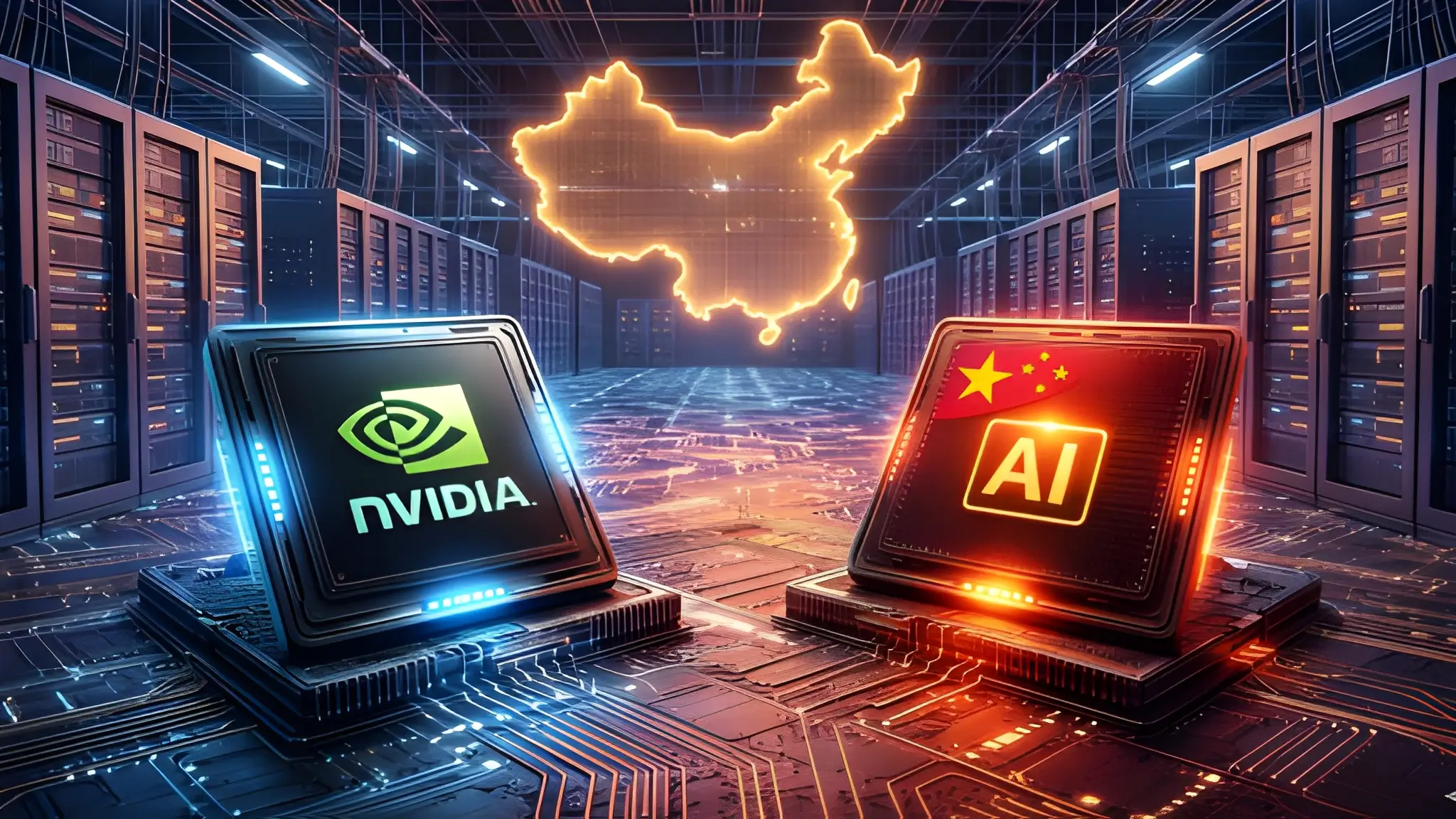
Nvidia Leads in China, but Competitive Gap Is Closing

A Market Reshaped by Policy, Not Just Performance China’s AI chip market is entering a new phase, one defined less

Share
China AI Chip

A Market Reshaped by Policy, Not Just Performance

China’s AI chip market is entering a new phase, one defined less by technological hierarchy and more by structural realignment. While Nvidia continues to lead in absolute terms, the competitive dynamics underpinning that leadership are shifting with unusual speed. Market share is no longer the sole indicator of influence; policy direction, supply constraints, and national priorities are redefining the contours of competition.

Data from International Data Corporation, reviewed by Reuters, indicates that Chinese firms collectively captured around 41% of AI accelerator server shipments in 2025. That figure marks a decisive inflection point in a market long dominated by foreign suppliers. It reflects not only the growing technical maturity of domestic vendors but also the weight of state-backed demand shaping procurement decisions across the country.

The shift is not occurring in isolation. It is unfolding against a backdrop of ongoing U.S. export restrictions that have constrained access to Nvidia’s most advanced chips. These limitations have introduced a supply-side ceiling, compelling Chinese cloud providers and enterprises to reconsider sourcing strategies. As a result, substitution has become less a matter of preference and more a necessity.

Nvidia’s Lead Persists, but Narrows

Despite these pressures, Nvidia remains the single largest supplier in China’s AI chip ecosystem. The company continues to ship over half of total units, underscoring the entrenched demand for its CUDA-enabled architecture and mature software stack. Its products remain deeply embedded across training and inference workloads, particularly in large-scale deployments.

However, leadership in volume does not fully capture the evolving competitive landscape. Nvidia’s share has declined as domestic alternatives gain traction, particularly in segments where absolute performance parity is less critical than availability and compliance. The company’s dominance is increasingly defined by legacy deployments and constrained supply pipelines rather than unconstrained market expansion.

Advanced Micro Devices, while present, holds only a limited position in China’s AI accelerator market. Its footprint remains modest relative to both Nvidia and emerging domestic players, reflecting a combination of market timing, ecosystem depth, and geopolitical considerations.

Domestic Players Scale with Strategic Alignment

China’s domestic semiconductor ecosystem has moved quickly to capitalize on this opening. Huawei has emerged as the leading local player, accounting for roughly half of domestically branded shipments. Its Ascend series chips have gained visibility across government-backed AI infrastructure projects, where alignment with national priorities carries as much weight as technical specifications.

Other players are reinforcing the breadth of the domestic stack. Alibaba’s T-Head division, Baidu’s Kunlunxin, and Cambricon are each contributing to a diversified supply base. These firms are not merely filling gaps left by constrained imports; they are establishing footholds in specific workload categories, from cloud inference to edge deployment.

Smaller companies and startups are also entering the fray, adding to a rapidly expanding ecosystem. This proliferation reflects a broader industrial policy framework that encourages domestic substitution while fostering competitive diversity. The result is a market that is becoming less concentrated and more resilient to external shocks.

Policy as the Primary Catalyst

The acceleration of domestic adoption is being driven less by direct competition with Nvidia and more by policy alignment. Beijing has actively encouraged the use of homegrown technologies, particularly in strategic sectors such as artificial intelligence. Government-backed investments in AI infrastructure have created a reliable demand base for domestic chips, while implicit “buy local” mandates have reinforced procurement trends at the provincial level.

This policy-driven demand has altered the traditional adoption curve. Instead of gradual displacement based on performance benchmarks, domestic chips are being integrated through coordinated deployment strategies. These include pilot programs, public cloud partnerships, and state-supported data center expansions.

The implications extend beyond market share. Policy alignment has enabled domestic vendors to scale production, refine software ecosystems, and build customer relationships at a pace that would have been difficult under purely market-driven conditions. Over time, these factors could narrow the performance and ecosystem gap that has historically favored Nvidia.

A Transition from Dominance to Multipolarity

The broader trend emerging from China’s AI chip market is a transition from foreign dominance to a more multipolar structure. Nvidia remains central to the ecosystem, but it is no longer the defining force across all segments. Instead, the market is fragmenting into layers where different players hold advantages based on use case, availability, and regulatory alignment.

This transition does not imply an immediate erosion of Nvidia’s relevance. Its technology continues to underpin a significant portion of China’s AI workloads, and its software ecosystem remains a critical differentiator. However, the company’s future trajectory in the market will likely be shaped as much by policy developments as by product innovation.

For domestic players, the current environment offers a window of opportunity. Sustained demand, coupled with policy support, provides the conditions necessary to scale both hardware and software capabilities. The challenge will be to convert this momentum into long-term competitiveness, particularly in high-performance segments where global benchmarks remain exacting.

The Strategic Outlook

China’s AI chip market is no longer defined by a single axis of competition. It is being reshaped by a confluence of geopolitical constraints, industrial policy, and technological ambition. Nvidia’s leadership persists, but it is being recalibrated within a system that increasingly prioritizes domestic capacity.

The competitive gap is closing, not through direct displacement, but through structural evolution. As domestic players continue to scale and diversify, the market is likely to become more balanced, with multiple suppliers coexisting across different layers of the AI stack.

In that sense, the story is not about the decline of a leader, but about the emergence of a new equilibrium. One where leadership is distributed, influence is negotiated, and the boundaries of competition are defined as much by policy as by performance.


[simple-author-box]

More from AI Infrastructure

Every major AI announcement tends to emphasize graphics processors, cloud capacity, or multi-billion-dollar data

The conversation surrounding every major power disruption follows a familiar pattern. Engineers examine protective

Singapore rarely enters energy conversations as a country defined by what exists beneath its

COMPUTE WEEKLY

The briefing that 40,000+ tech leaders read every Monday. Sharp, fast, essential.

Great! We’ve received your information.

We couldn’t process your submission. Please retry

Building an AI Startup Without Owning GPUs

Not owning GPUs has become the default, deliberate strategy for building an AI company — not a compromise founders accept reluctantly. H100 rental rates fell 64-75% in fifteen months, a dense ecosystem of neoclouds and inference-as-a-service providers now lets startups skip infrastructure entirely, and credit programs can fund a company’s first year before a founder writes a check
Most Read

Infrastructure planning discussions often prioritize engineering, construction, and utility considerations before examining how end

AI infrastructure deployment schedules depend on coordinated progress across hardware availability, electrical infrastructure, cooling

Artificial intelligence has transformed the economics of digital infrastructure. Every new AI model requires

Data centers do not visibly smoke. They have no smokestacks, no visible exhaust, and

Artificial intelligence has transformed the economics of digital infrastructure. Companies once competed by acquiring

Disruptor Spotlight

Cerebras Systems

The chip that makes Nvidia nervous. Cerebras’ Wafer Scale Engine is rewriting the rules of AI inference at scale.
Faster
0 x
YoY Revenue
0 x
Transistors
0 T
Market Pulse
NVDA
$924.60
-2.11%
MSFT
$421.30
-2.94%
AMZN
$192.80
-4.87%
AMD
$924.60
-2.40%
TSMC
$924.60
-2.32%
Indicative only · Not financial advice
Upcoming Events
SEP
The AI Infrastructure Race (India)
WEBINAR · ONLINE
The AI Infrastructure Race: Won on Power, Land and Trust — Not Capital
MAY
0
AI Infrastructure Summit
DUBAI · IN PERSON
MEA’s premier AI infrastructure event.
JUN
0 0
Compute Forecast Summit
SINGAPORE · IN PERSON
Our flagship APAC event. Early bird open.
Latest Moves
Live
ecolab
Ecolab Deepens Cooling Strategy With $4.75B CoolIT Acquisition
Ecolab is making one of its biggest moves yet into AI infrastructure after completing its $4.75 billion acquisition of liquid cooling specialist CoolIT Systems
Pure DC AVK Europe data center microgrid Dublin 110MW AI infrastructure Ireland 2026
Pure DC and AVK Deploy Europe’s First 110 MW Data Center Microgrid in Dublin
The Pure DC Dublin microgrid has made history as Europe’s first large-scale on-site data center microgrid, launched in partnership with power solutions provider AVK at Pure DC’s campus in Ireland.
Pace Digitek
Pace Digitek Partners With MEGMEET to Expand AI Data Center Power Business
India’s AI infrastructure ecosystem continues to mature as domestic technology manufacturers move beyond traditional telecommunications and industrial markets toward high-growth digital infrastructure opportunities
Follow Compute Forecast
11K followers
1200 followers
Companies to Watch
CW
CoreWeave
Neo Cloud · $19B · IPO Watch
CB
Cerebras Systems
AI Hardware · $4.25B · Pre-IPO
G42
G42
Sovereign AI · Abu Dhabi
H
Humain
Saudi AI · $40B Fund
Latest Podcast
AI Capex, Cloud Margins & the Nuclear Bet
48 MIN · 25 APR 2026

Nvidia Leads in China, but Competitive Gap Is Closing

A Market Reshaped by Policy, Not Just Performance China’s AI chip market is entering a new phase, one defined less

Share
China AI Chip
32
847 SHARES

0
SHARES

[simple-author-box]

More from AI Infrastructure

Infrastructure planning discussions often prioritize engineering, construction, and utility considerations before examining how end

AI infrastructure deployment schedules depend on coordinated progress across hardware availability, electrical infrastructure, cooling

Artificial intelligence has transformed the economics of digital infrastructure. Every new AI model requires

Data centers do not visibly smoke. They have no smokestacks, no visible exhaust, and

COMPUTE WEEKLY

The briefing that 40,000+ tech leaders read every Monday. Sharp, fast, essential.

Great! We’ve received your information.

We couldn’t process your submission. Please retry

Global AI Infrastructure Outlook 2026

The briefing that 40,000+ tech leaders read every Monday. Sharp, fast, essential.
Download Free
Most Read

Infrastructure planning discussions often prioritize engineering, construction, and utility considerations before examining how end

AI infrastructure deployment schedules depend on coordinated progress across hardware availability, electrical infrastructure, cooling

Artificial intelligence has transformed the economics of digital infrastructure. Every new AI model requires

Data centers do not visibly smoke. They have no smokestacks, no visible exhaust, and

Artificial intelligence has transformed the economics of digital infrastructure. Companies once competed by acquiring

Disruptor Spotlight

Cerebras Systems

The chip that makes Nvidia nervous. Cerebras’ Wafer Scale Engine is rewriting the rules of AI inference at scale.
Faster
0 x
YoY Revenue
0 x
Transistors
0 T
Market Pulse
NVDA
$924.60
+2.4%
MSFT
$421.30
+1.1%
AMZN
$192.80
-0.6%
NVDA
$924.60
+2.4%
NVDA
$924.60
+2.4%
Indicative only · Not financial advice
Upcoming Events
MAY
0 0
DCD Global — London
LONDON · IN PERSON
World’s largest DC event. CF is media partner.
MAY
0
AI Infrastructure Summit
DUBAI · IN PERSON
MEA’s premier AI infrastructure event.
JUN
0 0

Compute Forecast Summit

SINGAPORE · IN PERSON
Our flagship APAC event. Early bird open.
Latest Moves
  • Live
Sam Altman
OpenAI appoints new Chief Infrastructure Officer to lead $100B DC programme
27 APR · OPENAI
Sam Altman
OpenAI appoints new Chief Infrastructure Officer to lead $100B DC programme
27 APR · OPENAI
Sam Altman
OpenAI appoints new Chief Infrastructure Officer to lead $100B DC programme
27 APR · OPENAI
Follow Compute Forecast
18.4K followers
12.1K followers
9.3K subscribers
41 episodes
Companies to Watch
CW
CoreWeave
Neo Cloud · $19B · IPO Watch
CB
Cerebras Systems
AI Hardware · $4.25B · Pre-IPO
G42
G42
Sovereign AI · Abu Dhabi
CW
Humain
Saudi AI · $40B Fund
Latest Podcast
AI Capex, Cloud Margins & the Nuclear Bet
48 MIN · 25 APR 2026
Scroll to Top