 Skip to content
The New Bottleneck Isn’t Power, It’s Permission
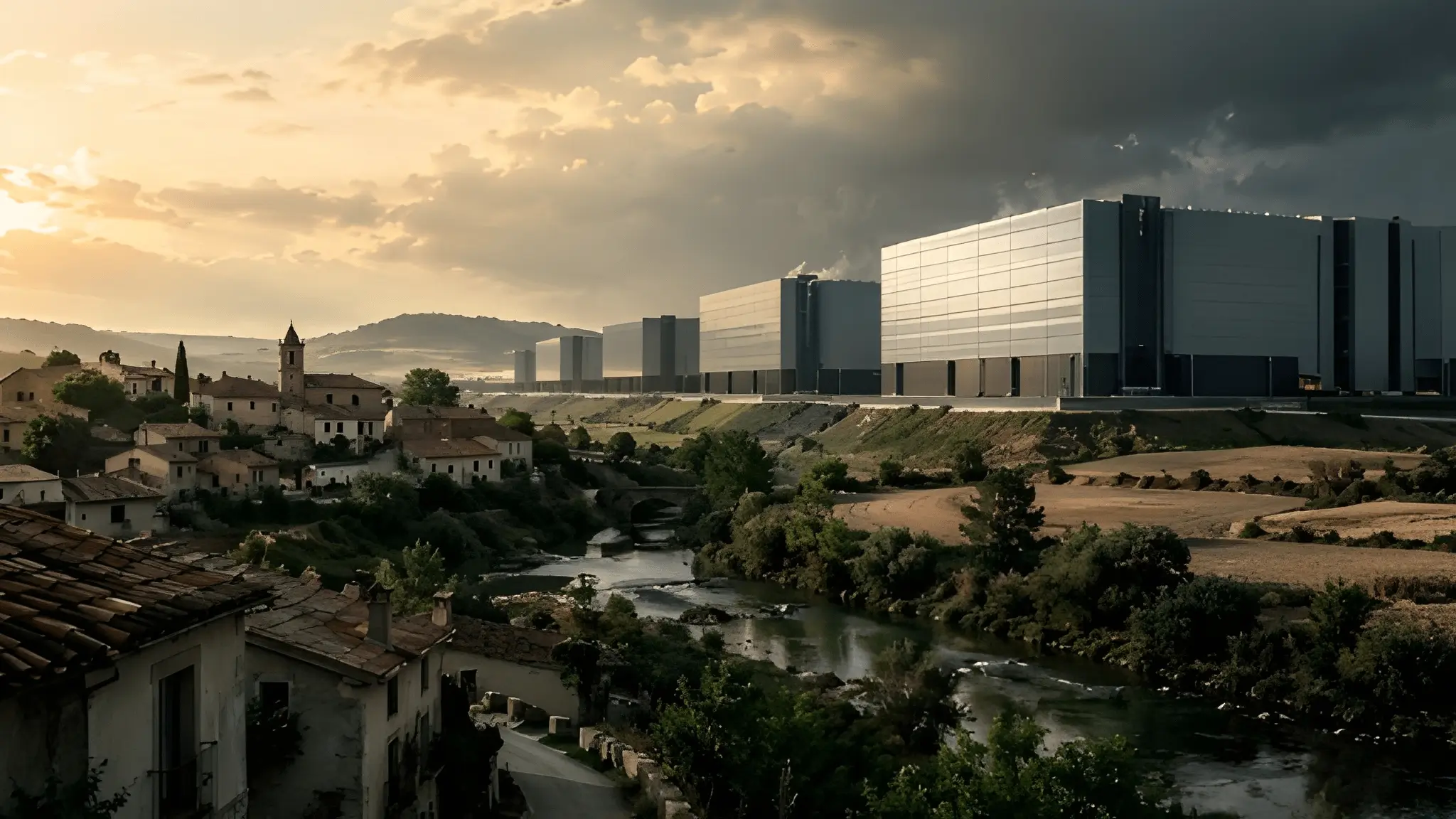
Across Europe’s countryside, a quiet standoff is taking shape. It doesn’t involve regulators in capital cities or rival hyperscalers competing for dominance. Instead, it is unfolding in small towns and places now being recast as critical nodes in the global AI economy.

What appears, on paper, as strategic infrastructure expansion is colliding with something less quantifiable: local consent. The data center industry has long optimized for three variables, land, power, and connectivity. That equation is now incomplete. A fourth variable is asserting itself with increasing force: social license.
When Rural Becomes Strategic
Hyperscalers are no longer confined to dense urban corridors. The shift toward rural and semi-rural regions is deliberate. These areas offer cheaper land, fewer zoning constraints, and in some cases, more favorable climates for cooling efficiency.
From a systems perspective, the move makes sense. AI workloads are scaling at unprecedented rates. Training clusters and inference layers require distributed, resilient infrastructure. Smaller towns, once peripheral to digital networks, now sit at the center of expansion strategies.
But the transformation is not purely technical. It is spatial, cultural, and political. For residents, the arrival of data centers does not feel like a seamless upgrade to the digital economy. It feels like industrialization, fast, opaque, and externally driven.
The Resource Paradox
At the heart of the resistance lies a fundamental contradiction: data centers are marketed as clean, digital infrastructure, yet they operate with heavy physical footprints. Water consumption has become a flashpoint. Cooling systems, particularly in warmer regions, can demand significant volumes. In areas already sensitive to water scarcity, this raises immediate concerns.

Energy presents a similar tension. While operators increasingly commit to renewable sourcing, local grids still bear the strain of large-scale demand. Communities question whether infrastructure built to serve global compute needs should draw from local energy systems. The issue is not only environmental, it is perceptual. Residents see resources flowing outward while benefits remain uncertain or unevenly distributed.
The Jobs Narrative Falls Short
Economic development has long been the industry’s strongest argument. Data centers promise investment, tax revenue, and job creation. But in smaller towns, that narrative is under scrutiny.
Modern facilities are highly automated. They require fewer on-site workers than traditional industrial projects. Construction phases generate temporary employment, but long-term roles remain limited.
This creates a mismatch between expectation and reality. Communities anticipate broad economic uplift; instead, they encounter concentrated benefits. The result is not outright opposition to technology, but skepticism toward its local value.
Identity Versus Infrastructure
Beyond economics and resources lies a less tangible but equally powerful concern: identity. Small towns are not blank canvases for infrastructure deployment. They carry histories, cultural rhythms, and social cohesion that resist abrupt transformation.
The introduction of large-scale data centers can alter that balance. Landscapes change. Land use shifts. The character of a place evolves not always by local choice. For residents, this is not simply about buildings or power lines. It is about agency. Who decides what a town becomes in the age of AI?
These tensions expose a deeper structural issue: governance frameworks have not kept pace with infrastructure evolution. Approval processes often prioritize economic and technical feasibility. Community engagement, when it occurs, can feel procedural rather than participatory.
Sustainability claims, while increasingly detailed, are not always transparent at the local level. Metrics that satisfy corporate reporting standards may not address community concerns about water usage or grid impact. This disconnect creates friction. It also erodes trust. And once trust declines, even well-intentioned projects face resistance.
Social License Becomes Strategic
The concept of social license is not new. Extractive industries have grappled with it for decades. What is new is its relevance to digital infrastructure. Data centers, once perceived as neutral enablers of the internet, now operate at a scale that demands public accountability. Community acceptance is no longer a soft factor. It is becoming a hard constraint.
Projects delayed by opposition carry financial implications. Reputational risks extend beyond individual sites. Regulatory scrutiny increases when local resistance gains visibility. In this environment, social license is not a communications challenge, it is an operational requirement.
The Industry’s Next Adaptation
If the bottleneck has shifted, the response must follow. Transparency will need to move beyond sustainability reports. Communities will expect clear, accessible explanations of resource usage and local impact.
Benefit-sharing models may require rethinking. Instead of broad economic promises, operators may need to deliver tangible, localized value, whether through infrastructure investments, energy partnerships, or community programs.
Engagement must evolve as well. Early-stage dialogue, rather than post-approval consultation, can reshape outcomes. Listening will matter as much as planning. These shifts are not cosmetic. They represent a structural adaptation to a new operating reality.
The demand for data centers will not slow. AI workloads continue to expand, and the infrastructure supporting them must scale accordingly. But scaling is no longer purely a technical challenge. It is a coordination problem between global systems and local realities.
The industry has solved for latency, redundancy, and efficiency. It now faces a different optimization problem: alignment. Without it, expansion will encounter increasing friction not from lack of capital or innovation, but from the communities hosting that infrastructure.
The Real Constraint Is Human
The future of data center expansion will not be defined by compute limits or energy capacity alone. It will be shaped by human factors, trust, perception, and participation. Small towns in Spain and beyond are not resisting technology. They are questioning its terms. That distinction matters.
Because the next phase of digital infrastructure will depend not just on where it can be built, but on where it is allowed. And in that equation, social license is no longer optional. It is decisive.












