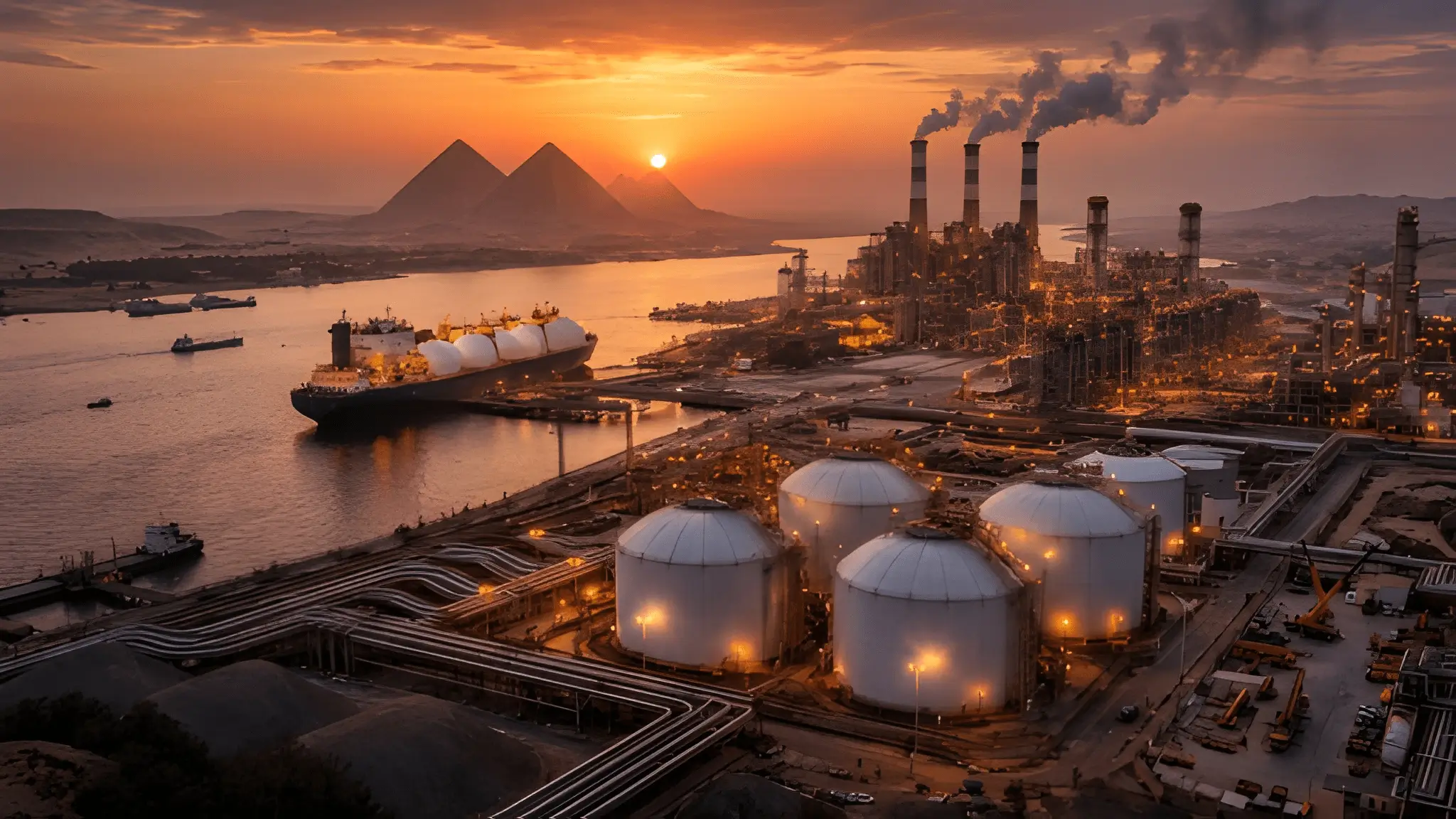
A Model Under Pressure, Not Collapse
Egypt’s energy narrative is undergoing a quiet but consequential reset. Once framed as a rising regional gas exporter with ambitions to anchor Eastern Mediterranean energy flows, the country is now confronting a structural imbalance that challenges the very premise of its energy independence.
The shift is not abrupt, but it is undeniable. Domestic production, particularly from legacy gas fields, has begun to plateau and decline. At the same time, demand curves are steepening driven by demographic expansion, industrial activity, and intensifying climate patterns. The result is a widening delta between supply and consumption, one that cannot be bridged by legacy infrastructure or past export momentum.
This is not a story of failure. It is a story of exposure.
From Export Confidence to Import Necessity
Egypt’s earlier positioning as a liquefied natural gas (LNG) exporter created both economic leverage and policy confidence. Export terminals, strategic partnerships, and regional pipelines reinforced the perception of resilience. However, that positioning relied heavily on sustained upstream output, an assumption that is now under strain.
Declining production from key gas assets has forced a reversal in trade flows. LNG imports, once peripheral, are becoming essential to stabilize domestic supply. This transition introduces a new layer of complexity: Egypt is no longer insulated from global gas price volatility. Instead, it is increasingly tethered to it.
As a result, import dependence reshapes fiscal dynamics. Subsidy structures, foreign exchange exposure, and procurement strategies must now account for fluctuating international benchmarks. The cost of maintaining energy stability is no longer domestically contained.
Demand Growth Is Outpacing Structural Readiness
Egypt’s energy demand trajectory is not anomalous, it reflects broader patterns across emerging economies. Population growth continues to expand the residential load base, while industrialization drives sustained baseload demand. Seasonal peaks, amplified by extreme heat conditions, further intensify pressure on the grid.
What distinguishes Egypt’s situation is the speed at which demand is accelerating relative to system adaptability. Gas-fired power generation remains the backbone of the electricity mix. While efficient in the short term, this concentration introduces systemic rigidity. When gas supply tightens, the entire power ecosystem feels the impact. The challenge is not merely meeting demand. It is doing so without compounding vulnerabilities.
Natural gas has been both Egypt’s strength and its constraint. It enabled rapid capacity expansion, supported export ambitions, and offered a relatively cleaner alternative to heavier hydrocarbons. However, the concentration risk is now evident.
A gas-centric system lacks diversification buffers. When upstream output declines or import costs rise, there are limited alternatives to absorb the shock. This creates a feedback loop: higher costs strain public finances, while supply constraints risk power instability. Diversification is often framed as a long-term goal. In Egypt’s case, it is becoming an operational necessity.
Renewable Ambitions vs. Execution Realities
Egypt has articulated clear ambitions in renewable energy, particularly in solar and wind. The geographic advantage is undeniable. High solar irradiance and favorable wind corridors position the country as a potential renewable leader in the region. Yet ambition and execution remain misaligned.
Renewable deployment, while progressing, is not scaling at a pace sufficient to offset immediate supply pressures. Grid integration challenges, financing constraints, and project timelines limit the speed of transition. Moreover, renewables alone cannot address baseload reliability without complementary storage or dispatchable systems.
The gap between policy signaling and on-ground capacity is where the illusion of independence becomes most visible.
The Fiscal and Geopolitical Dimensions of Energy Dependence
Energy imports introduce more than economic cost, they introduce geopolitical exposure. LNG procurement is not purely transactional; it is influenced by global supply chains, regional tensions, and shifting alliances.
For Egypt, this creates a dual-layered risk profile. On one side, fiscal pressures increase as import bills rise. On the other, energy security becomes partially externalized, dependent on market access and international stability.
This does not imply vulnerability in isolation. It reflects a broader reality: energy systems are increasingly interconnected, and independence is rarely absolute. The core issue is not whether Egypt can regain export capacity or reduce import reliance. The more critical question is how energy security is defined moving forward.
Historically, export status was equated with strength. Today, resilience is measured differently. Reliability, affordability, and adaptability are becoming the primary metrics. A system that can absorb shocks, diversify inputs, and maintain stable output holds more value than one optimized solely for export. Egypt’s current trajectory suggests a transition toward this redefinition, albeit under pressure.
Infrastructure, Investment, and the Time Factor
Energy transitions are capital-intensive and time-sensitive. Upstream exploration requires sustained investment cycles. Renewable expansion demands grid modernization and storage solutions. Efficiency improvements depend on regulatory frameworks and behavioral shifts.
Egypt’s challenge lies in synchronizing these timelines. Delayed upstream investment has already contributed to declining output. Renewable projects, while promising, operate on multi-year horizons. Demand growth, however, is immediate. Bridging this temporal mismatch requires strategic prioritization and accelerated execution.
The window for incremental adjustments is narrowing. The concept of an “illusion” is not rooted in misinformation. It emerges from a lag between narrative and reality. Policy frameworks often reflect long-term aspirations, while operational realities are shaped by near-term constraints.
In Egypt’s case, the narrative of energy independence persists, even as import dependence grows. This disconnect can distort decision-making, delay necessary reforms, and obscure emerging risks.
Closing this gap is not about revising messaging. It is about aligning strategy with measurable outcomes. Egypt’s energy system is not in crisis, but it is at an inflection point. The pressures it faces declining production, rising demand, and import dependence are not unique. What is unique is the convergence of these factors within a compressed timeframe.
This convergence forces clarity. Energy independence, as previously defined, is no longer a stable benchmark. The future will be shaped by hybrid models where domestic production, imports, renewables, and efficiency measures coexist within a dynamic framework.
Beyond the Illusion
The fading illusion of energy independence in Egypt does not signal decline. It signals transition. The country’s ability to navigate this phase will depend on how quickly it can recalibrate its energy model to reflect current realities.
Reliance on past export status offers diminishing strategic value. What matters now is the capacity to deliver consistent, affordable power in an increasingly unpredictable global environment.
The illusion is not that Egypt once had energy strength. It is that past strength alone can sustain future stability. That assumption is now being tested and redefined in real time.