 Skip to content
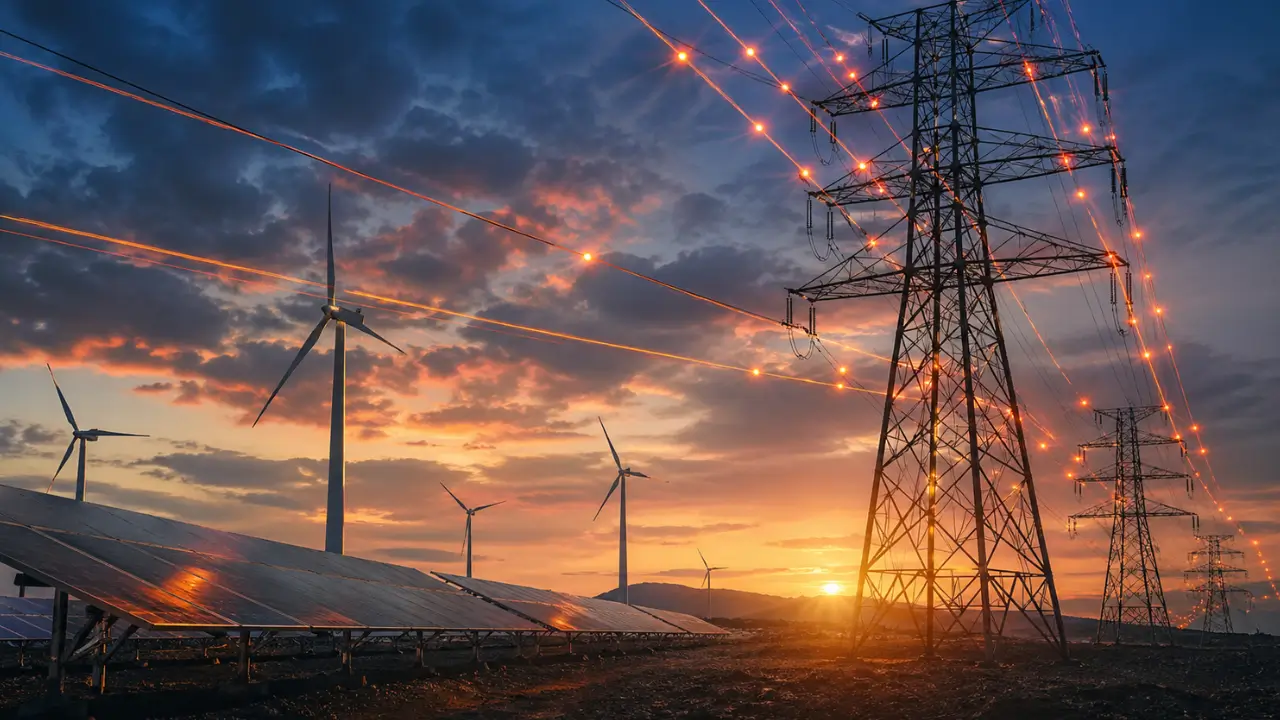
India’s renewable energy story often gets framed as a success of scale, but the system reveals a different constraint when examined closely. Solar parks and wind corridors continue to expand across states, driven by policy momentum and investor appetite. Yet the ability to transport that power across regions has not kept pace with the speed of capacity additions. This imbalance has turned transmission infrastructure into the defining friction point of the transition.

The current challenge does not lie in producing clean energy but in delivering it where demand exists. Renewable-rich states generate surplus electricity during peak production windows, while industrial and urban centers face deficits. This mismatch exposes a structural oversight in planning priorities, where grid expansion lagged behind generation targets. As a result, transmission has shifted from a background utility to a central constraint shaping outcomes.
Capacity expansion without delivery is distorting the transition
India’s energy transition risks being interpreted through headline capacity numbers that obscure operational inefficiencies. Installed gigawatts continue to rise, reinforcing a narrative of progress that aligns with national and global climate commitments. However, capacity alone does not equate to usable energy if the grid cannot evacuate and distribute it effectively. This disconnect creates a growing divergence between theoretical supply and actual consumption.
Projects that reach completion do not always translate into consistent dispatch. Curtailment becomes a recurring issue when transmission lines cannot absorb peak renewable output. Developers face uncertainty around revenue realization, especially when generated power cannot reach buyers. Over time, this dynamic erodes confidence in the reliability of returns tied to renewable investments.
Transmission planning remains reactive rather than anticipatory
The sequencing of infrastructure development has become a critical weakness in India’s energy strategy. Generation assets often get approved and executed faster than the transmission systems required to support them. This approach assumes that grid expansion can follow capacity growth, rather than enabling it. In practice, the lag creates systemic inefficiencies that compound over time.
Transmission corridors require long planning cycles, regulatory approvals, and capital-intensive deployment. When these processes begin after generation capacity comes online, delays become inevitable. The system then operates in a reactive mode, attempting to resolve congestion after it emerges. This reactive posture limits the overall efficiency of the energy ecosystem and amplifies operational risks.

Interstate dynamics are intensifying the strain
The mismatch between generation and demand is not just technical but also geographical. Renewable resources concentrate in specific states with favorable solar irradiation and wind patterns. Meanwhile, high-demand regions depend on consistent and stable electricity flows that originate elsewhere. This dependency increases the importance of interstate transmission networks.
Coordination between states introduces additional complexity in cost-sharing, access, and regulatory alignment. Disputes over transmission charges and grid usage rights can slow down the integration of new capacity. These tensions reflect deeper structural challenges in managing a federated energy system. Without stronger alignment, interstate flows risk becoming another bottleneck rather than a solution.
Storage remains underdeveloped relative to system needs
Energy storage represents a critical lever to balance variability in renewable generation. However, deployment has not scaled at a pace that matches the growth of solar and wind capacity. Storage could absorb excess generation during peak production and release it during demand surges. In its absence, the grid faces heightened pressure to manage fluctuations in real time.
The lack of sufficient storage capacity amplifies congestion in transmission networks. Excess energy cannot be buffered locally, forcing reliance on immediate evacuation through already constrained lines. This dynamic increases curtailment risks and reduces overall system efficiency. Storage, therefore, must be treated as an integral component of grid infrastructure rather than an optional add-on.
Investors are recalibrating risk perceptions
The emerging bottleneck in transmission is beginning to influence investor behavior. Renewable energy projects depend on predictable revenue streams linked to power delivery. When transmission constraints disrupt this flow, financial models face increased uncertainty. This shift alters the risk profile of projects that were previously viewed as stable and scalable.
Investors are paying closer attention to grid readiness alongside generation potential. Due diligence now extends beyond resource availability to include evacuation infrastructure and policy clarity. Projects located in congested regions may face higher scrutiny or require revised financial assumptions. This recalibration signals a broader shift in how the market evaluates renewable opportunities.
Policy narratives are confronting operational realities
India’s policy framework has consistently emphasized ambitious renewable targets. These targets serve as signals of intent and commitment on the global stage. However, execution challenges within the grid highlight a gap between policy ambition and infrastructure readiness. This gap is becoming increasingly visible as capacity additions accelerate.
The narrative of green growth risks being undermined by operational inefficiencies. When clean energy cannot be delivered reliably, the perception of progress becomes harder to sustain. Policymakers face the task of aligning targets with enabling infrastructure to maintain credibility. This alignment requires a more integrated approach to planning across the energy value chain.
Grid modernization must become a central priority
The current situation underscores the need to reposition transmission as the backbone of the energy transition. Grid expansion, modernization, and digitalization must receive the same strategic focus as generation capacity. Investments in high-capacity transmission lines, smart grid technologies, and real-time monitoring systems can improve efficiency. These measures can also enhance the resilience of the overall system.
Planning frameworks need to shift toward anticipatory models that align transmission development with future capacity pipelines. This approach requires coordination across central and state authorities, as well as alignment with private sector stakeholders. Integrated planning can reduce delays and ensure that infrastructure keeps pace with generation growth. Without this shift, congestion will continue to define system performance.
The transition risks becoming a congestion story
India’s renewable energy journey stands at a critical juncture where infrastructure determines outcomes more than ambition. The gap between generation and transmission has introduced a structural inefficiency that cannot be resolved through capacity additions alone. As long as clean energy remains stranded or curtailed, the system operates below its potential. This inefficiency challenges the narrative of seamless progress.
The transition risks being characterized by congestion rather than transformation if underlying issues remain unaddressed. Transmission constraints, limited storage, and coordination challenges form an interconnected set of barriers. Addressing them requires systemic interventions rather than incremental fixes. The focus must shift from how much energy is produced to how effectively it is delivered.
Reframing success beyond installed capacity
India’s energy transition needs a recalibrated definition of success. Installed capacity should no longer serve as the primary indicator of progress. Instead, metrics such as delivered energy, grid efficiency, and reliability should take precedence. These measures provide a more accurate reflection of system performance.
A transition defined by delivery rather than capacity would align incentives across stakeholders. Developers, policymakers, and investors would operate within a framework that prioritizes end-to-end efficiency. This shift would also highlight the importance of transmission and storage as core components of the energy ecosystem. Only then can the promise of renewable energy translate into tangible outcomes.












