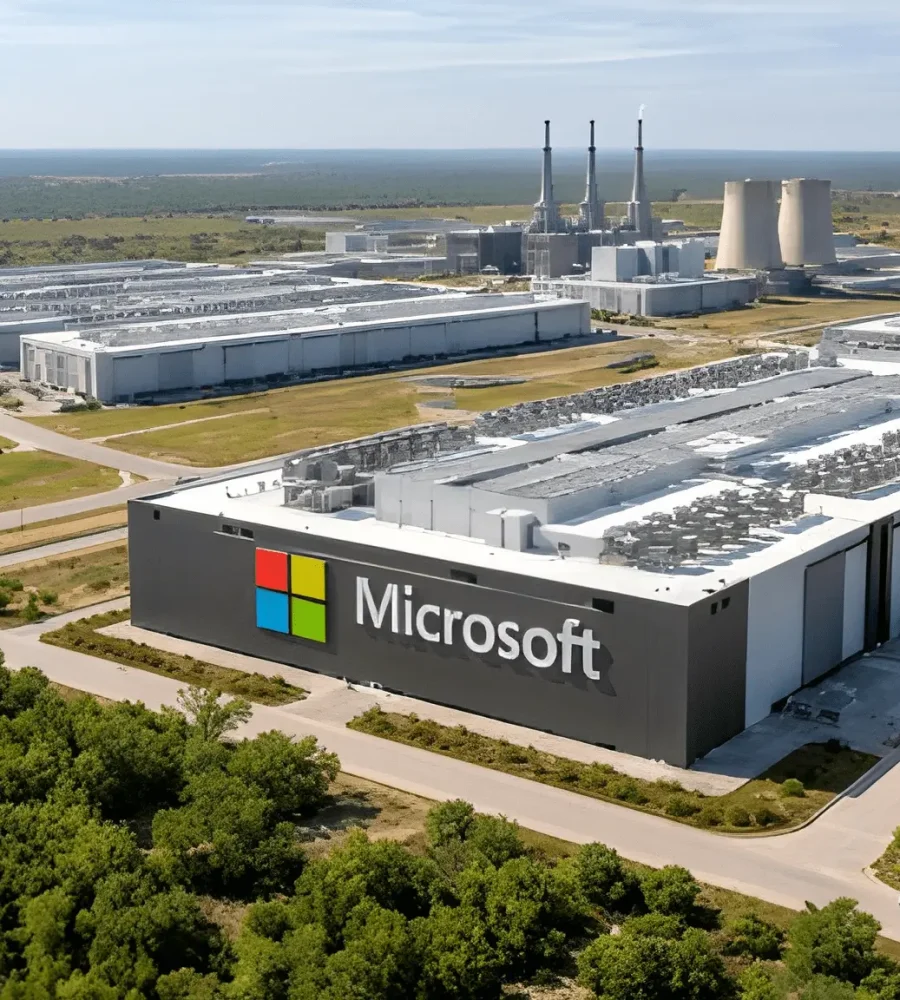

The Ohio Power Siting Board (OPSB) made a decision that permanently altered the future of Wood County. Without public hearings and through an accelerated “fast-track” process, the board approved the Apollo Power Generation Facility and cleared it for construction. The Apollo project is a 350-megawatt (MW) gas-fired power plant built for one reason only: to supply energy to the neighboring Meta hyperscale data center.
For residents of Middleton Township, it represents clear evidence of a much larger story involving corporate secrecy and environmental bait-and-switch tactics.
The irony is impossible to ignore. Meta promotes itself as a climate-conscious company and spends millions on public relations campaigns highlighting its “100% renewable energy” goals and LEED Gold certifications. Yet, at the same time, Meta stands to benefit from a facility that will emit an estimated 2.4 million tons of carbon dioxide every year.
This contradiction raises a fundamental question. If these data centers are truly “green,” why do they require a massive fossil-fuel power plant next door?
The “Behind-the-Meter” Loophole
Industry insiders describe the Apollo plant as a “behind-the-meter” (BTM) facility. The plant does not exist to power Ohio homes or stabilize the regional grid. Instead, developers designed it as a private utility that operates outside the public transmission system. Its sole purpose is to bypass grid constraints that cannot keep pace with Big Tech’s rapidly expanding AI operations.
By keeping the facility behind the meter, Meta and its development partners, working through the shell company Liames LLC, avoided the public scrutiny that typically accompanies large-scale power projects. Local officials held no town halls to address how nitrogen oxide and ozone emissions could affect nearby families. This includes residents like the Wyatts, whose children already suffer from severe asthma. Rather than undergoing a full review, the project advanced through a “Letter of Notification” process intended for minor utility changes, not for the construction of a Title V polluter.
The True Cost of a “Megadeal”
The project’s economic justification is just as unclear as its environmental impact. To attract Meta to Wood County, local leaders approved a 75% property tax abatement that will last for 15 years. State officials frequently celebrate these arrangements as “megadeals.” However, research from organizations such as Good Jobs First suggests that taxpayers pay roughly $1.9 million for each job created.
In this case, the numbers are especially stark. The data center will employ fewer than 100 permanent workers, yet it consumes vast amounts of land and public resources. Developers are paving over prime agricultural soil, long central to Wood County’s identity, to construct what is essentially a “powered shell.” Industry experts expect such facilities to become obsolete within 10 to 15 years. In contrast, the gas plant supplying it is designed to operate for four decades.
Eventually, the data center will shut down or undergo major retrofitting. When that happens, the community may be left with a large gas plant seeking connection to the public grid. As a result, local ratepayers could inherit the financial burden of an aging fossil-fuel asset they never requested.
A Pattern of Secrecy
Meta assembled the project, internally known as “Accordion”, largely out of public view. Developers relied on Non-Disclosure Agreements (NDAs) to silence elected officials and keep residents uninformed until after land purchases were complete. This approach, often described as “security through obscurity,” blocks any meaningful cost-benefit analysis.
As a result, critical questions remain unanswered. Who will fund the massive water infrastructure required to cool the servers? Who will bear responsibility if Wood County’s already “C-grade” air quality declines even further?
As construction begins, the Apollo plant now stands as a symbol of the Sustainability Paradox. We are repeatedly told that artificial intelligence will help solve the climate crisis. Yet, in the physical world, that promise materializes as a 16-inch gas pipeline and 2.4 million tons of additional greenhouse gas emissions.
The Bottom Line
Ohio’s so-called data center boom increasingly resembles a bust for the people who live nearby. If Big Tech intends to build the “infrastructure of the future,” it must first acknowledge the energy realities of the present. A data center that depends on its own private gas plant is not truly green. Instead, it functions as a digital factory with an unusually long exhaust pipe.
It is time for Ohio to stop fast-tracking Silicon Valley’s priorities and start listening to Wood County residents. Transparency should not be optional for billion-dollar corporations. It should be the minimum requirement for doing business in the state.