
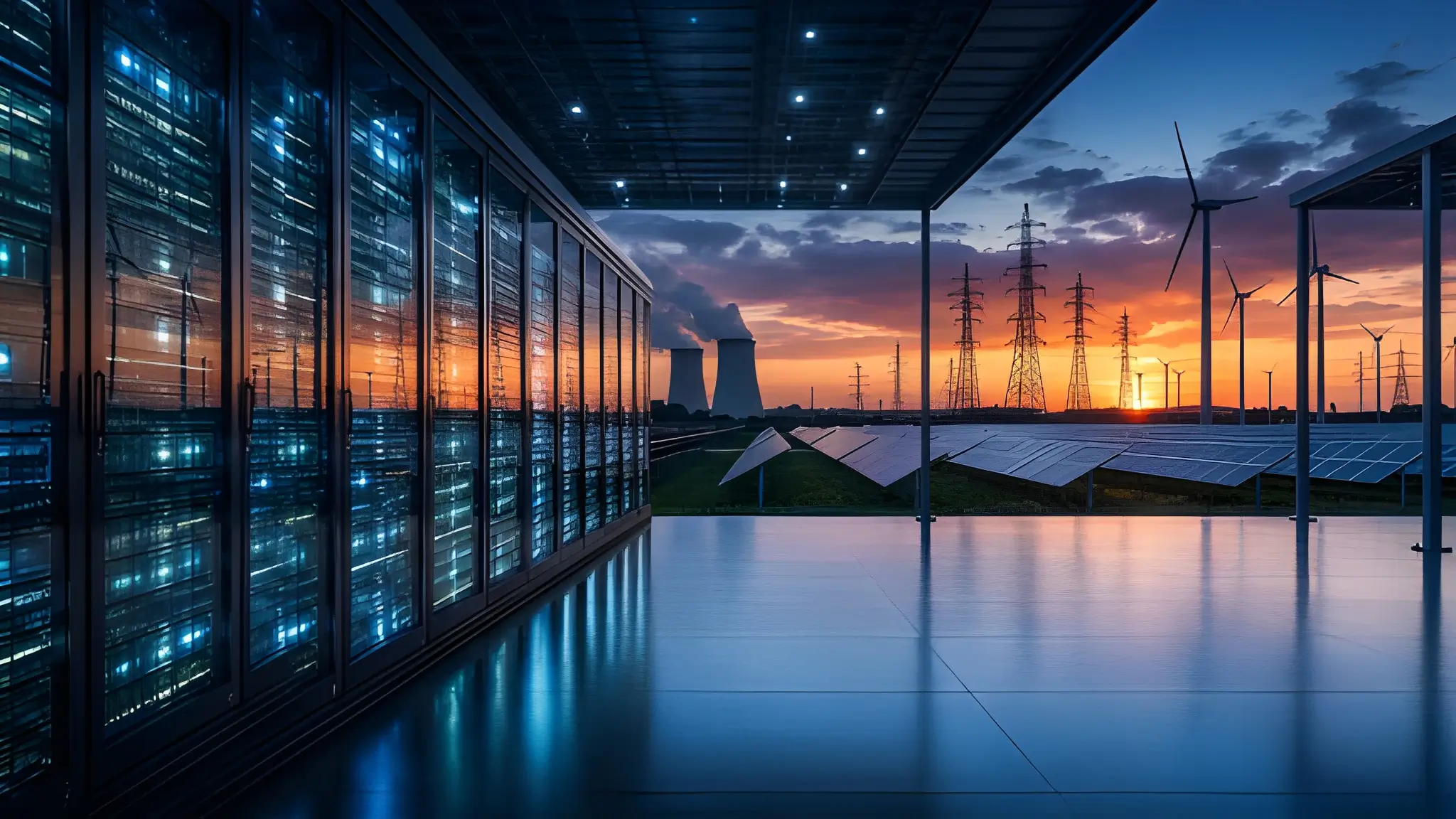
The Illusion of Infinite Compute
the technology industry expanded on the back of sustained gains in compute performance and declining unit costs, driven by advances in semiconductor scaling and cloud infrastructure. However, that trajectory is no longer linear. Artificial intelligence has intensified focus on power availability as a critical constraint in infrastructure planning.

The rapid expansion of artificial intelligence workloads has intensified focus on power availability as a critical constraint in infrastructure planning. Not abstract energy in sustainability reports, but physical electricity delivered, measured, priced, and increasingly contested. The shift is subtle in headlines but profound in consequence. AI does not just consume compute; it consumes continuity of power at a scale grids were never designed to serve.
This is where the narrative begins to change. The cost of running intelligence is no longer defined purely by silicon or software optimization. It is now tethered to something far less elastic.
Power Is No Longer a Background Variable
Electricity used to sit in the background of digital growth, absorbed into operational expenditure and rarely discussed in strategic terms. That era has ended.

Data centers have evolved into concentrated energy nodes, drawing power with the intensity of heavy industry. The difference is not just scale, but behavior. AI workloads require sustained and high-density energy supply, often operating at significantly higher utilization levels than traditional enterprise computing. They demand persistent, high-density energy flows that leave little room for grid flexibility.
What emerges is a new kind of infrastructure tension. Compute infrastructure can be deployed relatively quickly, whereas power generation and grid expansion typically require longer development and regulatory timelines. Grid expansion, permitting, and generation capacity move at institutional speed, while AI scales at venture speed. Yet, This reflects an ongoing mismatch between the pace of digital infrastructure deployment and the timelines required for expanding energy systems.
The industry is beginning to respond, but the response itself signals the shift. When technology companies negotiate demand-response agreements, secure long-term power purchase agreements, or invest in energy infrastructure, they are taking a more active role in managing energy supply and consumption.
The Quiet Repricing of Intelligence
The economics of AI are being rewritten in ways that are still under-appreciated. Electricity is no longer a predictable input cost. It is becoming a variable shaped by geography, regulation, and competition. Securing long-term energy supply now resembles securing scarce infrastructure, not negotiating a commodity contract.
This introduces additional cost considerations into AI deployment, where energy consumption increasingly contributes to the overall operational expenditure of compute infrastructure. The industry has spent years optimizing for latency and throughput. It now faces a different optimization problem how much power each unit of intelligence requires.
This is not a marginal adjustment. It alters how value is measured. Code, once lightweight and infinitely scalable, now carries a physical weight. It draws from grids, competes with other sectors, and reflects the constraints of the systems that sustain it.
From Cloud Abstraction to Physical Reality
Cloud computing succeeded because it abstracted infrastructure. Developers no longer needed to think about servers, storage, or networks. AI challenges that abstraction. Electricity supply remains dependent on physical generation, transmission, and distribution systems that operate in real time. It must be generated, transmitted, and consumed in real time. As a result, the physical layer of technology is returning to the forefront of strategic decision-making.This shift, in turn, has consequences. Location matters again—not just for latency, but for access to reliable and scalable energy. Regions with strong grid capacity and energy surplus gain strategic relevance, while others face implicit ceilings on digital growth.
At the same time, the concept of “infrastructure ownership” is expanding. Technology firms are not just leasing compute; rather, they are increasingly anchoring themselves to energy ecosystems, whether through direct investment or long-term integration. Consequently, the boundary between digital and industrial sectors is beginning to blur.
The industry’s instinctive response has been to pursue efficiency, and rightly so. Improving performance per watt is now a central metric shaping everything from chip design to cooling architectures. Accordingly, innovations in power distribution, thermal management, and hardware optimization are accelerating. These efforts matter, and they will continue to define competitive advantage.
Even so, efficiency does not eliminate the underlying challenge. It slows the rate of escalation but does not reverse it. In fact, demand for AI continues to expand faster than efficiency gains can offset.
Yet efficiency does not eliminate the underlying challenge. It slows the rate of escalation but does not reverse it. Demand for AI continues to expand faster than efficiency gains can offset.
Efficiency Is Necessary, Not Sufficient
This creates a paradox. The more efficient AI becomes, the more it is used. The more it is used, the greater the total energy demand. Efficiency extends the runway, but it does not change the direction of travel. A more fundamental shift is emerging beneath the surface: the pursuit of energy control.
The traditional model relying entirely on public grids is proving insufficient for the scale and reliability AI requires. As a result, the industry is moving toward hybrid and self-sufficient energy systems. On-site generation, storage integration, and alternative energy sourcing are no longer experimental; they are becoming strategic necessities.
This trend reflects a broader realization. Access to energy is not guaranteed, and in some cases, it may become a competitive differentiator. The ability to secure, manage, and optimize power flows will increasingly influence where and how AI systems are built. This is not about bypassing the grid. It is about reducing dependency on its limitations.
The Broader Stakes
The implications extend beyond corporate strategy. As AI infrastructure expands, it intersects more directly with public systems energy grids, water resources, and local communities. This introduces a layer of accountability that the digital sector has historically navigated at a distance.
The conversation is no longer confined to innovation or growth. Instead, It now includes allocation, who gets access to power, at what cost, and under what conditions. These are not purely technical questions. They are economic and societal ones.
Therefore, the industry will need to navigate this terrain carefully, balancing expansion with responsibility while maintaining momentum.What is ultimately changing is not just cost structures, but perception.
Software has long been seen as weightless, infinitely replicable, unconstrained by physical limits. AI disrupts that perception. It reveals the physical infrastructure that underpins digital capability and forces it into the foreground.
The value of a system is no longer defined solely by what it can compute, but by what it requires to compute. This reframing has implications for pricing, investment, and even innovation priorities. The most advanced model is not necessarily the most valuable if it cannot scale within the constraints of energy availability. Capability must now align with sustainability not just environmental sustainability, but infrastructural sustainability.
Code, Now Priced in Watts
The industry often speaks of breakthroughs in terms of algorithms or architectures. Those breakthroughs will continue. But the next phase of AI will not be defined by capability alone. It will be defined by feasibility.
The question is no longer just how powerful a model can become. Rather, it is whether the systems that support it can sustain that power. Electricity is emerging as a significant factor in the cost structure of large-scale compute systems.
AI has not run out of ideas. It is running into limits that are older, slower, and harder to scale. And in that reality, watts are no longer an afterthought. They are becoming the most expensive line in the code.











