Skip to content
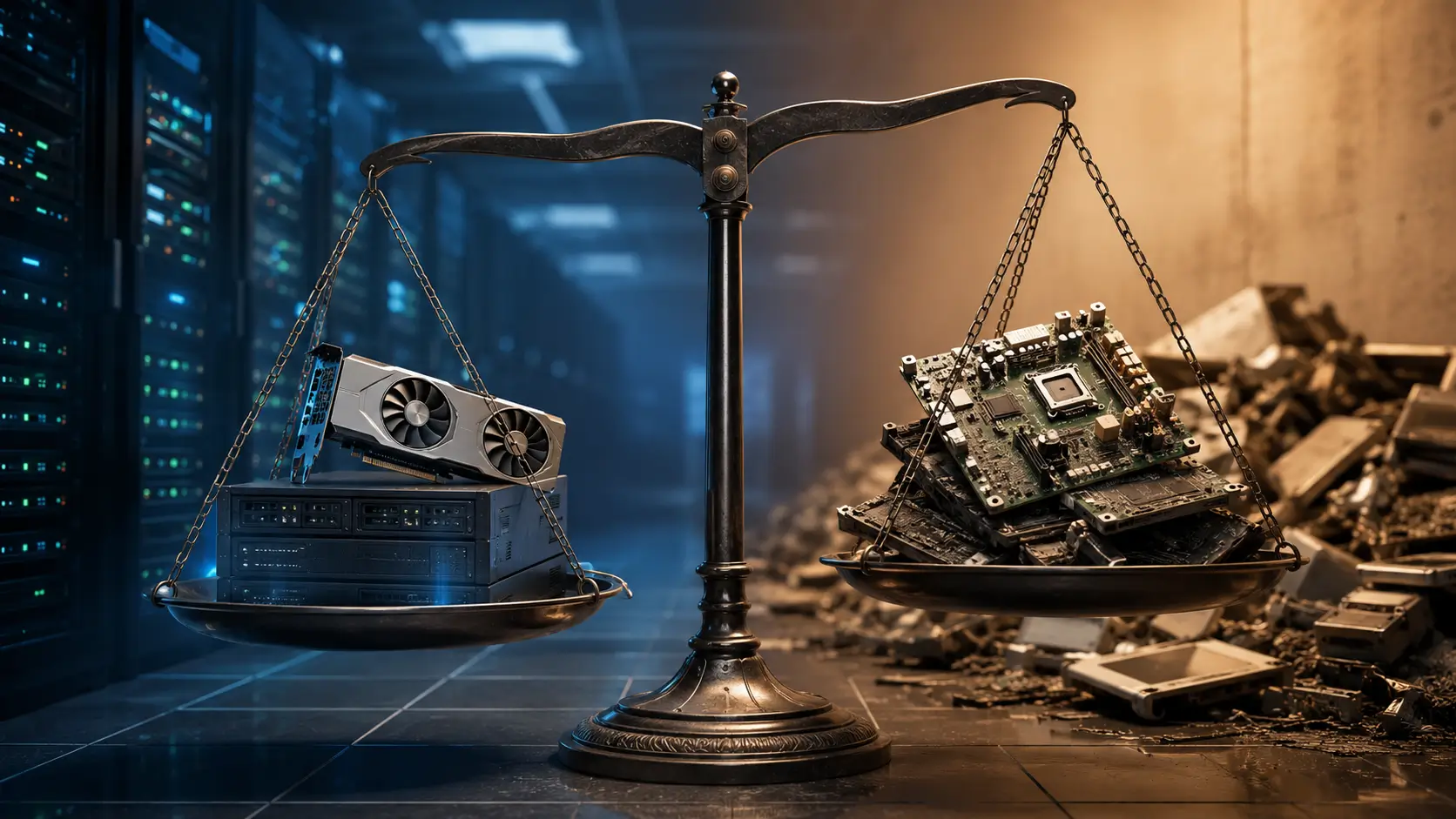
The AI upgrade question is becoming a replacement question
A data center can be technically functional and still become strategically unsuitable for modern AI workloads. That distinction is becoming important as operators weigh whether to extend existing infrastructure or replace equipment that still has useful operating life. The pressure comes from a widening gap between conventional server environments and increasingly power-dense accelerated computing. The International Energy Agency projects global data center electricity consumption to rise from about 485 TWh in 2025 to around 950 TWh in 2030, roughly doubling over the period, while electricity consumption from AI-focused data centers is growing significantly faster than overall data center demand. Those projections make efficiency an increasingly important infrastructure decision, but efficiency cannot be measured only by the electricity consumed by new equipment. A replacement also introduces additional material, manufacturing, transportation, installation and end-of-life considerations that do not disappear simply because the resulting system performs more computations per watt. For end users, the sustainability question therefore moves beyond whether newer hardware is more efficient and toward whether replacing functioning infrastructure creates enough operational value to justify its broader footprint. That calculation is becoming one of the more consequential decisions in the next phase of AI infrastructure planning.

Working equipment is not automatically inefficient equipment
AI workloads can make some legacy infrastructure less suitable for higher power densities. However, age alone does not establish that replacement is the sustainable choice. A functioning server may still provide useful capacity for conventional enterprise workloads. Existing power and cooling systems can also continue supporting equipment outside high-density AI clusters. The more relevant question is whether an asset prevents the facility from meeting its operational requirements. Operators should examine utilization, performance per watt, remaining service life and maintenance needs. They should also consider the opportunity cost of retaining the equipment. A premature replacement can add manufacturing and end-of-life considerations while displacing equipment that still has useful service life.
AI changes the economics of infrastructure efficiency
AI creates a difficult trade-off because newer accelerators can deliver major performance gains. Those gains can also change the requirements placed on supporting infrastructure. The International Energy Agency expects accelerated servers to account for almost half of the net increase in global data center electricity use through 2030. This makes the efficiency of the entire computing environment more important. Operators may need to reconsider rack power delivery, distribution equipment and cooling capacity. Networking and monitoring systems can also become part of the modernization decision. Replacing only compute hardware can leave supporting infrastructure designed for a different thermal and electrical profile. The better approach is to identify the AI-related constraint before deciding what needs to be replaced.
Retrofitting can become the middle path
Retrofitting is becoming an alternative for facilities that need to introduce AI capability. It can reduce the need to replace an entire operating environment at once. High-density AI racks can challenge traditional air-cooling systems. That challenge does not automatically mean an existing facility must be abandoned. ASHRAE guidance supports hybrid approaches for appropriate AI retrofit scenarios. Direct-to-chip liquid cooling can support high-density processors in these configurations. Existing air systems can continue handling residual heat from other equipment. This creates a path for operators to modernize selected infrastructure while retaining useful assets.

The strongest case for replacement comes from constraint, not novelty
The strongest trigger for replacement should be an infrastructure constraint. That constraint must affect required computing capacity, efficiency or reliability. The International Energy Agency says AI is driving greater deployment of accelerated computing. It also identifies rising power density as an important feature of AI infrastructure growth. Higher densities can expose limitations in electrical and cooling systems. Transformers, switchgear, backup systems and facility layouts may all require evaluation. In some facilities, retaining existing infrastructure can create more operational risk than targeted replacement. The decision should therefore start with the workload requirement rather than the arrival of new hardware.
End users need a broader sustainability calculation
For enterprise customers, sustainability cannot sit apart from availability, performance and cost. AI infrastructure must meet business requirements without creating avoidable resource burdens. Procurement teams should examine the expected useful life of new equipment. They should also assess utilization, power efficiency and cooling requirements. Repairability and opportunities for redeployment deserve similar attention. The same principle can apply to cooling and power equipment. Compatible components may remain useful after a facility changes its computing architecture. These factors give end users a broader basis for judging whether replacement is actually justified.
Replacement should be measured against the workload it enables
A useful sustainability calculation should examine the value created by replacement. It should not focus only on the efficiency of the new equipment. An AI accelerator may consume more electricity than a conventional server. However, it can deliver substantially more useful computation for a defined workload. The comparison should therefore include performance, utilization, energy and cooling requirements. Embodied impacts should also form part of the broader infrastructure assessment. AI workloads can vary significantly across training, inference, reasoning and agentic applications. Matching each workload with suitable infrastructure can therefore become as important as upgrading the hardware itself.
The grid adds another reason to question blanket replacement
Power availability may become a stronger constraint than equipment availability for some AI projects. The International Energy Agency reported a 17% increase in global data center electricity consumption during 2025. It also reported faster growth in electricity consumption from AI-focused data centers. New infrastructure therefore competes for capital and available grid capacity. It also depends on electrical and mechanical infrastructure that can support higher-density computing. In some markets, an existing electrical connection can make retrofit more attractive. Grid infrastructure can also require longer planning and delivery timelines than a data center project. End users should therefore assess the facility and its power requirements as one connected infrastructure decision.
The replacement threshold should become more disciplined
The industry does not need one universal rule for replacing working infrastructure. Workloads, facility designs and energy markets vary too widely for such a rule. Instead, operators need a disciplined decision framework. A replacement decision should demonstrate measurable operational or efficiency gains. It should also account for the remaining useful life of existing assets. Redeployment, refurbishment and retirement options should form part of that assessment. When a targeted retrofit can deliver the required outcome, full replacement may be difficult to justify. When existing systems limit AI density or power delivery, delaying replacement can create operational and financial costs.
The next sustainability metric may be avoided replacement
The most interesting sustainability opportunity may come from infrastructure operators choose not to replace. That does not mean preserving inefficient equipment regardless of its operating impact. It means setting a higher threshold for discarding assets that still provide useful service. AI infrastructure will continue to evolve rapidly. Yet not every workload requires the newest compute platform or the highest rack density. Organizations can separate infrastructure that must change from infrastructure that remains useful. They can also evaluate retrofit, workload migration and hardware reuse. The central question is no longer only how efficiently a new AI data center operates. It is whether replacing a working one was necessary in the first place.