 Skip to content
The artificial intelligence boom has triggered one of the largest infrastructure buildouts in modern technology history. Yet as cloud providers race to deploy larger GPU clusters and expand computing capacity, a less visible challenge increasingly determines the economics of AI growth: heat. Every new generation of advanced processors delivers greater computational performance, but it also concentrates more thermal energy into smaller spaces, forcing operators to devote growing portions of their electricity budgets to cooling systems rather than computing workloads. As power availability tightens across major markets, the question is no longer how many chips companies can buy, but how efficiently they can operate them.

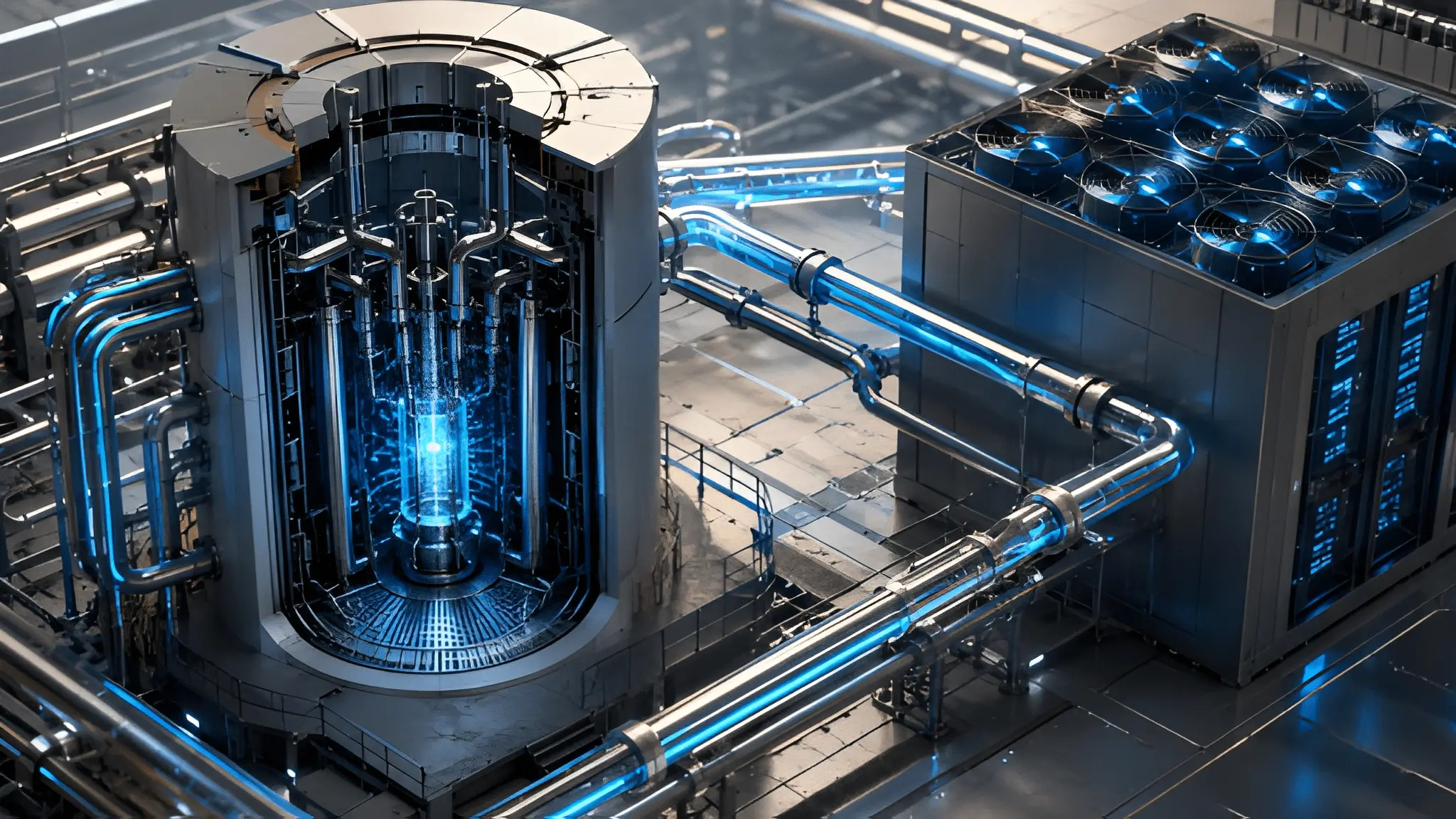
A startup founded by two Massachusetts Institute of Technology researchers believes the answer may lie in a principle developed for one of the world’s most demanding engineering environments. Ferveret, established by former MIT nuclear engineering postdoctoral researcher Reza Azizian and MIT professor Matteo Bucci, has adapted thermal-management concepts originally developed for nuclear reactors into a cooling architecture designed specifically for AI infrastructure. The company argues that by improving how heat moves away from processors, data centers can unlock more computing output from existing power allocations while reducing water consumption at the same time. The timing reflects a broader shift occurring across the digital infrastructure sector. Industry forecasts suggest data centers could account for between 9% and 17% of total U.S. electricity demand by the end of the decade as AI adoption accelerates across industries.
AI Infrastructure Faces a Cooling Bottleneck
Cooling represents a significant share of facility power consumption, with estimates cited by MIT indicating that roughly one-third of data-center electricity is devoted to cooling systems that support AI workloads. Consequently, operators increasingly view thermal management as a strategic lever for expanding capacity without securing additional grid connections, a process that often requires years of planning and regulatory approvals. Ferveret’s approach centers on immersion cooling, a technique that places computing hardware directly inside a specially engineered liquid rather than relying on conventional air circulation. While immersion cooling itself has gained momentum across the industry, the company’s differentiation lies in how heat transfer occurs at the processor surface. Its Adaptive Phase Cooling, or APC, platform generates exceptionally small vapor bubbles that detach rapidly and repeatedly from the chip surface. That continuous cycle accelerates thermal transfer and allows heat to move away from processors more efficiently than conventional liquid-cooling methods.
How Nuclear Engineering Inspired Ferveret’s Technology
The concept originates from decades of research inside the nuclear sector, where heat management directly affects operational performance. Azizian and Bucci first collaborated while studying heat-transfer dynamics in reactor systems, focusing on methods to extract thermal energy more effectively. Azizian later transitioned into the technology industry, working on Microsoft’s HoloLens program before joining Nvidia, where he gained firsthand exposure to the thermal constraints facing modern processors. Bucci remained at MIT, advancing research in thermal sciences and engineering systems. Their work eventually led them to explore whether heat-transfer techniques developed for nuclear systems could be adapted to improve thermal management in data centers. Azizian’s exposure to large-scale computing facilities reinforced that conclusion. During a visit to a data center in 2017, he encountered the enormous mechanical infrastructure required to keep servers within acceptable operating temperatures.
The experience highlighted a growing inefficiency at the center of digital infrastructure economics. Vast quantities of electricity flowed into cooling equipment whose sole purpose was to remove heat generated by computing systems. As AI models grew larger and more power-intensive, that imbalance appeared likely to worsen. “Heat transfer determines how much energy you can extract from the reactor core, which translates directly to revenue,” Azizian explains. That principle increasingly applies to AI facilities as well. Reducing cooling energy requirements can allow operators to dedicate a larger share of available power capacity to computational workloads. As AI workloads continue to increase chip power densities, many operators are evaluating liquid-cooling approaches that can manage higher thermal loads more effectively than conventional air-based systems. Advanced AI processors now generate enough heat that many operators view liquid cooling as a requirement rather than an optional efficiency upgrade.
Adaptive Phase Cooling Uses Bubble Physics to Increase Efficiency
Bucci believes the underlying science favors this transition. “Liquid is a better heat transfer medium than air. That’s why when you stick your hand into room temperature water it still feels cold,” Bucci explains. “When liquid is boiling, it becomes even better at removing heat because the phase change requires a lot of energy, which is the energy you remove from the chip. That lets you transfer large quantities of heat with minimal temperature differences between the chips and the liquid.” Rather than merely adopting immersion cooling, Ferveret refined a process known in nuclear engineering as subcooled boiling. According to the company, the system uses a low-boiling-point fluid that does not contain PFAS chemicals. At the processor surface, tiny vapor bubbles form and detach at a higher frequency than in conventional immersion systems.

The engineering gains translate into measurable operational benefits, according to company testing. In a study conducted with the Samueli Computer Science Department at the University of California, Los Angeles, Ferveret reported a 15% improvement in computational power efficiency compared with advanced liquid-cooling alternatives. The company further claims that when APC operates alongside its proprietary power-management software, facilities can generate significantly more AI output from the same energy budget. The objective is not simply reducing electricity use but maximizing productive computation per unit of power consumed. “Our goal is to make data centers as sustainable as possible and help them use every single watt of power to generate tokens, which are the most useful outputs,” Azizian says. “Our system enables the operation of more powerful chips, it helps data centers waste a lot less energy, and it accomplishes all that with zero water consumption.”
Water-Free Cooling Could Change Data Center Sustainability
Water consumption has emerged as an increasingly important consideration for operators planning future AI deployments. Many hyperscale facilities rely on evaporative cooling systems that consume substantial volumes of water during operation. As governments, utilities, and local communities scrutinize the environmental impact of large digital infrastructure projects, technologies that reduce both energy and water requirements are attracting greater attention. Therefore, technologies that reduce or eliminate cooling-water requirements may expand deployment options in regions where water availability is a growing operational consideration.
Ferveret’s physical architecture also reflects practical deployment considerations. Instead of placing multiple servers inside large immersion tanks, the company packages its technology into compact, rack-mounted modules designed to house individual servers. The modular structure allows operators to integrate cooling capacity incrementally and simplifies maintenance procedures. It also reduces the operational disruption often associated with retrofitting existing facilities for immersion-based cooling systems. “Physics enables us to get to form factors that weren’t possible in the past,” Azizian says. “Most immersion cooling solutions are large tanks that people submerge the servers in. We have a smaller, modular rack-mounted solution that makes it adaptable to the current infrastructure, so it’s easier for people to deploy our technology.”
Modular Design Targets Faster Data Center Deployment
Beyond thermal management, the company has developed software intended to optimize system performance continuously. Sensors embedded throughout the infrastructure monitor temperature, pressure, and operating conditions in real time. The software then adjusts power delivery and cooling parameters to maintain efficient performance across varying computational loads. Moreover, this integration of hardware and software reflects a broader trend in AI infrastructure, where operators increasingly seek full-stack solutions capable of extracting incremental efficiency gains at scale. “We deliver full-stack systems that include the cooling box, the rack, the cooling distribution units, and sensors that measure the temperature and pressure,” Bucci says. “Our software monitors those sensors and optimizes the operating condition inside each box to ensure that energy consumption is minimized in the system.”
The company has already begun validating its technology with commercial partners. Ferveret is testing its systems with bitcoin mining and data center operator CleanSpark, AI chip developer FuriosaAI, and data center operator Switch. These early deployments provide an opportunity to evaluate performance under real-world operating conditions while generating the operational data needed to support broader adoption across enterprise and hyperscale environments. Meanwhile, discussions with major cloud providers are underway as competition intensifies around infrastructure efficiency. Hyperscalers increasingly face constraints related to electricity availability, transmission capacity, and permitting timelines. In several major markets, access to power is increasingly emerging as a limiting factor for new data-center development and expansion plans. Consequently, technologies capable of extracting additional computational output from existing infrastructure may deliver strategic advantages beyond simple energy savings.
Hyperscalers Search for More Computing From Existing Power
The broader significance of Ferveret’s approach extends beyond cooling. The AI industry has entered a phase where infrastructure efficiency increasingly influences competitiveness, sustainability objectives, and long-term expansion plans. Operators increasingly pursue incremental efficiency gains because even modest improvements can have meaningful operational impacts when deployed across large server fleets. Technologies that simultaneously reduce energy consumption, eliminate water use, and increase computing output address several of the industry’s most pressing constraints at once.
Ferveret participates in Nvidia’s Inception startup program and plans to announce additional partnerships later this year. The company’s founders see the coming years as a critical period for scaling technologies that allow AI growth without proportionally increasing environmental pressures. As governments, utilities, and technology companies attempt to balance digital expansion with sustainability targets, innovations rooted in unexpected disciplines may prove increasingly valuable. “The computing industry is facing a huge challenge in the form of access to power, and they have a problem with access to water in many regions,” Azizian says. “That will only become more limiting as the industry grows. The main goal for these data center operators would be to get more tokens from the power they have. We’ve shown we can do that.”












