
The Shift From Conventional Cloud Data Centers to AI Factories
The architecture of hyperscale data centers is entering a new phase as artificial intelligence workloads demand a different combination of computing power, networking capacity, energy delivery, and thermal management than many conventional cloud applications require. Traditional hyperscale facilities evolved around large pools of general-purpose processors that supported web services, enterprise applications, databases, storage, and distributed cloud platforms, whereas AI infrastructure increasingly depends on tightly coordinated accelerators that process massive volumes of data in parallel. The change is not simply about installing more servers inside existing buildings because AI workloads alter the relationship between compute, memory, networking, power, and cooling at the facility level. Training and serving advanced models can require clusters in which thousands of accelerators operate as a coordinated system, making latency between compute nodes and the movement of data across the network important factors in overall performance.

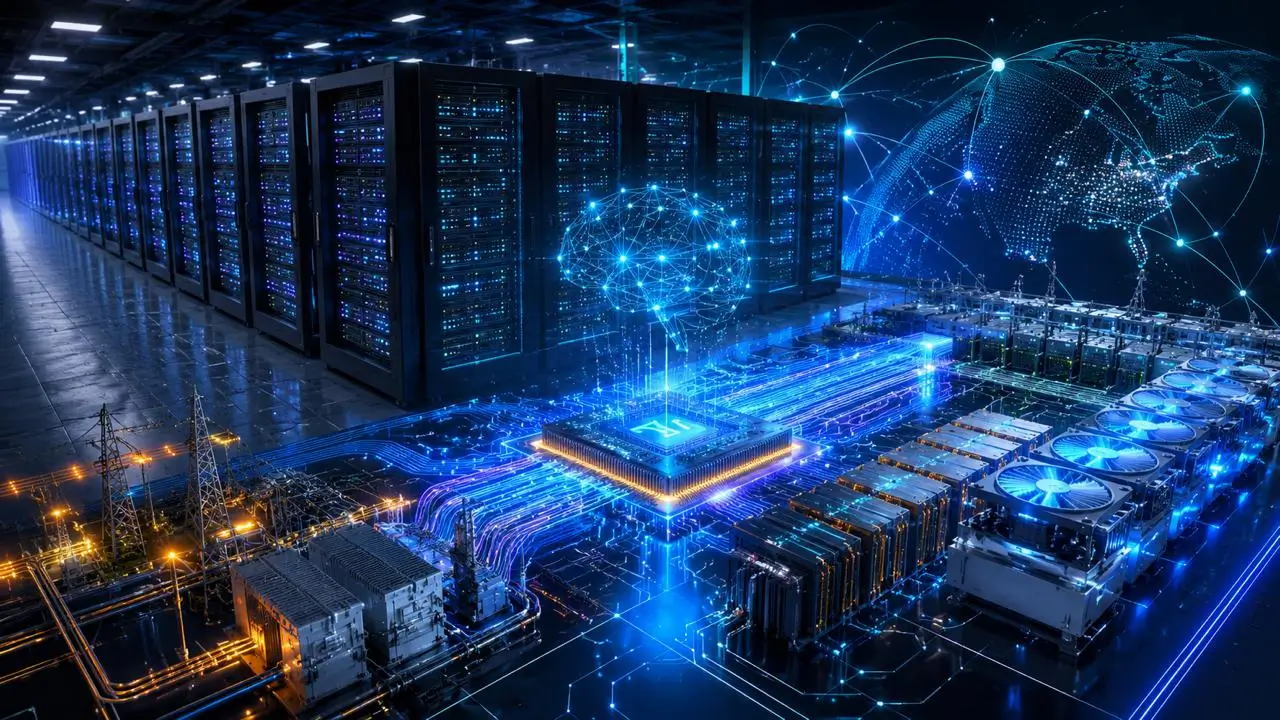
The term “AI factory” describes integrated computing environments built for AI workloads. These facilities support model training, inference, and other forms of machine-generated output. The concept places compute infrastructure closer to an industrial production system, where the facility must maintain predictable throughput, high availability, efficient resource utilization, and rapid scalability across the entire technology stack. Hyperscale operators therefore face a design challenge that extends beyond increasing floor space because the physical infrastructure must evolve alongside processor architectures, software frameworks, networking technologies, and changing AI workloads. The result is a new generation of data centers. Engineers increasingly design buildings, electrical systems, cooling plants, network fabrics, and computing platforms as one integrated environment.
Why AI Workloads Are Changing Data Center Design
AI workloads place distinctive demands on data center infrastructure. Their performance depends on parallel computation and rapid data movement between processors and memory.. Modern AI systems commonly rely on GPUs and other specialised accelerators that can execute highly parallel mathematical operations efficiently, making them well suited to many AI workloads that involve large-scale matrix and tensor computations. The resulting infrastructure can create higher power density at the rack level, while the interconnection between compute nodes becomes critical because a large distributed workload may depend on thousands of processors communicating with one another. Uptime Institute has noted that AI and high-performance computing environments use specialized hardware and high-speed interconnects that can create significantly greater density and thermal-management challenges than typical IT equipment. This means that a facility designed around conventional enterprise servers may not automatically provide the electrical capacity, cooling performance, or network topology required for large AI clusters.
AI infrastructure also introduces different workload patterns because training, fine-tuning, inference, and data processing can place different demands on computing resources and system availability. A hyperscale operator must therefore consider not only peak computational requirements but also how efficiently infrastructure can support multiple workload stages without creating unnecessary idle capacity. The physical layout of racks, the placement of power equipment, the design of network pathways, and the availability of cooling capacity can all influence how effectively an AI cluster operates. These requirements are encouraging data center developers to move toward purpose-built facilities and modular designs that can accommodate high-density computing while retaining flexibility for future processor generations. Higher-density infrastructure is changing data center planning. Engineers no longer measure capacity only by floor are. Available power, cooling capacity, network bandwidth, and compute performance per unit of space now define capacity alongside floor area.

High-Density Computing Is Becoming a Core Design Requirement
The growing concentration of accelerators within AI clusters is changing how data center engineers approach rack density and equipment layout. Conventional data center racks historically supported a wide range of server configurations, often with power and cooling requirements that allowed air-based systems to handle the majority of the heat generated by IT equipment. AI systems concentrate more computing hardware within a smaller physical footprint. This increases the thermal load on each rack and, in some cases, on individual components. Higher density affects more than the cooling system because electrical distribution must deliver sufficient power to each rack while maintaining voltage stability, redundancy, and operational resilience. The network infrastructure also needs to support high-throughput connections between accelerators, storage systems, and other nodes, which can increase the complexity of cabling and switching architecture.
Data center operators must consequently coordinate rack placement, power delivery, cooling distribution, network connectivity, and maintenance access during the design stage rather than treating these systems as separate engineering disciplines. High-density deployments can reduce the usable capacity of existing facilities. This is especially true when designers originally built facilities for lower rack power requirements. Retrofitting such facilities may require upgrades to electrical distribution, cooling systems, network pathways, or other building infrastructure, depending on the existing facility design and the power and thermal requirements of the intended AI deployment. Purpose-built AI facilities can address these requirements earlier by designing the power and thermal systems around the expected compute architecture instead of adapting legacy infrastructure after deployment. The shift toward higher density therefore represents a fundamental change in data center planning because operators now evaluate capacity by floor area, available power, cooling capability, network bandwidth, and compute performance per unit of space.
Power Infrastructure Is Moving to the Center of the Conversation
The expansion of AI computing is placing greater emphasis on the relationship between data centers and the electrical grid because large-scale AI clusters can require substantial power capacity. The International Energy Agency projects that global data center electricity consumption could reach around 945 terawatt-hours by 2030 under its base-case scenario. AI-driven accelerated servers will account for a significant share of that increase. The same analysis indicates that data center electricity consumption could more than double between 2024 and 2030, although the sector would still represent a relatively small share of total global electricity demand. These figures demonstrate why power availability has become a strategic consideration for hyperscale development, particularly in regions where grid interconnection queues and transmission constraints already affect new large-scale loads. Large AI facilities can require substantial power capacity, with demand patterns depending on workload, infrastructure design, and operational strategy.
The resulting demand encourages developers to evaluate sites according to access to reliable electricity rather than relying solely on traditional data center selection criteria such as network connectivity and land availability. Grid capacity, transmission infrastructure, energy procurement, backup generation, and the ability to expand electrical supply can all influence the feasibility and timeline of a hyperscale project. Large AI facilities may also create new requirements for power quality because sensitive high-performance computing equipment must operate within defined electrical parameters to maintain reliability. The design challenge therefore extends from the data center building to the wider energy ecosystem that supplies it, making collaboration between technology companies, utilities, power developers, and regulators increasingly important.
Liquid Cooling Is Becoming More Important at Higher Densities
Thermal management has emerged as one of the most visible infrastructure changes associated with high-density AI computing because the amount of heat generated by densely packed accelerators can exceed the practical capabilities of traditional air cooling in some deployments. Air cooling remains an important technology across the data center industry, but higher rack densities can increase the airflow volume and temperature management requirements needed to remove heat effectively. Liquid cooling offers a different approach by transferring heat closer to the source through a fluid medium, which can provide higher thermal transfer capability than air for certain high-density configurations. Several approaches exist, including direct-to-chip cooling, rear-door heat exchangers, and immersion cooling, with the appropriate technology depending on equipment design, facility architecture, operational requirements, and maintenance strategy. Direct-to-chip systems can circulate liquid through cold plates attached to high-power processors, allowing heat to move away from the components through a dedicated cooling loop.
The cooling infrastructure must then manage heat rejection through heat exchangers, chillers, dry coolers, or other systems according to local climate and facility design. AI factories also require careful attention to coolant distribution, leak detection, water treatment where applicable, serviceability, and redundancy because a cooling failure can affect a large concentration of valuable computing equipment. Uptime Institute’s research highlights the connection between AI workloads, high-density hardware, and the need to evaluate different cooling methods according to capacity and operational requirements. The increasing use of liquid cooling does not mean every AI data center will adopt the same solution. However, it shows that thermal design has become a core part of infrastructure architecture instead of an afterthought during equipment selection.
Why Networking Is Becoming a Critical Component of AI Data Centers
The performance of a large AI cluster depends on more than the processing capability of individual accelerators because distributed workloads require rapid communication between computing nodes. Training large models can involve many accelerators working together, which makes the speed and efficiency of data exchange an important factor in determining how effectively the overall system performs. High-speed networking technologies allow processors to exchange information with lower latency and greater bandwidth, reducing communication bottlenecks that could otherwise limit the utilisation of expensive compute resources. The network fabric must also scale alongside the number of nodes, creating requirements for switching capacity, topology design, optical connectivity, and efficient data movement across the cluster. NVIDIA’s recent infrastructure announcements around its Vera Rubin platform illustrate the industry’s focus on networking as part of the broader AI factory architecture, including technologies intended to support very large-scale GPU deployments.
Such systems demonstrate that next-generation AI infrastructure increasingly treats compute, networking, and storage as coordinated elements rather than independent layers. Network design also affects power consumption because high-speed switching and optical systems contribute to the overall energy footprint of the facility. The physical placement of network equipment can influence cable lengths, pathway requirements, cooling needs, maintenance access, and the topology used to connect compute systems across racks and rows. Hyperscale data centers are therefore evolving toward architectures where engineers design the network fabric alongside the accelerator cluster. This approach allows operators to optimize communication performance across the entire computing environment.
AI Factories Require More Integrated Infrastructure Planning
The emergence of AI factories is also changing the way hyperscale data centers are planned because traditional capacity models often treated servers, power, cooling, and networking as separate infrastructure layers. AI systems create stronger interdependencies between these components, meaning a limitation in one area can reduce the effective capacity of the entire facility. A data center may have sufficient physical space for additional racks but lack the electrical infrastructure required to power them, or it may have adequate power but insufficient cooling capacity to operate high-density equipment safely. Network limitations can create a similar constraint if the facility cannot provide enough bandwidth or switching capacity to support the intended accelerator cluster. These dependencies encourage developers to adopt integrated planning models that consider the computing platform and the supporting infrastructure as a single system.
The approach also affects construction because electrical substations, cooling plants, water systems, network rooms, and equipment halls may need to be coordinated around the anticipated AI architecture. Modular construction can help operators deploy capacity in phases, allowing infrastructure to expand as computing requirements become clearer and equipment becomes available. This model can reduce the need to build every component at maximum capacity on day one, although the facility still needs sufficient expansion pathways to avoid costly redesign later. The planning process increasingly involves technology vendors, engineering firms, utilities, equipment manufacturers, and cloud operators working together to align infrastructure requirements with deployment schedules. The facility must therefore accommodate changes in computing hardware and infrastructure requirements while maintaining reliable operation throughout its lifecycle.
The Architecture of the Hyperscale Campus Is Expanding
The growth of AI workloads is influencing not only individual data center buildings but also the design of entire hyperscale campuses. Large AI deployments may require multiple buildings connected through high-capacity electrical and networking infrastructure, allowing computing resources to operate as part of a broader cluster. Campus-scale planning can provide additional flexibility because power generation, substations, cooling systems, and network infrastructure can be distributed across multiple facilities according to operational requirements. This approach also allows developers to phase construction and bring new computing capacity online as demand grows rather than completing an entire campus before starting operations. The physical distance between buildings becomes an important factor when workloads require high-speed communication, making network latency and fibre infrastructure relevant to campus design. Electrical infrastructure must also support coordinated operation across the site while maintaining appropriate redundancy and isolation for critical systems.
The development of large data center campuses requires consideration of land availability, construction requirements, electrical supply, transmission infrastructure, permitting, environmental conditions, and other local infrastructure factors that can influence project feasibility and timelines. The International Energy Agency’s analysis of data centerelectricity growth highlights why the location of future facilities has become closely connected with energy availability and grid planning. A hyperscale campus designed for AI therefore requires coordinated planning across computing, power, cooling, networking, connectivity, and future expansion requirements.
AI Infrastructure Is Increasing the Importance of Infrastructure Efficiency
Efficiency remains a central consideration because higher computing performance does not automatically translate into better overall data center utilisation if the supporting infrastructure consumes excessive resources. AI factories must evaluate efficiency across the complete system, including processor utilisation, memory movement, networking, power conversion, cooling, and facility operations. The commonly used Power Usage Effectiveness metric remains useful for assessing facility overhead, but it does not fully describe the efficiency of AI workloads because it does not measure how much useful computational output a facility produces for the energy it consumes. Operators may therefore examine additional measures related to compute utilisation, energy per workload, performance per watt, and the efficiency of model training or inference.
Hardware selection can influence these outcomes because newer accelerators may provide greater computational performance within a similar power envelope, although the overall facility impact depends on the complete system configuration. Software optimisation also matters because inefficient code, poor scheduling, or underutilised accelerators can waste capacity that the facility has already invested in powering and cooling. AI workload management systems can allocate resources dynamically, helping operators match computing capacity with demand and reduce unnecessary idle periods. Facility operators can also improve efficiency through advanced monitoring that identifies thermal conditions, power consumption, equipment performance, and operational anomalies across large deployments. The result is a broader definition of data center efficiency in which the objective shifts from simply reducing facility overhead toward maximising useful AI output from every unit of energy, space, and infrastructure capacity.
The Next Hyperscale Data Centers Will Be Designed Around Adaptability
AI hardware is evolving rapidly, which creates a design challenge for hyperscale facilities that may operate for decades while individual processor generations can change within much shorter cycles. A data center built for one accelerator architecture must ideally accommodate future systems without requiring extensive reconstruction of its electrical, cooling, and network infrastructure. This requirement encourages developers to design facilities with flexible power distribution, adaptable cooling loops, scalable network pathways, and sufficient physical space for equipment changes. Rack-scale systems are also becoming more important because AI infrastructure can be deployed as integrated units rather than assembled from independent servers in the same way as many traditional enterprise environments. NVIDIA’s Vera CPU Rack, for example, is described as a liquid-cooled rack-scale infrastructure platform intended for AI factory environments, illustrating the movement toward tightly integrated computing systems.
Such architectures can provide a standardised deployment model by integrating computing, networking, and thermal-management requirements into a defined rack-scale system rather than treating each server as an independent deployment unit. The approach can also change maintenance planning because technicians may need to service integrated rack-scale systems in which computing, networking, and cooling components are closely coordinated. Hyperscale operators must therefore balance standardisation with flexibility, ensuring that infrastructure remains consistent enough to operate efficiently while allowing new generations of hardware to enter the environment. Adaptability is becoming a defining characteristic of next-generation facilities because the useful life of the building is likely to extend well beyond the lifecycle of any individual AI processor or server platform.











