 Skip to content
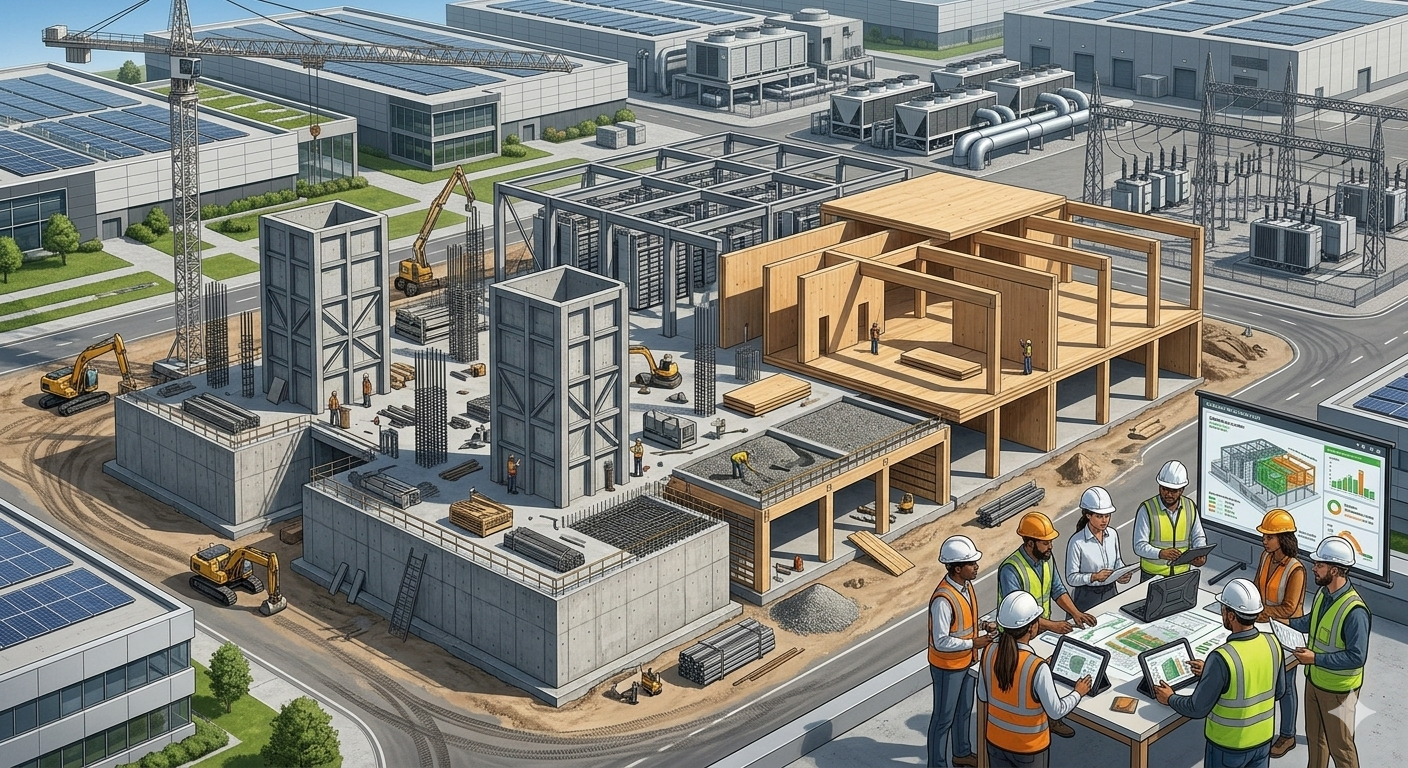
The rapid expansion of digital infrastructure has pushed the construction industry into a new phase where material choices carry greater environmental significance. Data centers now rank among the most resource-intensive commercial buildings because they require substantial structural strength, operational resilience, and long service lives.

Concrete has traditionally served as the backbone of these facilities due to its durability, load-bearing capacity, and fire-resistant characteristics. Questions about embodied carbon have prompted developers, engineers, and sustainability experts to evaluate whether alternative materials can replace concrete in future projects.
Growing pressure from investors, regulators, and customers has accelerated discussions about reducing the environmental footprint of new facilities. The debate increasingly centers on whether the industry can eliminate concrete entirely or achieve meaningful reductions through smarter material strategies.
Why Data Center Construction Materials Still Depend on Concrete
Modern data centers support equipment loads that differ significantly from conventional office or commercial buildings. Server racks, backup power systems, cooling infrastructure, and electrical equipment generate concentrated weight that requires strong foundations and structural stability.
Reinforced concrete provides the compressive strength necessary to distribute these loads across large facilities without compromising operational reliability. High-density computing environments also create vibration considerations that engineers must address through robust structural design.

Fire resistance requirements further strengthen the case for concrete because operators seek materials that protect critical assets during emergency events. For these reasons, concrete continues to occupy a central role in facility design despite growing environmental concerns regarding its carbon footprint.
The rise of artificial intelligence workloads has reinforced demand for stronger structural systems rather than reducing it. Advanced computing clusters often require heavier racks, larger cooling systems, and greater power distribution infrastructure than previous generations of facilities.
Designers increasingly account for higher floor loading requirements as AI deployments expand across hyperscale campuses. Structural engineers therefore face practical limitations when evaluating wholesale material substitutions for major load-bearing components.
Operational resilience remains a primary objective because service interruptions can carry significant financial consequences. As a result, developers often prioritize proven performance characteristics when selecting core construction materials.
The Carbon Challenge Behind Conventional Concrete
Although concrete offers clear operational advantages, its environmental impact remains difficult to ignore. Cement production, which represents a critical ingredient in concrete, generates substantial carbon dioxide emissions during manufacturing and chemical processing. Industry analysts increasingly focus on embodied carbon because construction emissions occur before a facility becomes operational.
Large hyperscale campuses can require enormous volumes of concrete for foundations, slabs, utility structures, and supporting infrastructure. Environmental assessments therefore examine material sourcing and production methods alongside energy consumption metrics. The conversation has shifted from operational efficiency alone toward a broader evaluation of lifecycle emissions.
Developers now face competing objectives when planning new projects in major markets. Business requirements demand rapid deployment schedules, while sustainability commitments encourage reductions in embodied carbon.
Material selection decisions have become increasingly important because construction emissions remain locked into a facility for decades. Several operators have introduced carbon accounting frameworks that measure emissions associated with building materials before procurement begins.
Procurement teams increasingly evaluate suppliers based on environmental performance in addition to cost and availability. This shift has encouraged experimentation with lower-carbon alternatives across different stages of project development.
Low-Carbon Concrete Is Becoming a Practical Option
Rather than eliminating concrete entirely, many organizations have focused on improving the material itself.
Manufacturers increasingly produce lower-carbon concrete mixes by reducing the amount of traditional cement and incorporating supplementary cementitious materials. Fly ash, slag, calcined clay, and other alternatives can decrease embodied carbon while preserving required structural characteristics.
Engineers often tailor these mixes according to specific performance requirements and environmental conditions. Construction teams can therefore maintain familiar building practices without introducing major structural uncertainties.
This approach has emerged as one of the most practical pathways for reducing construction-related emissions in large facilities.
Adoption continues to expand because low-carbon concrete aligns with existing design standards and construction workflows. Project teams generally encounter fewer regulatory obstacles when modifying material formulations rather than introducing entirely new structural systems.
Performance testing has also improved confidence among developers responsible for mission-critical infrastructure. Engineers can validate strength, durability, and curing characteristics before implementation at scale.
Consequently, lower-carbon mixes have gained traction across both enterprise and hyperscale developments. Industry observers increasingly view material optimization as an achievable near-term strategy rather than a distant aspiration.
Mass Timber Offers Promise but Faces Limitations
Mass timber has attracted attention as a lower-carbon construction material capable of storing carbon throughout its service life. Several commercial building sectors have adopted engineered wood products to reduce embodied emissions and diversify material portfolios.
Data center developers have explored timber applications in office spaces, administrative buildings, and selected support structures. The material offers attractive sustainability benefits because production generally generates fewer emissions than conventional concrete manufacturing.
Architectural flexibility and reduced construction weight also appeal to some project teams. Interest in timber solutions continues to grow as organizations seek alternatives capable of supporting corporate climate objectives.
Despite these advantages, significant barriers limit mass timber adoption within core computing environments. Heavy equipment loads create structural demands that many timber-based systems struggle to satisfy without additional reinforcement.
Fire safety considerations require extensive analysis because operators must protect critical infrastructure and maintain stringent resilience standards. Building codes vary across jurisdictions, creating further complexity for large-scale deployment.
Many experts therefore view timber as a complementary material rather than a complete replacement for concrete in mission-critical facilities. Current applications remain concentrated around peripheral structures rather than primary equipment halls.
Retrofitting Existing Facilities May Deliver Greater Impact
A growing number of industry participants argue that the most sustainable building may already exist. Retrofitting existing industrial facilities can significantly reduce the need for new construction materials while extending the useful life of existing structures.
Developers increasingly evaluate adaptive reuse opportunities before pursuing greenfield development projects. Existing foundations, structural systems, and utility connections can reduce embodied carbon compared with entirely new builds.
This strategy also helps shorten development timelines in regions where permitting and land acquisition present challenges. Retrofitting therefore represents an important component of broader sustainability planning.
Not every facility can accommodate modern computing requirements through renovation alone. Older buildings often require upgrades to support higher power densities, advanced cooling systems, and modern resilience standards.
Structural limitations may restrict the deployment of heavier AI infrastructure in some locations. Project teams must carefully assess whether retrofit costs justify the anticipated environmental benefits. Nevertheless, successful conversions demonstrate that strategic reuse can reduce material consumption while supporting growing digital demand.
Many operators now consider adaptive reuse as part of their long-term infrastructure planning frameworks.
Designing for Material Efficiency Instead of Material Elimination
Industry discussions increasingly recognize that eliminating concrete may not represent the most realistic objective. Engineers often achieve greater environmental benefits by reducing unnecessary material use through optimized structural design.
Advanced modeling tools enable project teams to identify opportunities for material efficiency without compromising performance requirements. Structural systems can often achieve the same operational outcomes with lower volumes of concrete when designers incorporate optimization techniques early in the planning process.
Furthermore, improved coordination between architects, engineers, and contractors can minimize waste during construction. These incremental improvements collectively contribute to measurable reductions in embodied carbon.
The future of sustainable data center construction will likely involve a combination of strategies rather than a single transformative solution. Low-carbon concrete, selective timber adoption, adaptive reuse, and design optimization each address different aspects of the emissions challenge.
Developers must balance environmental objectives against operational reliability, structural integrity, and economic feasibility. Meanwhile, demand for AI infrastructure continues to reshape facility requirements and construction priorities across global markets.
Evidence suggests that concrete will remain essential for foundations and high-density computing spaces for the foreseeable future. The industry’s progress will therefore depend less on abandoning concrete and more on using it with greater precision, efficiency, and environmental awareness.












