 Skip to content
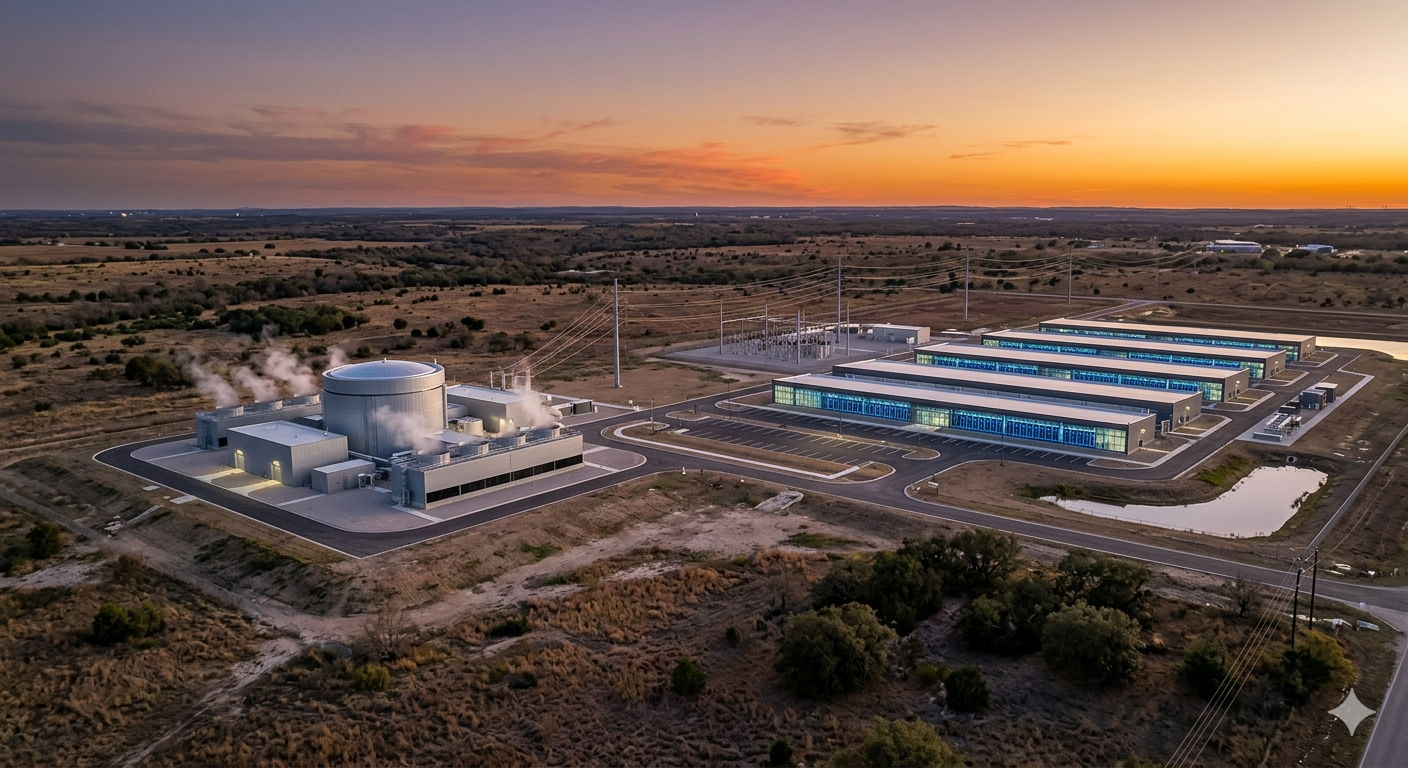
The global electric grid was not designed for the scale of artificial intelligence. As hyperscalers and digital infrastructure operators race to build compute capacity, the energy bottleneck has become the single most consequential constraint in the industry. Across the United States and abroad, a structural shift is underway: data center operators are moving away from grid dependency and toward dedicated, on-site power generation increasingly centered on advanced nuclear technology. This article examines the conditions driving that shift, the corporate partnerships accelerating it, and the obstacles that must be cleared before nuclear becomes a reliable pillar of AI infrastructure.

The Grid Cannot Keep Up With AI
The numbers are stark. According to the International Energy Agency, electricity demand from data centers climbed 17% in 2025 alone, outpacing total global electricity demand growth of 3% by a significant margin. AI-focused facilities drove even faster consumption. Global data center electricity generation is projected to grow from 460 terawatt-hours in 2024 to over 1,000 TWh by 2030 and 1,300 TWh by 2035. To put that figure in context, the IEA notes that a single hyperscale data center consumes roughly the same electricity annually as 100,000 homes.
The U.S. Department of Energy and Lawrence Berkeley National Laboratory project that data centers could account for as much as 12% of total U.S. electricity consumption by 2030, up from approximately 4% today. The infrastructure required to deliver that power transmission lines, substations, interconnection approvals simply does not exist at the pace the industry demands. Grid interconnection queues in several U.S. markets now stretch seven years or more, according to data tracked in April 2026 by industry analysts. Of the 16 gigawatts of data center capacity announced across 140 U.S. projects for 2026 delivery, only 5 GW was under active construction. The remainder sat in planning limbo, blocked primarily by power procurement challenges.
Behind-the-Meter: The Strategic Pivot
Faced with this time-to-power mismatch, data center developers are adopting a fundamentally different operating model: behind-the-meter generation. Rather than purchasing power from the utility grid, operators build dedicated generation capacity directly adjacent to their facilities, reducing both transmission costs and interconnection delays.
A March 2026 Bloom Energy survey of hyperscalers, colocation providers, independent power producers, and equipment vendors found that time-to-power now runs roughly 1.5 to 2 years longer than previously expected in key markets. That gap is what makes behind-the-meter configurations not just attractive but operationally necessary for operators who cannot afford to wait. On-site natural gas remains the most immediate solution for many developers, but its long-term viability as a sustainability-compatible option is limited. Nuclear, with its carbon-free baseload profile, has emerged as the preferred trajectory for operators with multi-decade infrastructure horizons. The economics of behind-the-meter nuclear carry distinct advantages. Direct connection to a reactor eliminates transmission costs, provides nuclear plants with steady contracted revenue that supports license extensions, and gives the data center operator a predictable cost base over a 20-plus year horizon. For high-density GPU clusters where power costs routinely exceed hardware costs, that price stability constitutes a meaningful strategic edge.
What Are Small Modular Reactors?
Small modular reactors are nuclear reactors rated at up to 300 megawatts of generating capacity, engineered for factory fabrication, modular assembly, and on-site installation. Unlike conventional gigawatt-scale reactors that require enormous facilities, bespoke civil engineering, and decade-long construction timelines, SMRs are designed for serial production a manufacturing model intended to compress costs and construction schedules through standardization. Multiple units can operate in parallel at a single site, allowing operators to scale capacity incrementally. Their smaller physical footprint and lower per-unit capital commitment make them suitable for co-location with industrial facilities and data center campuses, including sites at retired coal plants where existing grid infrastructure can be repurposed. The DOE’s Office of Nuclear Energy identifies SMRs as particularly well-suited for powering large industrial loads such as data centers, noting their ability to deliver reliable, dispatchable, carbon-free electricity without the intermittency challenges inherent in wind and solar.

Beyond the standard light-water reactor design used in most existing nuclear plants, a new generation of advanced reactor concepts is entering the regulatory pipeline. These include high-temperature gas-cooled reactors, sodium-cooled fast reactors, and molten salt reactors — each offering specific operational characteristics relevant to industrial heat and power applications. It is within this latter category that some of the most commercially active partnerships in the data center sector are now forming.
Riot Platforms and Terrestrial Energy: A Generation IV Collaboration
The clearest signal of where the industry is heading arrived in May 2026, when Riot Platforms Inc. (NASDAQ: RIOT) and Terrestrial Energy Inc. (NASDAQ: IMSR) announced a formal collaboration to develop nuclear-powered, large-scale data center projects. The two companies signed a memorandum of understanding to jointly assess candidate sites in the United States, including existing Riot facilities in Texas and Kentucky, with an initial combined target of up to 4 gigawatts of new nuclear capacity deployed across multiple locations.
Terrestrial Energy is developing the Integral Molten Salt Reactor, a Generation IV advanced nuclear design based on molten salt reactor technology originally demonstrated at Oak Ridge National Laboratory. The IMSR plant architecture separates non-nuclear energy conversion systems housed in a dedicated Thermal and Electric Facility from the regulated nuclear systems. This configuration allows for hybrid energy operation, including natural gas bridging for early-stage deployments, and gives the design a distinct commercial advantage in behind-the-meter data center applications. Terrestrial’s design is currently under licensing review by the U.S. Nuclear Regulatory Commission, with a target to commission first IMSR plants in the early 2030s.
“This partnership brings together two companies with sector-leading capabilities to unlock the tremendous value in IMSR Plant supply to data center operations,” said Simon Irish, CEO of Terrestrial Energy, at the time of the announcement. Riot’s technical profile — large-scale digital infrastructure at high power density, originally built for Bitcoin mining — maps closely onto the operational requirements of high-performance AI computing. The partnership signals how infrastructure operators that built expertise in power-intensive compute are now positioning nuclear as the next strategic layer.
Hyperscalers Lead the Nuclear Charge
The Riot-Terrestrial partnership is not an isolated development. Across the hyperscale tier, nuclear procurement has become standard practice. As of May 2026, every major technology hyperscaler has signed at least one nuclear power deal for AI data center capacity, representing a combined 9.7 gigawatts or more of committed capacity across 13 documented transactions.
Microsoft signed a 20-year power purchase agreement with Constellation Energy in September 2024 to restart Three Mile Island Unit 1 renamed the Crane Clean Energy Center securing 835 megawatts of carbon-free power by 2028. Constellation committed $1.6 billion to refurbish the plant, and a $1 billion DOE loan closed in November 2025. Google made history in October 2024 with the first corporate SMR purchase agreement in the United States, partnering with Kairos Power to procure 500 megawatts from a fleet of six to seven molten salt reactors, with first delivery targeted for 2030 and full deployment by 2035. Amazon Web Services invested $700 million in SMR developer X-energy and signed agreements through utility consortium Energy Northwest for up to 12 Xe-100 reactors, with a go-live target in the early 2030s. Oracle’s chairman Larry Ellison publicly announced plans to build a data center powered by three SMRs. Meta issued requests for proposals covering 1 to 4 gigawatts of new nuclear generation capacity. The IEA reported in April 2026 that the pipeline of conditional offtake agreements between data center operators and SMR projects had grown from 25 gigawatts at the end of 2024 to 45 gigawatts a near-doubling in roughly 16 months. Wood Mackenzie projects that U.S. nuclear generation will remain steady through 2035 and then increase 27% through 2060 as SMRs come online at scale.
Risk Factors and Structural Barriers
Nuclear’s resurgence in corporate energy planning does not eliminate the substantial risks that have historically constrained the technology’s commercial expansion. These risks warrant clear-eyed assessment for any infrastructure decision-maker evaluating nuclear as a near-term option.
Regulatory timelines remain the most immediate constraint. No SMR design has yet been commercially commissioned and operated at scale in the United States. NuScale Power’s US460 received Standard Design Approval from the NRC in May 2025, making it the first SMR to achieve that milestone. Executive Order 14300, signed in May 2025, calls for fixed decision deadlines of no more than 18 months for new reactor construction-and-operation applications but implementing rules must first be finalized and proven in practice before those timelines become reliable. Compressing regulatory review without compromising safety rigor introduces its own set of risks, particularly for novel designs and behind-the-meter configurations that introduce new siting and emergency planning considerations.
Fuel supply is a second structural concern. Many advanced SMR designs require high-assay low-enriched uranium, a fuel type for which domestic U.S. production infrastructure remains limited. Current supply chains partially depend on foreign sources, and domestic enrichment capacity is still in development. The DOE has active programs to accelerate HALEU availability, but the production timeline is not yet confirmed at commercial scale.
Capital costs for first-of-a-kind deployments carry substantial uncertainty. While SMRs promise lower per-unit costs than large conventional plants through serial manufacturing, early project costs for pioneer units are difficult to forecast with precision. Cost overruns in nuclear construction have historically been a persistent challenge across global markets.
Public acceptance varies significantly by region and community. Surveys indicate mixed views, with communities weighing clean energy benefits against concerns shaped by the historical record of nuclear incidents. Social license to operate is a prerequisite for any behind-the-meter deployment on or near existing infrastructure.
Investment Outlook
The financial signals surrounding nuclear for data infrastructure are directionally strong, even as specific project timelines carry uncertainty. Capital expenditure among five large technology companies surged to more than $400 billion in 2025 and is projected to increase by a further 75% in 2026, per IEA data. A significant and growing portion of that spending is directed toward power procurement and on-site generation, with nuclear representing the highest-conviction long-term commitment in that mix. The IEA projects that, alongside continued renewable expansion, SMRs will reduce the need for additional natural gas generation in U.S. data centers such that by 2035, low-emissions sources account for over half of the country’s data center electricity supply. Deloitte’s analysis estimates that new nuclear capacity could meet approximately 10% of the projected increase in data center electricity demand by 2035 a meaningful share given the scale of total projected demand. Wood Mackenzie places global nuclear capacity growth at between 800 GW and 1,600 GW by 2060, up from 400 GW currently, with data center demand serving as a primary commercial catalyst.
For infrastructure investors and enterprise decision-makers, the near-term practical path to nuclear power runs primarily through power purchase agreements with existing plants, while SMR-based co-location enters realistic planning horizons for projects targeting 2030 and beyond. Projects that have secured confirmed power procurement whether from existing plants or through advanced agreements with SMR developers carry materially lower development risk than those dependent on future grid capacity. The convergence of regulatory policy, corporate capital, and constrained grid capacity has made power sourcing the defining site-selection criterion for data center development in this decade.












