...
NVIDIA H200 shipments delayed to Q3  · BREAKING: Microsoft confirms 3GW data centre expansion in Asia-Pacific ·  AWS announces new sovereign cloud regions in India and UAE  · Arm-based servers now 24% of hyperscale deployments ·  EU AI Act enforcement enters phase two  · Global data centre investment hits $612B in 2026 ·  TSMC Arizona yields improve to 68% on 3nm process  · OpenAI valuation reaches $400B after latest funding round ·  NVIDIA H200 shipments delayed to Q3  · BREAKING: Microsoft confirms 3GW data centre expansion in Asia-Pacific ·  AWS announces new sovereign cloud regions in India and UAE  · Arm-based servers now 24% of hyperscale deployments ·  EU AI Act enforcement enters phase two  · Global data centre investment hits $612B in 2026

Google’s Virgo Network Signals a Fundamental Shift in How AI Data Centers Are Designed

Google’s Virgo Network, introduced at Google Cloud Next 2026, is a megascale AI data center fabric that Google describes as

Share
Google Virgo AI data center network design shift two-layer fabric 134000 TPU bandwidth latency

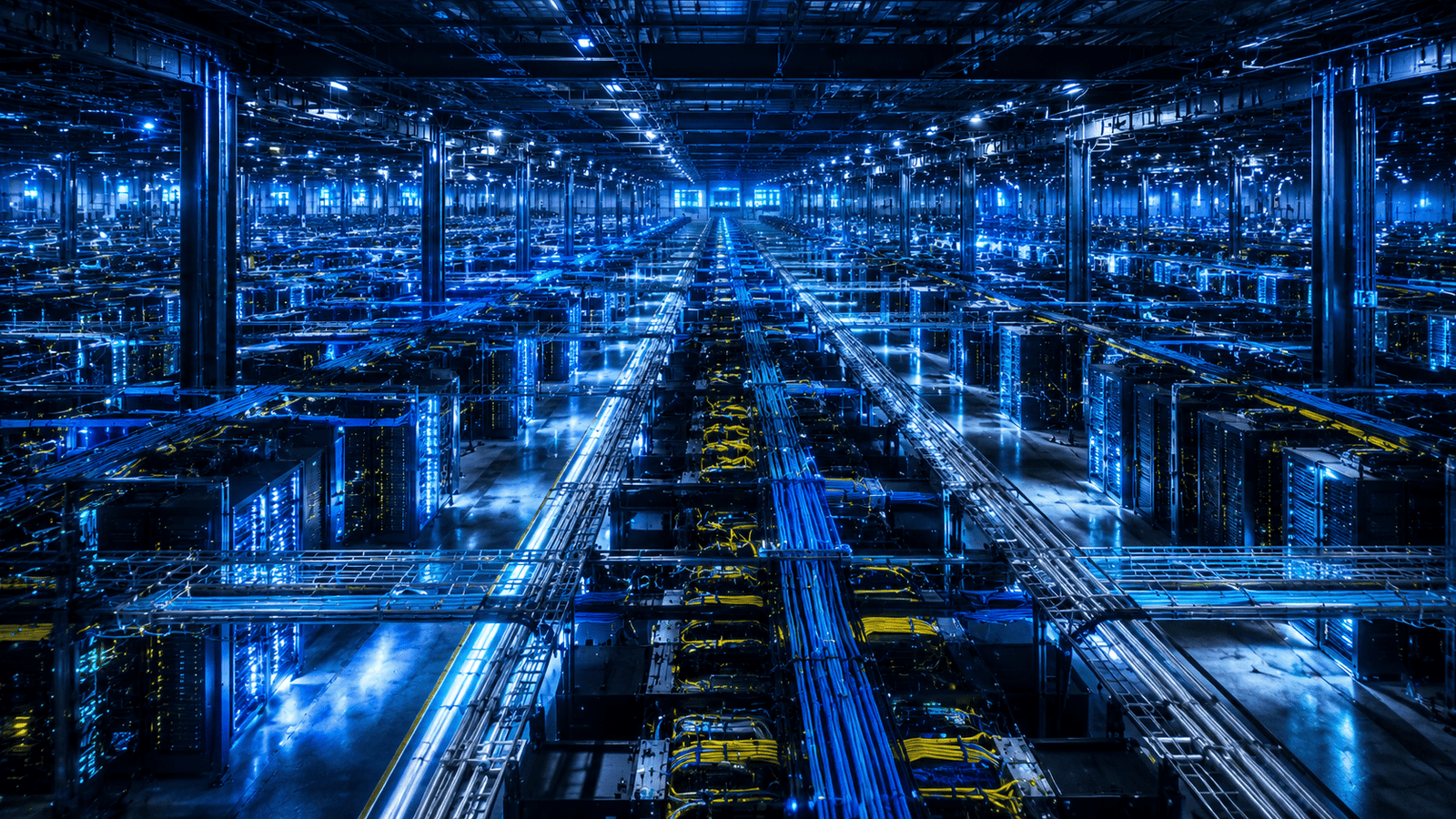
Google’s Virgo Network, introduced at Google Cloud Next 2026, is a megascale AI data center fabric that Google describes as built on a campus-as-a-computer philosophy, connecting up to 134,000 TPU chips within a single data center with 47 petabits per second of bisectional bandwidth. The design delivers four times the bandwidth per accelerator of Google’s previous generation networking fabric and 40% lower unloaded latency, while enabling more than one million TPUs across multiple data center sites to operate as a single training cluster. The numbers are striking, but the more significant aspect of Virgo is not its performance specifications. It is what the design choices embedded in Virgo reveal about what AI at scale actually requires from data center networking, and how far those requirements diverge from the general-purpose networking architectures that hyperscale data centers have used for the past decade.

The core architectural departure in Virgo is the shift from a three-layer network topology to a two-layer non-blocking fabric. Conventional data center networks use a three-tier hierarchy of access, aggregation, and core switching layers, a design optimised for the east-west traffic patterns of enterprise workloads and cloud services where many small flows compete for shared bandwidth. AI training clusters generate a fundamentally different traffic pattern: massive, tightly synchronised collective communications where tens of thousands of accelerators exchange gradient updates simultaneously on a precise schedule. The three-tier hierarchy creates queuing delays at aggregation and core layers that appear as tail latency in AI training, slowing the entire cluster when a subset of transfers experience delays. Virgo addresses this by eliminating the aggregation layer entirely, using high-radix switches with more ports per switch to flatten the topology and reduce the hop count between any two nodes in the fabric.

The Three Traffic Domains That Define Virgo’s Architecture

Virgo’s flat two-layer fabric handles a specific category of AI traffic: the tightly coupled accelerator-to-accelerator communication of large training clusters. However, Google’s data centers serve multiple traffic types simultaneously, and Virgo’s architecture explicitly segments these into three independent network domains. The first domain is the tightly coupled AI training fabric that Virgo’s flat topology addresses. The second is the broader east-west traffic that moves data across larger clusters and between training and serving infrastructure. The third is the north-south traffic that connects accelerators to storage and external services through Google’s existing Jupiter fabric.

This segmentation reflects a design philosophy that the data center network is no longer a single uniform system but a set of coordinated layers, each tuned to the specific traffic pattern it serves. As Ron Westfall, vice president and analyst at HyperFrame Research, noted in analysis of Virgo, Google has reimagined the data center as a campus-as-a-computer, treating tail latency as a hardware reliability issue rather than a network tuning problem and isolating AI training traffic to keep large clusters in synchronisation. The practical implication is that operators designing AI data centers cannot apply conventional network architecture thinking to the AI training layer. The traffic characteristics are different enough that a purpose-built fabric, rather than a tuned general-purpose network, is the appropriate design response.

The Scaling Tax That Virgo Eliminates

Google describes Virgo’s architecture as eliminating the scaling tax — the performance degradation that conventional networks experience as cluster sizes increase. In traditional three-layer networks, adding more accelerators to a cluster does not produce proportionally more training throughput because the aggregation and core switching layers become bottlenecks as the number of concurrent flows increases. The result is that 100,000 accelerators do not produce 10 times the training throughput of 10,000 accelerators, because network congestion at aggregation layers grows faster than the compute capacity being added. Virgo’s non-blocking two-layer topology ensures that every accelerator has a dedicated path to every other accelerator with no shared aggregation bottleneck, enabling near-linear scaling of training throughput with cluster size.

The elimination of the scaling tax has direct implications for how data center operators and hyperscalers should think about network infrastructure investment relative to compute infrastructure investment. A cluster whose training throughput scales linearly with compute additions justifies higher per-accelerator spending on compute than a cluster where network bottlenecks limit the effective utilisation of added capacity. Conversely, a network investment that eliminates the scaling tax and enables linear compute scaling can generate returns that exceed the cost of the additional accelerators otherwise required to achieve the same training throughput. The economic logic of Virgo is therefore not just about better network performance. It is about changing the relationship between network investment and compute utilisation in ways that alter the optimal capital allocation for AI infrastructure at scale.

As covered in our analysis of the AI infrastructure spending model resting on assumptions nobody has actually tested, the assumptions embedded in AI infrastructure investment models have not been stress-tested at the scale that Virgo-class infrastructure enables.

What Virgo Means for the Broader Networking Market

Virgo’s architectural choices are not simply Google-specific engineering decisions. They reflect constraints of AI training workloads that apply to every operator building large-scale AI infrastructure, and the solutions Google has implemented in Virgo are influencing how the broader networking industry thinks about AI fabric design. The shift from three-layer to two-layer topology, the use of high-radix switches to reduce hop count, and the segmentation of AI training traffic from other data center traffic types are all design patterns that competing hyperscalers, independent data center operators, and enterprise AI infrastructure teams are evaluating in their own network architecture decisions.

The convergence between Virgo and MRC, OpenAI’s multipath networking protocol released through the Open Compute Project on May 5, illustrates how the networking layer of AI infrastructure is undergoing coordinated evolution across the industry rather than incremental improvement within existing frameworks. Both Virgo and MRC reflect the same underlying insight: general-purpose data center networking cannot efficiently support the synchronised, high-bandwidth, low-latency demands of large-scale AI training because engineers originally designed it for diverse workloads with unpredictable traffic patterns. The solutions they implement from different starting points, Virgo through topology redesign and MRC through transport protocol redesign, are complementary approaches to the same problem. Data center operators who are planning AI networking infrastructure for the next three to five years need to engage with both simultaneously rather than treating network topology and transport protocol as independent design decisions.


[simple-author-box]

More from AI Infrastructure

The procurement challenge behind artificial intelligence infrastructure is becoming more complex. Earlier data center

A 202-acre parcel off President Donald J. Trump Highway in western Palm Beach County

President Donald Trump is asking the artificial intelligence industry to make a stronger public

COMPUTE WEEKLY

The briefing that 40,000+ tech leaders read every Monday. Sharp, fast, essential.

Great! We’ve received your information.

Building an AI Startup Without Owning GPUs

Not owning GPUs has become the default, deliberate strategy for building an AI company — not a compromise founders accept reluctantly. H100 rental rates fell 64-75% in fifteen months, a dense ecosystem of neoclouds and inference-as-a-service providers now lets startups skip infrastructure entirely, and credit programs can fund a company’s first year before a founder writes a check
Most Read

Demand is broadening across enterprise workloads APAC’s infrastructure story is changing in ways that

AI infrastructure decisions increasingly influence what enterprises can build, test, and deliver. They also

Why Infrastructure Planning Now Starts With Availability A data center project can have a

A property can look enormous from the site entrance and still offer almost no

As rack power rises toward the megawatt range, the physical footprint of power-delivery equipment

Disruptor Spotlight

Cerebras Systems

The chip that makes Nvidia nervous. Cerebras’ Wafer Scale Engine is rewriting the rules of AI inference at scale.
Faster
0 x
YoY Revenue
0 x
Transistors
0 T
Market Pulse
MSFT
+1.02%
NVDA
+0.66%
AMZN
-0.078%
AMD
-6.95%
TSMC
-2.98%
Indicative only · Not financial advice
Upcoming Events
SEP
The AI Infrastructure Race (India)
WEBINAR · ONLINE
The AI Infrastructure Race: Won on Power, Land and Trust — Not Capital
MAY
0
AI Infrastructure Summit
DUBAI · IN PERSON
MEA’s premier AI infrastructure event.
JUN
0 0
Compute Forecast Summit
SINGAPORE · IN PERSON
Our flagship APAC event. Early bird open.
Latest Moves
Live
ecolab
Ecolab Deepens Cooling Strategy With $4.75B CoolIT Acquisition
Ecolab is making one of its biggest moves yet into AI infrastructure after completing its $4.75 billion acquisition of liquid cooling specialist CoolIT Systems
Pure DC AVK Europe data center microgrid Dublin 110MW AI infrastructure Ireland 2026
Pure DC and AVK Deploy Europe’s First 110 MW Data Center Microgrid in Dublin
The Pure DC Dublin microgrid has made history as Europe’s first large-scale on-site data center microgrid, launched in partnership with power solutions provider AVK at Pure DC’s campus in Ireland.
Pace Digitek
Pace Digitek Partners With MEGMEET to Expand AI Data Center Power Business
India’s AI infrastructure ecosystem continues to mature as domestic technology manufacturers move beyond traditional telecommunications and industrial markets toward high-growth digital infrastructure opportunities
Follow Compute Forecast
11K followers
1200 followers
Companies to Watch
CW
CoreWeave
Neo Cloud · $19B · IPO Watch
CB
Cerebras Systems
AI Hardware · $4.25B · Pre-IPO
G42
G42
Sovereign AI · Abu Dhabi
H
Humain
Saudi AI · $40B Fund
Latest Podcast
AI Capex, Cloud Margins & the Nuclear Bet
48 MIN · 25 APR 2026

Google’s Virgo Network Signals a Fundamental Shift in How AI Data Centers Are Designed

Google’s Virgo Network, introduced at Google Cloud Next 2026, is a megascale AI data center fabric that Google describes as

Share
Google Virgo AI data center network design shift two-layer fabric 134000 TPU bandwidth latency
102
847 SHARES

0
SHARES

[simple-author-box]

More from AI Infrastructure

Demand is broadening across enterprise workloads APAC’s infrastructure story is changing in ways that

AI infrastructure decisions increasingly influence what enterprises can build, test, and deliver. They also

Why Infrastructure Planning Now Starts With Availability A data center project can have a

A property can look enormous from the site entrance and still offer almost no

COMPUTE WEEKLY

The briefing that 40,000+ tech leaders read every Monday. Sharp, fast, essential.

Great! We’ve received your information.

Global AI Infrastructure Outlook 2026

The briefing that 40,000+ tech leaders read every Monday. Sharp, fast, essential.
Download Free
Most Read

Demand is broadening across enterprise workloads APAC’s infrastructure story is changing in ways that

AI infrastructure decisions increasingly influence what enterprises can build, test, and deliver. They also

Why Infrastructure Planning Now Starts With Availability A data center project can have a

A property can look enormous from the site entrance and still offer almost no

As rack power rises toward the megawatt range, the physical footprint of power-delivery equipment

Disruptor Spotlight

Cerebras Systems

The chip that makes Nvidia nervous. Cerebras’ Wafer Scale Engine is rewriting the rules of AI inference at scale.
Faster
0 x
YoY Revenue
0 x
Transistors
0 T
Market Pulse
NVDA
$924.60
+2.4%
MSFT
$421.30
+1.1%
AMZN
$192.80
-0.6%
NVDA
$924.60
+2.4%
NVDA
$924.60
+2.4%
Indicative only · Not financial advice
Upcoming Events
MAY
0 0
DCD Global — London
LONDON · IN PERSON
World’s largest DC event. CF is media partner.
MAY
0
AI Infrastructure Summit
DUBAI · IN PERSON
MEA’s premier AI infrastructure event.
JUN
0 0

Compute Forecast Summit

SINGAPORE · IN PERSON
Our flagship APAC event. Early bird open.
Latest Moves
  • Live
Sam Altman
OpenAI appoints new Chief Infrastructure Officer to lead $100B DC programme
27 APR · OPENAI
Sam Altman
OpenAI appoints new Chief Infrastructure Officer to lead $100B DC programme
27 APR · OPENAI
Sam Altman
OpenAI appoints new Chief Infrastructure Officer to lead $100B DC programme
27 APR · OPENAI
Follow Compute Forecast
18.4K followers
12.1K followers
9.3K subscribers
41 episodes
Companies to Watch
CW
CoreWeave
Neo Cloud · $19B · IPO Watch
CB
Cerebras Systems
AI Hardware · $4.25B · Pre-IPO
G42
G42
Sovereign AI · Abu Dhabi
CW
Humain
Saudi AI · $40B Fund
Latest Podcast
AI Capex, Cloud Margins & the Nuclear Bet
48 MIN · 25 APR 2026
Scroll to Top
Seraphinite AcceleratorOptimized by Seraphinite Accelerator
Turns on site high speed to be attractive for people and search engines.