 Skip to content
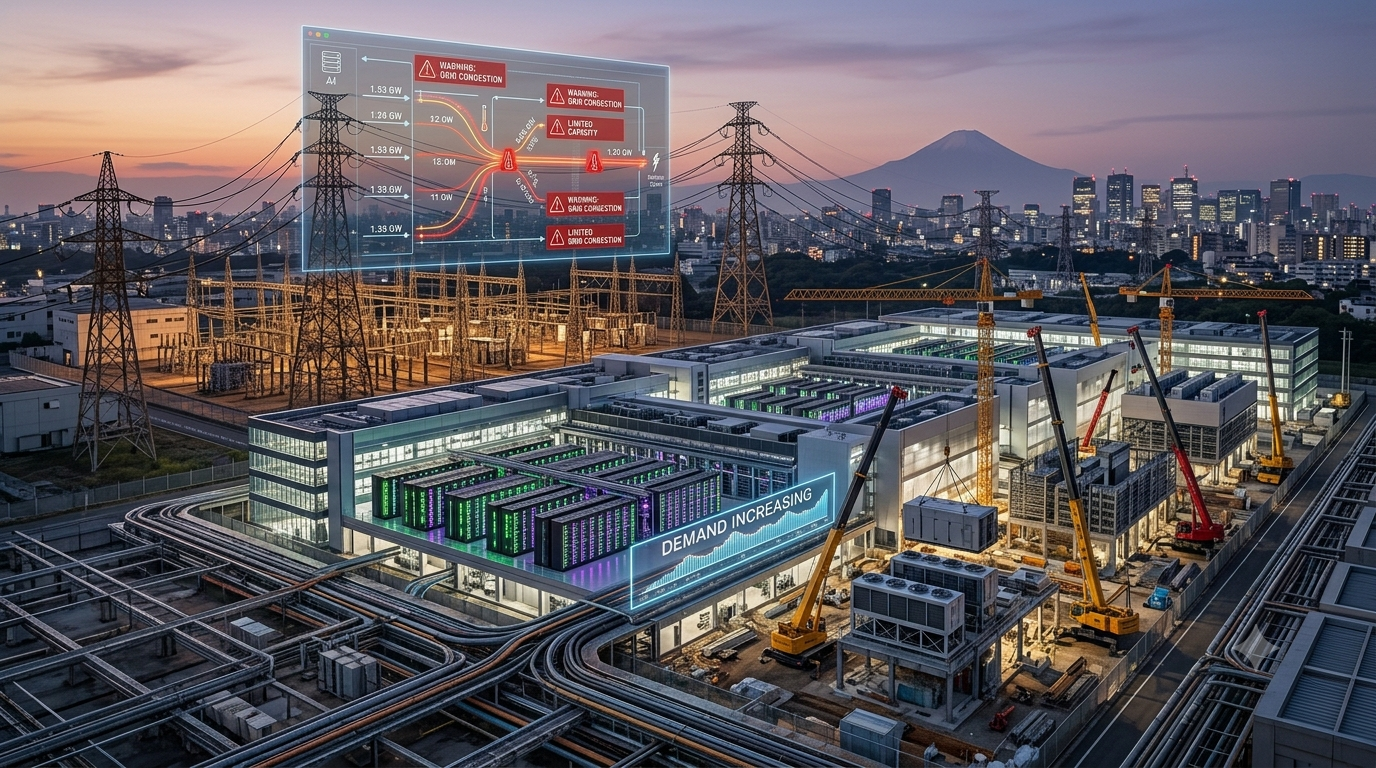
Japan has become one of the most active battlegrounds in the global race for artificial intelligence infrastructure. Over the past two years, hyperscalers, cloud providers, and domestic technology firms have committed tens of billions of dollars to new AI-ready data centers, GPU clusters, and sovereign computing platforms. The scale of investment reflects growing demand for local AI capacity, data sovereignty, and enterprise adoption. Global technology companies increasingly view Japan as a strategic market capable of supporting the next phase of AI growth across Asia. At the same time, policymakers see AI infrastructure as an important component of economic competitiveness and national security. Yet the country’s infrastructure ambitions now face a challenge that capital alone cannot solve.

A wave of investment from Amazon Web Services, Microsoft, Oracle, SoftBank, Sakura Internet, and other infrastructure operators is colliding with a much older reality. Electricity networks in and around Tokyo are struggling to accommodate new demand from hyperscale facilities. Grid connection timelines that once measured months now stretch into years. In several cases, operators report waiting periods ranging from five to ten years before sufficient capacity becomes available. The result is a growing mismatch between the speed of AI investment and the pace of power infrastructure expansion. Consequently, Japan’s AI future is becoming increasingly tied to the limitations of its electricity system.
Japan’s AI Infrastructure Boom Accelerates
The current investment cycle is unprecedented by Japanese data center standards. AWS committed approximately $15 billion to expand cloud and AI infrastructure in Japan, while Oracle announced an $8 billion expansion focused on GPU-enabled computing environments. Microsoft initially pledged $2.9 billion before expanding its broader commitment to roughly $10 billion through 2029. These projects collectively represent one of the largest concentrations of AI infrastructure investment outside North America. Together, they signal strong confidence in Japan’s long-term position within the global AI economy. Developers expect enterprise demand for AI services to continue growing throughout the decade.
Domestic firms are also increasing their presence. Sakura Internet has emerged as one of Japan’s most important local AI infrastructure providers through investments in GPU clusters and high-performance computing environments. The company’s SAKURAONE platform recently ranked among the world’s leading HPC systems, demonstrating Japan’s growing capabilities in AI-oriented computing infrastructure. SoftBank continues to expand its own AI ambitions through cloud partnerships and infrastructure projects. These investments support a broader national effort to strengthen domestic computing resources while reducing dependence on foreign infrastructure. As a result, Japan is building a more diverse AI ecosystem than many observers anticipated.
Government policy has reinforced this momentum. Officials increasingly view AI as a strategic technology capable of influencing economic productivity, industrial competitiveness, and technological sovereignty. Public and private sector initiatives now focus on increasing domestic compute capacity, supporting AI adoption, and encouraging infrastructure development. Enterprise demand continues to expand across manufacturing, finance, healthcare, and telecommunications. Therefore, infrastructure operators expect utilization rates to remain high as new facilities enter service. The challenge is not finding customers but finding enough electricity to support future growth.
The Power Problem Nobody Expected
The biggest obstacle to Japan’s AI expansion is not access to capital or GPUs. Instead, the limiting factor is increasingly power availability. Large AI facilities require enormous amounts of electricity to operate servers, cooling systems, networking equipment, and supporting infrastructure. Modern AI clusters consume significantly more power than traditional enterprise environments because accelerators operate continuously at high utilization levels. Demand increases further as organizations deploy larger models and support growing inference workloads. Under these conditions, power infrastructure becomes just as important as computing hardware.

Tokyo illustrates the challenge clearly. The metropolitan region remains Japan’s largest digital infrastructure market because it offers dense connectivity, proximity to enterprise customers, and established cloud ecosystems. However, demand for electricity has risen faster than available grid capacity. Operators seeking new connections increasingly encounter lengthy approval processes and infrastructure constraints. Reports indicate that some projects face waiting periods of five to ten years before receiving sufficient power allocations. Such delays fundamentally alter project economics because facilities cannot generate revenue until they become operational. Consequently, developers are reassessing where future infrastructure should be built.
Grid expansion is inherently slower than data center construction. Developers can often complete large facilities within two to three years. Utilities require much longer to plan transmission upgrades, secure regulatory approvals, acquire land, and construct new infrastructure. This mismatch creates a bottleneck that investment dollars cannot easily overcome. Even well-funded projects remain dependent on infrastructure timelines outside their control. Therefore, the AI boom is exposing weaknesses that remained largely hidden during previous generations of cloud expansion.
Why AI Changes Everything
Artificial intelligence creates a different type of electricity demand. Traditional cloud environments generally produce predictable usage patterns spread across large customer bases. AI workloads often operate at higher densities and maintain sustained utilization for extended periods. Training environments can require thousands of GPUs working simultaneously, while inference services generate continuous demand as adoption expands. These characteristics place additional pressure on generation capacity and transmission networks. As a result, utilities must plan for larger and more concentrated loads than before.
Industry projections suggest the scale of growth could be substantial. Estimates indicate that Japanese data center electricity demand may triple over the next decade as AI adoption accelerates. Such growth would place increasing pressure on an electricity system already navigating energy transition goals and infrastructure modernization requirements. Utilities must balance reliability, affordability, and sustainability while accommodating some of the largest new industrial loads in decades. Meanwhile, hyperscalers cannot afford to wait indefinitely for capacity. This tension is becoming one of the defining challenges of Japan’s AI infrastructure expansion.
Moreover, AI infrastructure introduces new planning complexities. Operators often seek hundreds of megawatts for individual campuses. Delivering that level of capacity requires significant upgrades to substations, transmission networks, and supporting infrastructure. Existing planning processes were not designed for multiple gigawatt-scale requests arriving within a short period. Therefore, utilities face growing pressure to adapt procedures and accelerate development timelines. The issue extends beyond Japan and increasingly affects major infrastructure markets worldwide.
Hyperscalers Are Adapting Their Strategies
Faced with growing constraints in Tokyo, hyperscalers are beginning to adjust their infrastructure strategies. Rather than concentrating capacity in a single region, operators increasingly evaluate multi-region deployment models. This approach distributes workloads across different parts of the country while reducing dependence on any single grid area. It also provides greater resilience and operational flexibility. Several major providers have already expanded infrastructure footprints beyond traditional metropolitan hubs. Consequently, geography is becoming a more important strategic consideration.
Regional markets may benefit from this shift. Areas with available power capacity, industrial land, and strong connectivity could attract investment that might otherwise have flowed into Tokyo. Similar patterns have emerged elsewhere as power availability becomes a primary site selection criterion. Infrastructure developers increasingly evaluate locations based on electricity access before considering other factors. Therefore, regions capable of delivering power quickly gain a significant competitive advantage. Japan’s next generation of AI infrastructure may be more geographically distributed than previous waves of cloud development.
Partnerships are also becoming more important. Microsoft’s collaboration with SoftBank and Sakura Internet reflects growing interest in combining global cloud capabilities with domestic infrastructure expertise. These arrangements help expand local computing resources while aligning with broader sovereignty objectives. At the same time, they create additional pathways for scaling infrastructure beyond traditional hyperscale models. Such partnerships could become increasingly common as operators search for practical solutions to power constraints.
The Search for New Power Solutions
The grid challenge is encouraging broader conversations about alternative infrastructure models. Across global markets, operators increasingly explore energy storage systems, flexible load management, and private power arrangements. These approaches aim to reduce dependence on conventional grid expansion while improving deployment timelines. Although they cannot eliminate infrastructure constraints entirely, they may help support future growth. Consequently, power strategy is becoming an integral component of AI infrastructure planning.
Researchers are also examining ways to make AI workloads more flexible. Studies suggest that shifting certain computing tasks across time or geography can reduce pressure on electricity networks. Flexible workloads may lower infrastructure requirements and improve utilization of existing resources. While these approaches remain in early stages, they highlight the growing interaction between computing and energy systems. The AI era increasingly requires coordination between digital infrastructure and power infrastructure rather than treating them as separate domains.
Investment trends reinforce this direction. Around the world, infrastructure investors are acquiring power developers and energy assets to secure future capacity. The objective is straightforward: controlling access to power can be as important as controlling access to land or hardware. Japan’s experience demonstrates why this shift is occurring. AI projects move at digital speeds, while power infrastructure evolves at industrial speeds. Bridging that gap is becoming one of the industry’s most important priorities.
A Ten-Year Wait Could Redefine Japan’s AI Future
Japan’s AI infrastructure boom reflects strong market fundamentals, growing enterprise demand, and significant investor confidence. Few countries have attracted such a concentrated wave of commitments from both global hyperscalers and domestic technology firms. The scale of planned investment demonstrates that Japan remains a critical market within the broader AI economy. Yet the next phase of growth depends less on funding announcements and more on physical infrastructure execution. Electricity networks now sit at the center of that equation.
The emerging challenge is not whether Japan wants more AI infrastructure. The challenge is whether the country’s power system can expand quickly enough to support it. Grid connection delays are transforming electricity from a utility service into a strategic competitive resource. Operators that secure power first will likely secure market share first. Therefore, the real race is no longer simply about GPUs, cloud services, or AI models. Japan’s twenty-eight-billion-dollar AI wave has reached a ten-year grid wall, and what happens next may determine the country’s position in the next era of digital infrastructure.












