
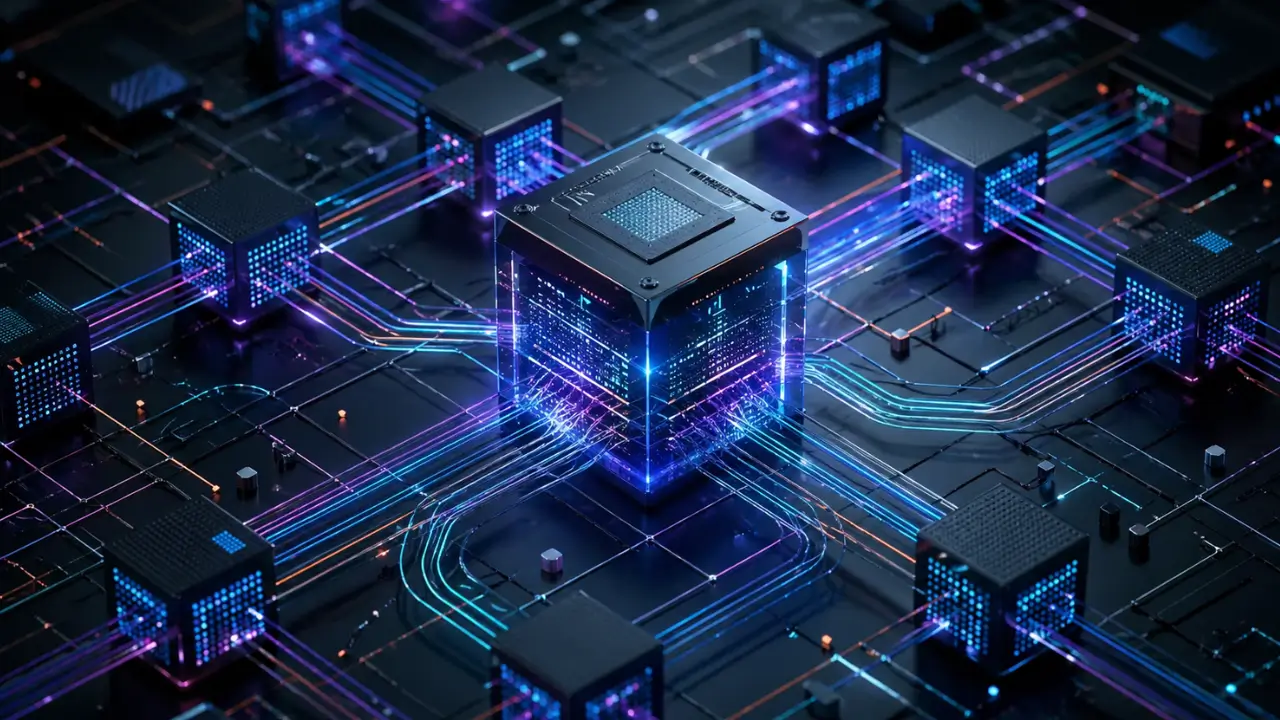
The modern AI facility no longer resembles a passive warehouse of servers waiting for isolated tasks. It behaves more like a coordinated machine where thousands of accelerators operate in lockstep, driven by strict timing and data dependencies that resemble scientific simulation environments. Latency budgets have tightened, and performance ceilings now depend on how well every node aligns with the rest of the system rather than how powerful any single unit appears in isolation. Training large-scale models exposes inefficiencies that traditional cloud abstractions can mask in large-scale AI workloads, forcing infrastructure teams to rethink architecture from first principles. This shift does not arrive as a theoretical evolution but as a direct response to the scaling limits observed in real-world deployments of advanced AI systems. The result is a structural convergence where hyperscale infrastructure begins to mirror the operational discipline of high-performance systems.

This Isn’t a Data Center, It’s a Machine
AI clusters now operate as cohesive systems where synchronization defines throughput and inefficiencies propagate instantly across the entire fabric. Each accelerator participates in tightly coordinated steps such as gradient exchange, parameter updates, and memory sharing, which require deterministic timing to sustain performance. Any delay in one segment of the system cascades into idle cycles elsewhere, making system-wide coordination the primary performance driver. This behavior closely resembles traditional supercomputers where nodes do not act independently but instead function as components of a larger, unified mechanism. Infrastructure design has therefore shifted toward minimizing jitter, stabilizing communication paths, and ensuring consistent execution cycles across the entire cluster. The physical facility fades into the background as the logical system increasingly emerges as the primary unit of operation for tightly coordinated workloads.
This transformation forces architects to rethink failure domains, maintenance windows, and scaling strategies in ways that prioritize system cohesion over component independence. Hardware placement now considers proximity and topology rather than just rack density, since communication paths directly influence throughput. Software layers also evolve to treat the cluster as a single entity, orchestrating tasks with awareness of global state rather than isolated node conditions. Observability tools track system-wide synchronization metrics instead of focusing solely on utilization percentages or node health indicators. The operational mindset shifts toward maintaining equilibrium across the entire system rather than optimizing individual components. This machine-like behavior marks a fundamental departure from earlier data center models.
Scale-Up Meets Scale-Out, And Neither Wins Alone
Traditional high-performance systems relied on scale-up strategies where tightly coupled components delivered predictable performance through shared memory and low-latency interconnects. Hyperscale environments, on the other hand, expanded through scale-out approaches that emphasized resilience, elasticity, and distributed task execution. AI workloads expose the limitations of both extremes, as they require tight coordination while still benefiting from distributed flexibility. Clusters now blend these models by combining high-bandwidth local domains with broader distributed layers that handle data ingestion, preprocessing, and orchestration. This hybrid structure allows systems to maintain efficiency during synchronized operations while still scaling horizontally when workloads demand expansion. The architecture evolves into a layered system where each tier serves a distinct performance role.

Balancing these approaches introduces complexity in workload placement, resource allocation, and failure handling across different layers of the system. Tight coupling improves performance during training phases but reduces flexibility when workloads shift or resources fail unexpectedly. Distributed layers provide adaptability but introduce latency that can degrade synchronized operations if not carefully managed. Engineers now design clusters with awareness of these trade-offs, optimizing topology and software behavior to maintain equilibrium between the two models. The system no longer adheres to a single architectural philosophy but instead can adapt dynamically based on workload characteristics in advanced implementations. This convergence reflects a pragmatic response to the demands of large-scale AI systems.
Interconnects Are the New Compute Layer
Networking has moved from a supporting role into the central determinant of system performance in modern AI clusters. High-speed interconnects such as InfiniBand and advanced Ethernet fabrics enable rapid data exchange required for synchronized training processes. Bandwidth, latency, and congestion control directly influence how efficiently the system operates as a unified entity. Optical links and advanced switching technologies further enhance communication paths, reducing delays that would otherwise disrupt coordination. Performance tuning now focuses heavily on network topology, routing strategies, and traffic shaping mechanisms. The interconnect effectively becomes a primary determinant of system behavior alongside memory efficiency and scheduling strategies.
Modern schedulers incorporate advanced heuristics and, in some cases, machine learning techniques, emerging in research and early production systems to predict workload behavior and optimize placement decisions. They account for factors such as communication intensity, memory usage, and synchronization requirements when assigning tasks. This approach reduces idle time and ensures that resources contribute effectively to the overall system objective. Real-time feedback loops allow schedulers to adapt to changing conditions, maintaining balance across the cluster. The system achieves higher efficiency not through static policies but through continuous optimization. As a result, scheduling emerges as a critical lever for performance in AI infrastructure.
The Return of Determinism in a Cloud World
Cloud environments historically prioritized flexibility and resilience, often accepting variability in performance as a trade-off for scalability. AI clusters challenge this model by demanding predictable latency and consistent bandwidth to maintain synchronization across thousands of accelerators. Determinism becomes essential, as even minor fluctuations can disrupt coordinated operations and reduce overall efficiency. Infrastructure providers now design systems with tighter control over resource allocation and communication paths. This approach mirrors traditional high-performance environments where predictability underpins performance. The cloud increasingly adopts characteristics once associated with supercomputing systems, particularly in AI-focused infrastructure environments.
This shift requires changes in infrastructure design, including dedicated networking paths, isolated resource pools, and strict performance guarantees. Providers implement techniques such as traffic isolation and hardware-level optimizations to reduce variability. Monitoring systems focus on maintaining consistency rather than simply maximizing utilization. Engineers prioritize stability and synchronization over elasticity in critical workloads. This transformation signals a broader evolution in how cloud systems operate under the demands of large-scale AI. The emphasis on determinism reflects the growing importance of coordinated execution in modern infrastructure.
The Cloud Is Quietly Becoming HPC
Hyperscale infrastructure continues to evolve toward a model where system-wide coordination defines performance rather than individual component capability. AI clusters exemplify this shift by operating as unified machines that rely on synchronization, high-speed communication, and deterministic behavior. The convergence of architectural principles from high-performance and hyperscale environments creates systems that balance efficiency with scalability. Organizations now increasingly compete not only on hardware capacity but also on how effectively their systems function as cohesive entities. This transformation reshapes infrastructure design, operational strategies, and performance optimization techniques across the industry. The boundaries between traditional data centers and supercomputing systems continue to blur. Future advancements will likely deepen this convergence as new technologies further integrate communication, processing, and orchestration layers into unified systems. Engineers will continue refining architectures to reduce latency, improve synchronization, and enhance system-wide efficiency. The evolution reflects a broader trend where infrastructure adapts to the demands of increasingly complex workloads. Performance gains will depend on how well systems behave as single entities rather than collections of independent components. This trajectory positions AI clusters as the foundation for next-generation infrastructure models. The cloud, in effect, transforms into a distributed supercomputing environment.











