
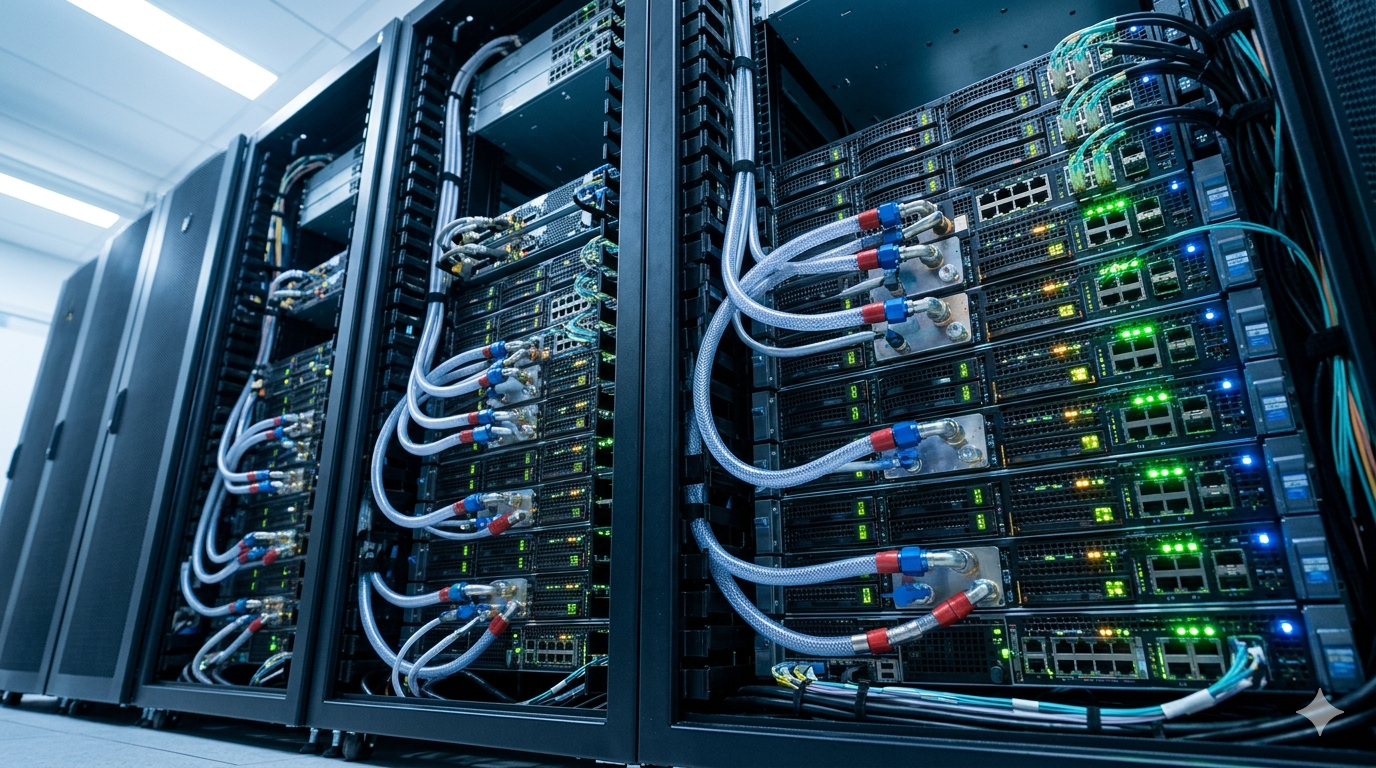
The sequence of decisions in data center design used to follow a predictable order: site, power, cooling, structure, hardware. Each layer informed the next, and the building itself served as a fixed container into which technology was later fitted. That sequence has broken down. The arrival of GPU-dense AI workloads has inverted the design logic entirely. Today, rack density is not a consequence of hardware selection. It is the starting constraint that shapes everything else.

A conventional enterprise data center rack runs at 5 to 10 kilowatts. A hyperscale cloud rack from five years ago might reach 15 to 20 kilowatts. A current-generation Blackwell GPU rack operates at 120 kilowatts and above. The Vera Rubin generation, arriving in the second half of 2026, targets rack densities that push further still. Consequently, the building, the power infrastructure, the cooling architecture, and the structural loading specifications all must be designed around that starting number. Without that alignment, the facility cannot physically operate the hardware it was built to house.
What Density Changes Structurally
The floor loading requirements for liquid-cooled AI racks at 120 kilowatts and above exceed the specifications of conventional raised-floor construction. Standard data center floors support loads of around 10 to 12 kilonewtons per square metre. However, fully populated high-density GPU racks with direct-to-chip cooling infrastructure can approach or exceed those limits depending on configuration. As a result, operators retrofitting existing facilities for AI workloads routinely discover that floor reinforcement is required before deployment can begin, adding cost and time to the project plan.
Power delivery scales proportionally with density. A 10-rack AI cluster at 120 kilowatts per rack demands 1.2 megawatts of delivered power for compute alone, before cooling overhead is added. Routing that power from the substation to the rack row requires bus duct sizing, transformer specifications, and UPS configurations that differ fundamentally from conventional power distribution. ASUS’s advanced liquid cooling architecture for next-generation AI racks shows how hardware vendors now design around density constraints that facility operators must match on the infrastructure side.

Why Cooling Follows Density, Not the Other Way Around
The cooling decision in a high-density AI facility is not a choice between air and liquid. At 120 kilowatts per rack and above, air cooling simply cannot work. The physics of heat removal at that density demand direct-to-chip liquid cooling at minimum, with rear-door heat exchangers or immersion as alternatives for specific configurations. Therefore, cooling system selection flows directly from the rack density target, not from operator preference or vendor recommendation.
That dependency means cooling infrastructure must be specified before the building layout is finalised. The pipe routing, leak detection systems, manifold positions, and structural penetrations for coolant distribution all need incorporation into the facility design from the start. Moreover, retrofitting cooling infrastructure into a building not designed for it costs significantly more than building it in from the beginning. In some cases, it is physically impractical at the densities that current AI hardware demands.
The Structural and Electrical Rethink Most Operators Underestimated
The structural and electrical implications of high-density AI deployment compound each other in ways that conventional engineering did not anticipate. Power delivery at 120 kilowatts per rack generates heat and electromagnetic interference that require dedicated containment design. Furthermore, cable management systems built for lower-density environments cannot handle the conductor sizes that high-current GPU rack distribution requires. Busway systems, overhead cable trays, and floor cutouts all need redesigning from scratch rather than adapting from existing specifications.
The electrical protection systems follow the same logic. Circuit breakers, PDUs, and automatic transfer switches sized for conventional rack densities are undersized for AI GPU clusters. Consequently, operators who deploy high-density hardware into infrastructure built for conventional loads risk nuisance tripping, thermal runaway in distribution equipment, and protection coordination failures that can take an entire zone offline. These are not theoretical risks. They are operational failures that operators who moved fast on hardware deployment without infrastructure validation have already experienced in production.
The Site Selection Implication
The density-first design logic changes where data centers can be built, not just how. High-density AI facilities require power delivery infrastructure that many available sites cannot support without significant grid upgrades. Additionally, they require structural specifications that older industrial buildings cannot meet without expensive reinforcement. They also require cooling water or coolant supply at volumes that constrain viable locations to areas with adequate water access or district cooling infrastructure.
Operators selecting sites for AI data center development must therefore evaluate density compatibility as the primary filter, ahead of location, cost, and connectivity. A site that cannot support 120 kilowatts per rack today and 200 kilowatts per rack in three years is not a viable AI data center site regardless of its other attributes. The operators who understood this two years ago are building facilities that will remain relevant when the next hardware generation arrives. The ones who did not are discovering the constraint at the most expensive point in the project lifecycle.











