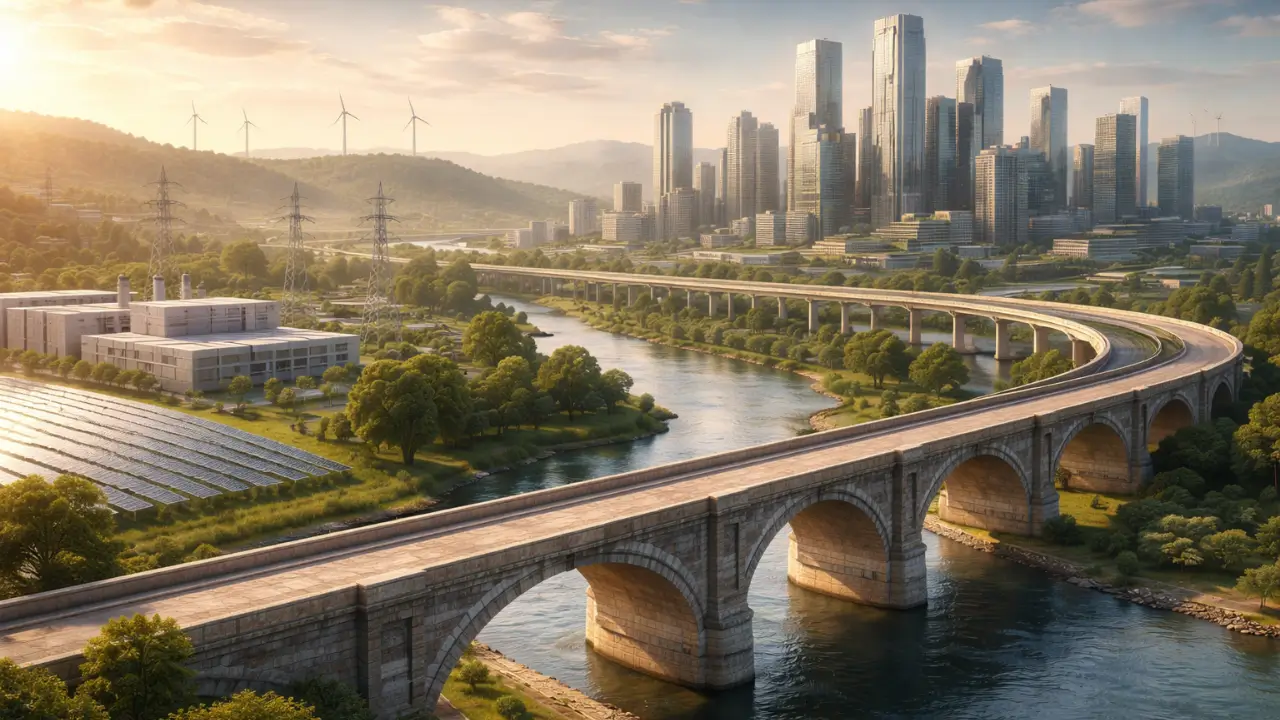
A city wakes before its people do, and beneath the silence its systems begin their quiet work. Steel contracts in the morning cool, substations regulate voltage with mechanical discipline, and server halls balance thermal loads without applause. No one notices the choreography because endurance rarely demands attention. Yet the true measure of intelligence in design lies not in spectacle, but in survival. Permanence does not shout innovation; it practices restraint through structure and foresight. In an age obsessed with iteration, the most radical act may be to build something that refuses to expire.
The Age of Acceleration vs. the Discipline of Durability
Digital culture has normalized velocity as virtue, compressing planning horizons into quarterly ambitions and rapid deployment cycles. However, physical systems obey a different clock that measures consequences in decades rather than download speeds. Bridges, grids, and transport corridors carry cumulative stress that punishes impulsive construction and rewards patient modeling. When design surrenders to haste, maintenance burdens multiply and resilience erodes beneath surface efficiency. Speed becomes a liability when it overrides lifecycle logic and material science. Therefore, durability demands an intellectual discipline that resists the seduction of immediacy.
Long-term thinking once defined civic ambition, shaping aqueducts, rail networks, and public institutions that outlived their founders. Today’s acceleration culture reframes infrastructure as a product release rather than a generational covenant. Consequently, design teams often prioritize launch dates over load paths and redundancy over decades of stress cycles. Structural fatigue does not negotiate with marketing timelines, nor does corrosion respect funding windows. Systems that ignore temporal depth accumulate invisible vulnerabilities that surface during a crisis. The discipline of durability restores time as a core design parameter rather than a constraint to bypass.
Infrastructure as Legacy, Not Experiment
Every road embedded in soil and every transmission line crossing terrain represents accumulated capital that shapes future possibility. Infrastructure anchors economic continuity, social mobility, and spatial coherence in ways no experimental prototype can replicate. Unlike consumer technology, civic systems resist beta testing at population scale. Therefore, their architecture must anticipate demographic shifts, resource variability, and cultural transformation. Legacy thinking frames infrastructure as inheritance rather than iteration. Such framing elevates foresight above novelty and stability above spectacle.
Market cycles rise and recede, yet concrete foundations and fiber backbones remain fixed in geography and expectation. Short-term experimentation risks embedding fragility into landscapes that demand reliability. Consequently, infrastructure design must integrate scenario planning, stress simulation, and adaptive margin into its blueprint. Generational assets require calibration against uncertainty rather than optimism alone. A bridge built for legacy considers both current loads and unforeseen expansion. This mindset transforms construction into stewardship rather than transaction.
The Shift from Build-Fast to Build-Adaptable
Adaptability defines permanence more accurately than rigidity ever could. Modular systems allow incremental expansion without structural compromise or operational disruption. Retrofit potential extends functional life while absorbing technological evolution. Consequently, design logic shifts from fixed endpoints toward expandable frameworks. Flexibility becomes engineered into joints, interfaces, and service corridors. Build-adaptable thinking transforms permanence into a living capacity rather than static endurance.
Future-proofed design recognizes that certainty rarely accompanies long timelines. Electrical rooms include spatial buffers, data halls incorporate scalable cooling distribution, and transit corridors preserve right-of-way for expansion. Such foresight reduces demolition cycles and conserves embodied energy. Systems engineered for modification invite recalibration instead of replacement. Therefore, adaptability secures continuity without surrendering innovation. Permanence thrives when structures anticipate revision without structural trauma.
Materials That Age with Dignity
Material intelligence determines whether time becomes an ally or adversary. Stone, treated timber, advanced composites, and high-performance concrete exhibit predictable aging curves that inform maintenance strategy. Conversely, low-grade substitutes degrade unpredictably, amplifying lifecycle costs and structural risk. Design that values dignity in aging selects components based on endurance rather than price compression. Weathering then narrates continuity instead of decline. Material choice thus becomes a philosophical commitment as much as a technical specification.
Durable materials interact with climate, load, and usage in measurable patterns. Engineers analyze corrosion rates, thermal expansion coefficients, and fatigue thresholds to forecast performance horizons. Consequently, permanence emerges from empirical modeling rather than romantic aspiration. Intelligent detailing prevents moisture ingress, distributes stress evenly, and simplifies inspection routines. Structures that age with dignity maintain integrity without constant intervention. Through disciplined material selection, time transforms from threat into validation.
Designing Digital Ecosystems for Longevity
Digital architecture confronts obsolescence at a pace unmatched by physical infrastructure. Software frameworks evolve rapidly, and hardware lifecycles compress under competitive pressure. Yet digital systems underpin financial networks, healthcare platforms, and energy management tools that demand continuity. Therefore, architects must prioritize interoperability, open standards, and scalable protocols. Longevity in digital ecosystems arises from modular codebases and backward-compatible interfaces. Such strategies enable adaptation without systemic collapse.
Cloud architecture illustrates how permanence intersects with flexibility. Distributed systems balance redundancy with latency management while maintaining data integrity across geographies. Version control, containerization, and microservices architecture reduce dependency on monolithic structures. Consequently, updates occur without destabilizing the entire ecosystem. Digital permanence depends on design patterns that accommodate iteration without erasure. Enduring platforms cultivate resilience through structured evolution rather than perpetual reinvention.
The Cost of Disposable Architecture
Disposable architecture masquerades as efficiency while embedding hidden liabilities. Short lifecycle buildings generate demolition waste, squander embodied carbon, and burden municipal systems with recurring reconstruction. Operational volatility increases when infrastructure requires frequent overhaul. Consequently, environmental externalities accumulate beneath superficial cost savings. Disposable logic fragments continuity and destabilizes resource planning. True efficiency considers lifecycle impact rather than upfront expenditure alone.
Commercial real estate often illustrates this cycle of premature obsolescence. Structures designed for narrow specifications struggle to accommodate evolving occupancy needs. Retrofitting then becomes economically prohibitive, prompting demolition and replacement. Such patterns inflate material extraction and intensify landfill demand. Therefore, permanence reduces environmental strain through extended utility and adaptive reuse. Sustainability aligns naturally with durability when design resists disposability.
Governance, Policy, and the Time Horizon Problem
Political calendars and quarterly reporting cycles frequently compress infrastructure vision into short windows. Long-term planning competes with immediate visibility and measurable milestones. Consequently, funding frameworks may undervalue maintenance and resilience investments that lack immediate recognition. The time horizon problem distorts decision-making by privileging immediacy over endurance. Institutional reform can extend planning cycles to align with infrastructural lifespans. Governance that embraces permanence recalibrates accountability toward future stability.
Policy instruments such as lifecycle budgeting and resilience mandates can embed durability into statutory frameworks. Transparent performance metrics encourage sustained oversight beyond electoral cycles. When governance integrates scenario analysis and stress testing, infrastructure planning matures beyond reactive repair. Therefore, permanence becomes a systemic objective rather than discretionary preference. Institutional continuity fosters technical continuity across generations. Time then transforms from political constraint into structural ally.
Climate Reality and the Case for Endurance
Climate volatility intensifies thermal extremes, precipitation variability, and sea-level rise across geographies. Infrastructure designed for historical baselines now confronts unprecedented stress patterns. Consequently, endurance demands predictive modeling that incorporates climate projections into structural parameters. Flood defenses require adaptive elevation strategies, and cooling systems must account for rising ambient temperatures. Designing for endurance transforms resilience into measurable engineering criteria. Climate-aware permanence protects communities without perpetual reconstruction.
Heat waves, intensified storms, and resource scarcity challenge both physical and digital systems simultaneously. Data centers, transport corridors, and water networks share exposure to environmental volatility. Therefore, integrated resilience planning reduces systemic vulnerability through cross-sector coordination. Endurance depends on redundancy, load diversification, and environmental buffering. Infrastructure that absorbs shock without cascading failure embodies strategic foresight. Climate reality thus elevates permanence from aspiration to necessity.
Designing for Maintenance, Not Just Completion
Ribbon-cutting ceremonies celebrate completion, yet true permanence begins after inauguration. Maintenance culture embeds inspection, calibration, and repair into operational rhythm. Consequently, design must prioritize accessibility, replaceable components, and diagnostic transparency. Service corridors, modular panels, and monitoring systems reduce intervention cost over time. Infrastructure conceived for maintenance extends life without disproportionate expense. Completion marks initiation rather than culmination.
Lifecycle stewardship integrates predictive analytics and routine evaluation into system governance. Sensors track structural strain, thermal fluctuation, and performance deviation in real time. Preventive maintenance prevents minor anomalies from escalating into systemic failure. Therefore, permanence relies on vigilance rather than passive durability. Maintenance culture transforms aging into managed evolution. Design that anticipates care secures longevity beyond initial intent.
Cultural Memory and the Psychology of Long-Term Thinking
Societies that build for permanence cultivate narratives of stewardship and continuity. Cultural memory reinforces respect for enduring structures and shared responsibility for preservation. Consequently, design decisions reflect collective identity rather than transient preference. Educational frameworks that emphasize intergenerational ethics strengthen commitment to sustained infrastructure. Permanence emerges from psychological orientation as much as engineering precision. Collective patience becomes a strategic asset.
Long-term thinking reframes progress as cumulative rather than consumptive. Communities that honor legacy structures internalize maintenance as civic virtue. Such orientation tempers impulsive redevelopment with measured adaptation. Therefore, infrastructure becomes a living archive of societal intent. Cultural continuity stabilizes architectural ambition across generations. Permanence ultimately reflects disciplined imagination anchored in responsibility.
Permanence as the Ultimate Sustainability Strategy
Sustainability discourse often emphasizes efficiency, yet permanence extends that conversation into temporal depth. Systems designed for longevity reduce extraction cycles and minimize waste accumulation. Consequently, resource intensity declines when replacement frequency diminishes. Enduring architecture absorbs technological evolution without structural erasure. Permanence integrates humility into design by acknowledging limits and anticipating change. In an era captivated by speed, endurance defines the boldest expression of innovation.