
The physical limits of electricity infrastructure rarely enter conversations about artificial intelligence, yet they increasingly dictate where and how compute gets built at scale. Engineers once treated power as a predictable input, sourced reliably from centralized grids that evolved around industrial demand patterns. That assumption has fractured under the weight of AI workloads that behave nothing like traditional enterprise consumption profiles. Massive training clusters create sudden, sustained peaks that utilities never modeled into their long-term capacity forecasts. As a result, infrastructure planners now confront a reality where access to electrons matters more than proximity to users or fiber routes. The conversation has shifted from optimizing latency to securing power certainty, marking a fundamental reset in how digital infrastructure gets deployed.

The mismatch between grid readiness and AI demand has forced operators to rethink the hierarchy of constraints that define site viability. Historically, land availability, tax incentives, and network connectivity guided decisions, with energy procurement treated as a downstream exercise. That sequence no longer holds because power availability now dictates whether a project can move forward at all. Developers increasingly encounter multi-year interconnection delays that stall projects before ground breaks. Utilities struggle to accelerate upgrades because transmission expansion requires regulatory alignment and capital deployment across fragmented jurisdictions. This bottleneck has triggered a wave of innovation that effectively routes around the grid rather than waiting for it to evolve.
The Grid Bottleneck Nobody Modeled for AI Scale
Electric grids were engineered around predictable load curves driven by residential cycles and industrial baselines, not the volatile intensity of AI compute clusters. Training models demand continuous high-density power over extended durations, eliminating the diversity factors utilities rely on to balance supply and demand. That shift compresses load variability into sustained peaks, which strain both generation capacity and transmission infrastructure. Grid planners did not anticipate thousands of megawatts clustering within tight geographic zones tied to data center ecosystems. Consequently, utilities now face localized congestion that cannot be resolved through incremental upgrades alone. This structural gap exposes the limitations of planning frameworks built on historical consumption rather than forward-looking computational demand.
The interconnection queue has become the most visible symptom of this planning mismatch, with projects waiting years for approval and capacity allocation. Developers often secure land and financing before realizing that grid access timelines extend far beyond deployment schedules. That delay undermines capital efficiency and introduces uncertainty that conflicts with the rapid iteration cycles of AI infrastructure. In many cases, utilities require significant transmission upgrades before approving new connections, which further extends timelines. These constraints effectively cap growth in regions that once attracted hyperscale expansion due to favorable economics. Therefore, the industry has begun exploring alternatives that bypass these bottlenecks entirely.

Private Power Is Becoming the New Default, Not Backup
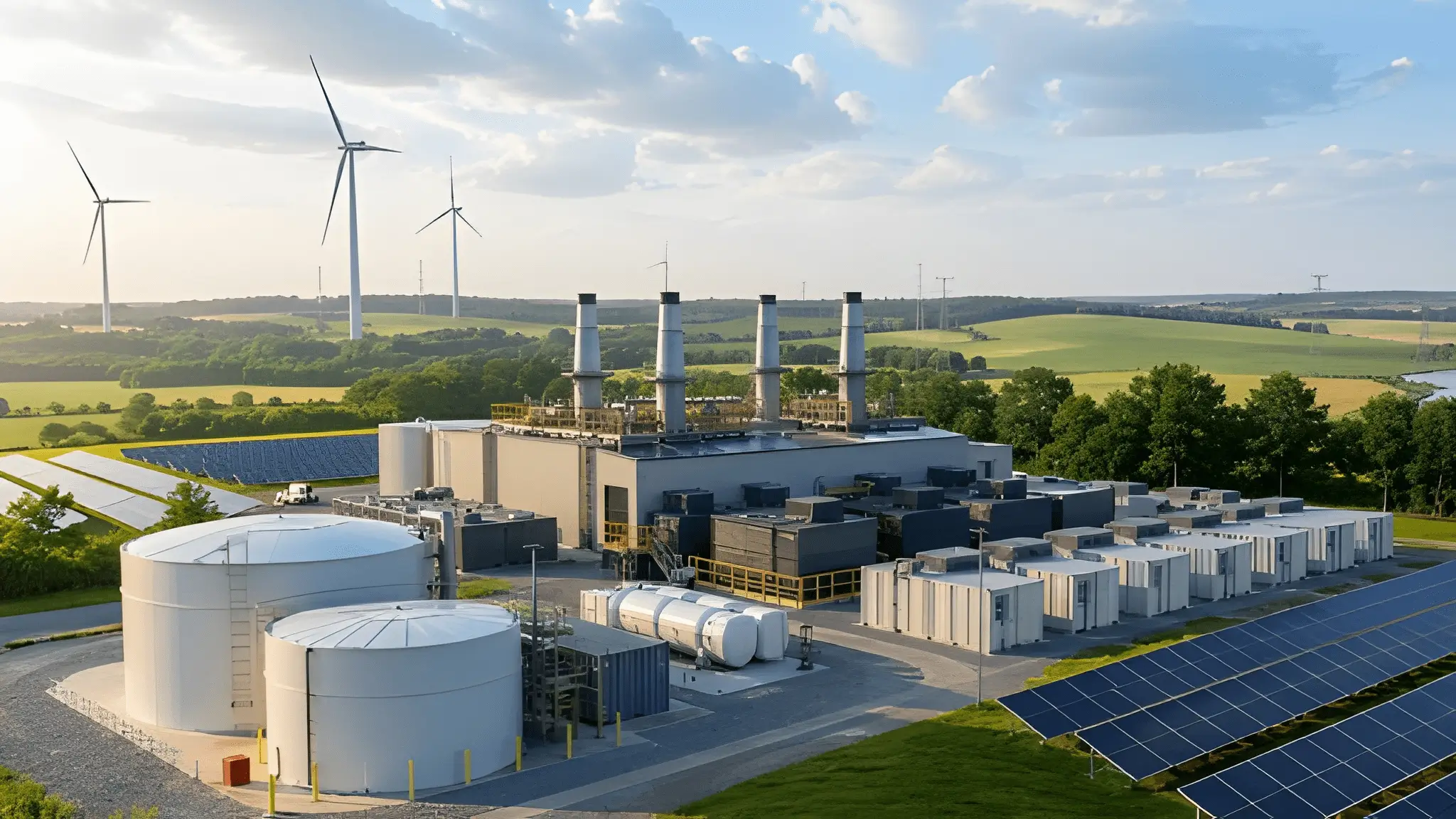
On-site generation has historically functioned as a redundancy layer, activated only during outages to maintain uptime commitments. That paradigm has shifted as operators recognize that relying solely on grid supply introduces unacceptable risk at AI scale. Private power systems now serve as primary energy sources, delivering consistent output independent of external constraints. Gas turbines, fuel cells, and hybrid renewable systems increasingly anchor new data center designs. This evolution grants operators direct control over energy availability, reducing dependence on utility timelines and pricing volatility. The shift transforms energy from a procurement function into a core component of infrastructure strategy.
Developers are also rethinking capital allocation as private generation moves into the critical path of deployment. Investing in on-site power requires higher upfront expenditure, yet it eliminates delays that can erode project value over time. Operators now evaluate energy infrastructure alongside compute hardware rather than as a separate layer. This integration enables tighter synchronization between capacity planning and workload deployment. However, it also introduces operational complexity that requires expertise in power systems traditionally outside the scope of data center teams. Meanwhile, regulatory frameworks continue to evolve as private generation scales beyond backup use cases into primary supply roles.
Microgrids Are Shifting Control From Utilities to Site-Level Dispatch
Microgrids represent a structural shift in how energy flows get managed within infrastructure environments. Instead of drawing power passively from centralized grids, facilities now orchestrate generation, storage, and consumption in real time. This localized control enables operators to optimize efficiency while maintaining resilience against external disruptions. Energy storage systems play a crucial role by smoothing fluctuations and enabling load balancing within the microgrid. As a result, facilities gain the ability to operate independently when grid conditions become unstable or constrained. This transition effectively redistributes control from utilities to site-level operators who manage their own energy ecosystems.
The rise of microgrids also introduces new operational models that align closely with the dynamic nature of AI workloads. Facilities can adjust power distribution based on compute demand, ensuring that energy flows match processing intensity. This capability reduces waste and enhances overall system efficiency. In specific deployments, microgrids can enable participation in energy markets by allowing facilities to export excess power or adjust consumption during peak periods where regulatory frameworks support such activity. These capabilities create additional revenue streams while strengthening resilience. However, implementing such systems requires sophisticated control software and integration across multiple energy assets.
Co-Located Generation Is Redefining Site Selection Logic
Site selection criteria have undergone a fundamental transformation as energy availability overtakes traditional considerations. Developers increasingly prioritize proximity to fuel sources, renewable generation sites, and transmission corridors over network latency advantages. This shift reflects the reality that compute capacity cannot scale without guaranteed access to power. Regions rich in natural gas or renewable resources now attract infrastructure investment even if they lack established connectivity hubs. As a result, the geographic distribution of data centers is becoming more diverse and less concentrated in traditional clusters. This trend signals a departure from network-centric planning toward energy-centric deployment strategies.
The integration of co-located generation also influences how projects get financed and structured. Investors are beginning to evaluate energy assets and compute infrastructure in closer coordination rather than treating them as entirely separate components. This approach aligns incentives across stakeholders and ensures that power availability supports long-term operational goals. In addition, co-location reduces transmission losses and enhances efficiency by minimizing the distance between generation and consumption. These benefits strengthen the economic case for integrated energy solutions. However, they also require coordination across industries that have historically operated independently.
AI Infrastructure Is Being Designed to Tolerate Grid Absence
Design philosophies for AI infrastructure increasingly assume that grid connectivity may not always be available or sufficient. Engineers now build systems that maintain functionality under constrained or intermittent power conditions. This approach prioritizes resilience by incorporating redundancy at multiple levels, including energy supply and workload distribution. Modular architectures allow facilities to scale incrementally while maintaining operational stability. These designs also enable rapid deployment in regions where grid infrastructure cannot support immediate expansion. Consequently, infrastructure becomes more adaptable and less dependent on centralized systems.
Workload management strategies have evolved alongside these architectural changes to ensure efficient operation under varying power conditions. Systems can dynamically shift workloads across locations based on energy availability and cost considerations. This flexibility reduces the impact of localized constraints and enhances overall system performance. Furthermore, advances in cooling and hardware efficiency reduce power requirements without compromising computational output. These innovations collectively support a model where infrastructure operates effectively even in the absence of continuous grid support.
The Future of Digital Infrastructure Is Grid-Optional
The trajectory of AI infrastructure development points toward a model where the grid serves as one of several energy inputs rather than the primary foundation. Operators increasingly integrate multiple power sources to create flexible and resilient systems. This approach reduces exposure to external constraints while enabling faster deployment cycles. Infrastructure planning now reflects a broader understanding of energy as a strategic variable rather than a fixed input. As a result, the industry is redefining how digital capacity scales in response to demand.
The shift toward grid-optional infrastructure also reshapes the relationship between utilities and large-scale consumers. Utilities must adapt to a landscape where demand becomes more decentralized and less predictable. At the same time, operators gain greater autonomy over their energy strategies. This evolution introduces both challenges and opportunities for collaboration across sectors. The outcome will depend on how effectively stakeholders align incentives and integrate emerging technologies. Ultimately, the future of compute infrastructure will depend on its ability to operate independently while remaining interoperable with existing systems.











