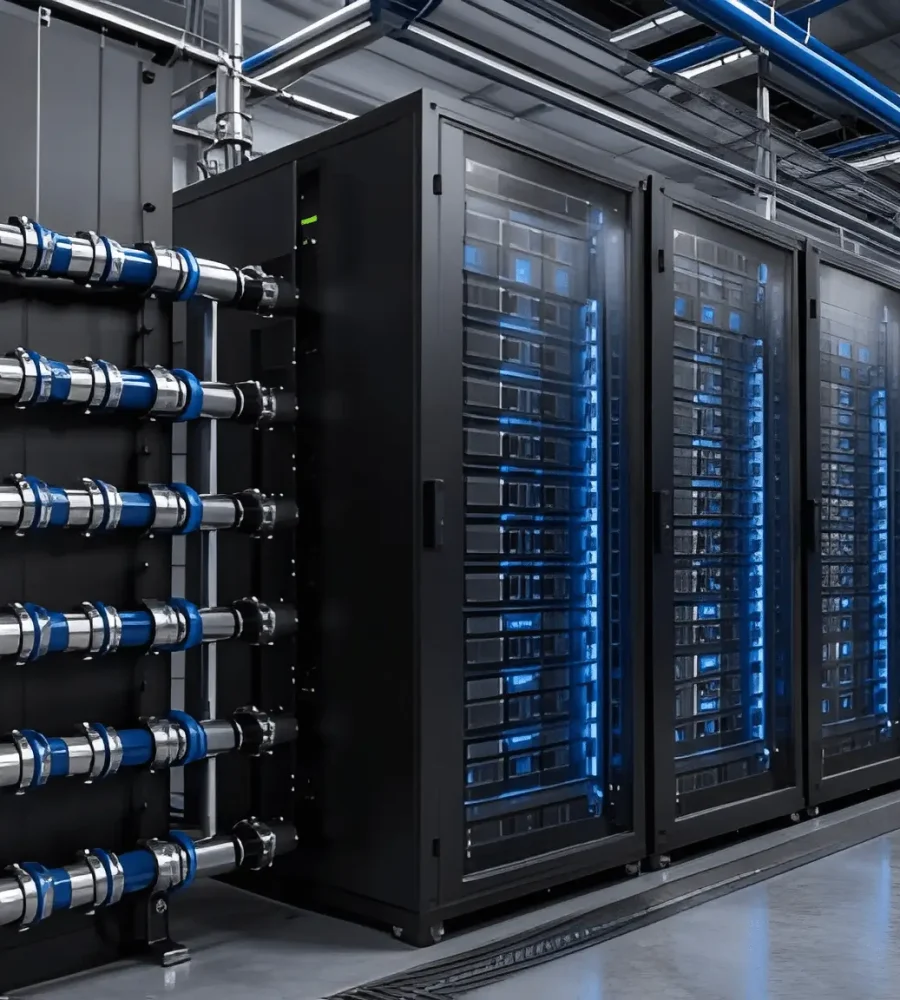

A server rack hums in a quiet room, and inside its metal enclosure billions of calculations unfold in silence. What appears as seamless digital interaction on a screen carries an invisible computational wake that stretches across data centers, grids, and silicon supply chains. The evolution of artificial intelligence has transformed abstract mathematics into physical infrastructure that consumes measurable energy. Each new breakthrough in language modeling, vision recognition, and generative capability deepens that infrastructural dependence. Intelligence no longer exists only in code, because it materializes in processors, cooling systems, and power flows. The story unfolding here is ultimately about the energy footprint of intelligence and how it reshapes the foundations of modern computation. Intelligence no longer exists only in code, because it materializes in processors, cooling systems, and power flows.
From Model Scaling to Computational Appetite
Early machine learning models relied on carefully tuned architectures that balanced precision with efficiency. As neural networks expanded in depth and width, scale itself became the dominant driver of performance gains. Research communities embraced larger parameter counts, broader datasets, and longer training cycles as reliable paths toward improved capability. Each additional layer increased not only representational power but also memory requirements and processing intensity. Training runs stretched across clusters of accelerators that operated continuously for extended durations. Intelligence began to reflect computational abundance rather than algorithmic minimalism.
As scaling laws demonstrated predictable improvements with larger models, the industry internalized growth as strategy. Parameter counts surged from millions to billions and then to trillions within a single decade. Computational appetite expanded accordingly, and power consumption followed that trajectory. Data movement within and between processors became as critical as arithmetic operations themselves. Consequently, network bandwidth and storage subsystems grew alongside core compute. Intelligence acquired a physical cost structure measured in kilowatt-hours rather than lines of code.
Moreover, inference workloads multiplied once trained models reached public deployment. Each query, prompt, or prediction triggered cascades of matrix multiplications across specialized chips. Latency requirements demanded constant availability, which prevented idle shutdown cycles. Therefore, compute intensity shifted from episodic training bursts to continuous operational demand. The architecture of intelligence started to resemble utility infrastructure that required reliability and redundancy. Computational appetite became an ongoing condition rather than a temporary phase.
Architecting Intelligence for Efficiency
As computational growth accelerated, efficiency moved from peripheral concern to architectural imperative. Researchers began revisiting pruning techniques that removed redundant weights without sacrificing model accuracy. Quantization strategies compressed numerical precision to reduce memory and processing load. Distillation methods transferred knowledge from large models into lighter variants that preserved functional capability. Architectural innovations such as sparse attention mechanisms introduced structured reduction of unnecessary computation. Efficiency transformed into a design philosophy embedded at the model conception stage.
Furthermore, model compression evolved beyond storage savings and began influencing runtime energy characteristics. Structured sparsity allowed hardware to skip inactive operations, which lowered effective computational throughput requirements. Adaptive inference pathways enabled systems to allocate more resources only when task complexity demanded deeper reasoning. Therefore, intelligence gained elasticity that aligned resource use with contextual necessity. Design decisions increasingly reflected awareness of hardware constraints and deployment realities. Efficiency ceased to represent compromise and instead defined sophistication.
Algorithmic refinement also reshaped training protocols by introducing curriculum learning and dynamic batching strategies. These techniques reduced unnecessary gradient updates while preserving convergence quality. Memory optimization frameworks reorganized tensor allocation to minimize redundant data replication. Consequently, training cycles shortened and hardware utilization improved. Architectural restraint began signaling maturity rather than limitation. Intelligence acquired discipline through deliberate constraint.
Training vs. Inference: The Hidden Lifecycle of AI Systems
Public attention often centers on the spectacle of large training runs, yet the lifecycle of AI systems extends far beyond initial model creation. Continuous retraining updates parameters to reflect new data distributions and evolving user interactions. Version control frameworks maintain multiple model iterations to support testing and rollback capabilities. Each of these processes demands additional computational cycles that accumulate over time. Deployment at scale multiplies inference requests across global networks of servers. Therefore, operational energy footprints frequently exceed the cost of the original training event.
Inference workloads introduce their own architectural pressures because they prioritize responsiveness and throughput. Systems must respond within milliseconds while handling unpredictable traffic patterns. To maintain performance, infrastructure provisions surplus capacity that absorbs peak demand. This redundancy ensures reliability but increases baseline power consumption. Moreover, geographically distributed deployments replicate model instances across regions to reduce latency. The lifecycle of intelligence thus resembles a persistent energy commitment rather than a single computational milestone.
Lifecycle analysis reveals that optimization efforts cannot focus solely on training efficiency. Monitoring tools now track real-time utilization patterns to identify idle compute segments. Model serving frameworks implement batching and caching strategies to consolidate similar requests. Hardware acceleration integrates closely with software orchestration to prevent resource fragmentation. Consequently, system design recognizes inference as a dominant contributor to long-term computational demand. Intelligence evolves through sustained operation rather than isolated experimentation.
Specialized Silicon and the Evolution of AI Compute
The growth of neural networks strained the capabilities of general-purpose processors. Graphics processing units provided parallelism suited to matrix operations, and they quickly became foundational to deep learning workloads. Over time, purpose-built accelerators emerged to optimize tensor computations with greater efficiency. These chips integrated high-bandwidth memory and specialized interconnects to reduce data transfer latency. Hardware-software co-design gained prominence as algorithms adapted to silicon constraints. Intelligence began to mirror the architecture of the chips that executed it.
Application-specific integrated circuits introduced further specialization by tailoring logic paths to neural network primitives. Field-programmable gate arrays offered configurable acceleration for targeted inference tasks. Each hardware innovation pursued improved performance per watt rather than raw throughput alone. Designers optimized instruction sets for reduced precision arithmetic that aligned with quantized models. Consequently, silicon evolved in tandem with machine learning theory. Intelligence manifested as a negotiation between computational ambition and physical limitation.
Hardware innovation also addressed memory bottlenecks that constrained model scalability. Emerging packaging technologies brought compute cores closer to memory stacks, which reduced energy spent on data movement. Interconnect architectures supported distributed training across clusters with lower synchronization overhead. These advancements reshaped how models partitioned tasks across devices. Therefore, compute evolution reflected both architectural creativity and energy awareness. Specialized silicon redefined the material basis of intelligence.
Distributed Intelligence and the Rise of Edge Learning
Centralized data centers once dominated machine learning workflows. Edge computing introduced a shift by relocating inference closer to users and devices. Smartphones, sensors, and embedded systems began hosting compact neural networks tailored to localized tasks. This redistribution reduced latency and alleviated bandwidth pressure on centralized infrastructure. Energy consumption migrated from singular hubs to distributed nodes across vast networks. Intelligence dispersed across physical space rather than remaining confined to hyperscale clusters.
Edge learning frameworks enabled on-device adaptation through federated approaches that preserved privacy. Devices trained local models and shared aggregated updates without transmitting raw data. This paradigm reduced central compute burden while introducing new coordination challenges. Energy usage shifted into millions of smaller increments that collectively shaped global demand. Consequently, distributed intelligence altered not only performance characteristics but also the geography of power consumption. The computational landscape grew more granular and interconnected.
Moreover, edge deployment encouraged development of lightweight architectures optimized for constrained environments. Model compression, low-precision arithmetic, and hardware-aware design became essential for battery-powered devices. These constraints fostered creativity that balanced capability with efficiency. Edge systems illustrated how architectural restraint could coexist with functional richness. Intelligence adapted to its environment rather than overwhelming it. Distributed learning reframed efficiency as contextual alignment.
Sustainability as a Machine Learning Objective
Environmental considerations gradually entered mainstream machine learning discourse as computational demand intensified. Researchers began measuring carbon emissions associated with training and deployment cycles. Benchmarking frameworks incorporated energy metrics alongside accuracy and latency. This integration signaled a shift from performance-centric evaluation toward multidimensional assessment. Optimization objectives expanded to include resource stewardship. Intelligence acquired an ecological dimension within its design criteria.
Model development strategies responded by prioritizing smaller architectures that achieved competitive performance through structural ingenuity. Transfer learning reduced redundant training by leveraging pretrained representations. Hyperparameter search processes adopted more sample-efficient algorithms to limit experimental compute overhead. These practices curtailed unnecessary cycles while sustaining innovation. Sustainability evolved from abstract principle to operational guideline. Machine learning research began acknowledging physical externalities embedded in digital systems.
Institutional frameworks also encouraged transparency around computational expenditure. Publications increasingly disclosed training duration, hardware configuration, and estimated energy consumption. Shared datasets enabled reproducibility that minimized redundant experimentation. Tooling ecosystems emerged to monitor real-time energy use during model execution. Consequently, sustainability entered both academic and applied workflows as measurable variable. Intelligence started confronting its own material consequences.
Intelligence with Constraint
The arc of artificial intelligence has traced a path from elegant algorithms to expansive infrastructure that spans continents. Computational growth delivered remarkable capabilities, yet it also anchored intelligence firmly within physical systems that draw continuous power. Efficiency innovations, lifecycle awareness, specialized silicon, distributed learning, and sustainability metrics collectively reshape this trajectory. The next chapter will not revolve solely around larger models or deeper networks. Instead, progress will hinge on how thoughtfully systems manage their computational demands within finite energy ecosystems. Intelligence will mature not through excess, but through deliberate architectural restraint.