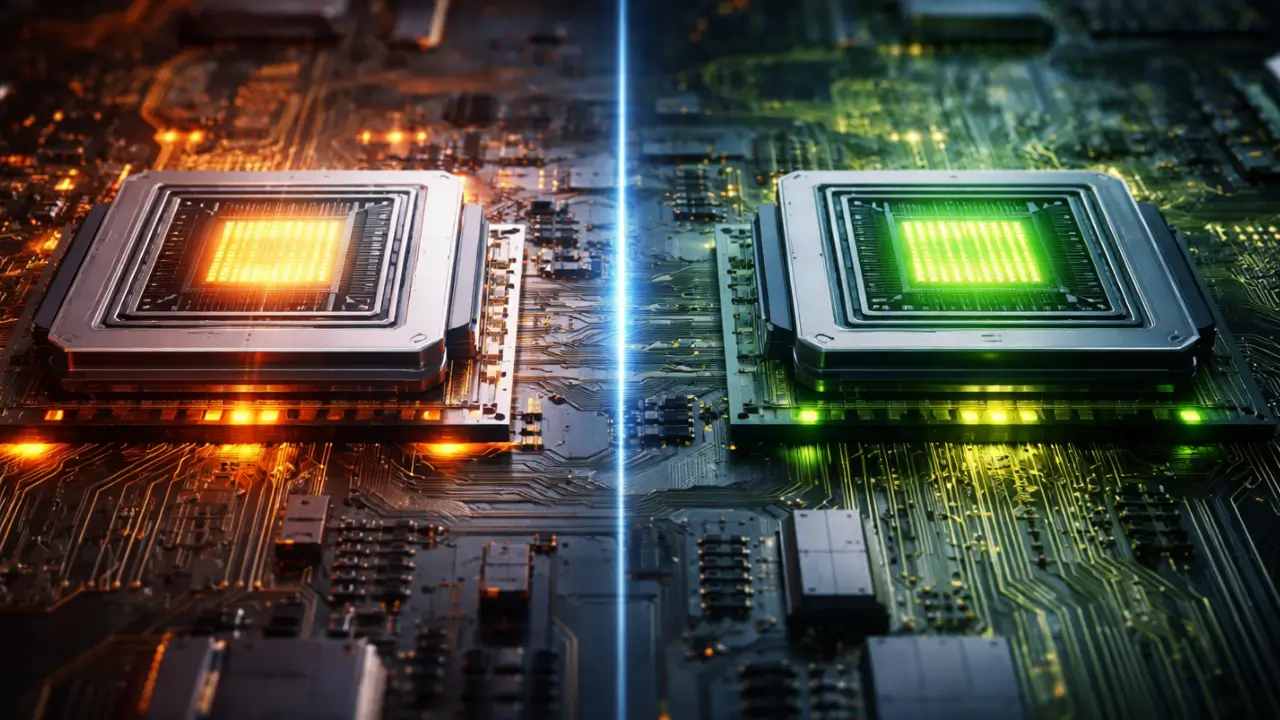
Tesla’s renewed focus on custom AI silicon reflects a structural shift in how the company approaches compute, autonomy, and large-scale machine intelligence. Rather than treating AI hardware as a supporting component, Tesla is positioning silicon design as a foundational layer across vehicles, robotics, and data infrastructure. NVIDIA’s Blackwell platform currently defines the frontier of AI acceleration, yet Tesla’s AI5 signals a deliberate attempt to reduce dependency on external compute architectures. The competitive question is no longer limited to benchmark performance but instead extends to system-level integration, scalability, and economic sustainability. Industry stakeholders increasingly evaluate AI platforms based on operational coherence rather than isolated chip specifications. The emergence of Tesla’s AI5 therefore invites a deeper examination of how custom silicon competes with established AI platforms in real-world environments.
Tesla’s Return to Custom AI Silicon
Tesla has confirmed that its Dojo supercomputer initiative has resumed after a period of strategic reassessment, with the latest iteration referred to internally as Dojo3. The company has indicated that progress in its in-house AI chip development contributed to the decision to restart the project. Tesla previously relied heavily on NVIDIA hardware for AI training workloads, which shaped its earlier infrastructure strategy. Growing demands from autonomous driving systems, robotics development, and model training have influenced Tesla’s renewed emphasis on proprietary silicon. The company’s roadmap now includes multiple generations of in-house AI chips, beginning with AI5 and extending to future iterations. This shift underscores Tesla’s intent to integrate compute capabilities more tightly with its AI-driven products and internal systems.
Tesla has publicly stated that AI5 represents a new stage in its custom silicon development, building on prior in-house processors used in vehicles and AI systems. Elon Musk has indicated that the company aims to improve performance relative to its previous chips and to achieve competitiveness with existing NVIDIA architectures. However, no independent benchmarks or third-party validation currently confirm performance equivalence between AI5 and NVIDIA’s Hopper or Blackwell platforms. Tesla has not released detailed technical specifications or standardized benchmark results for AI5, which limits direct architectural comparisons. The company’s disclosures therefore reflect design objectives rather than verified performance outcomes. This distinction remains critical when evaluating Tesla’s claims within the broader AI hardware landscape.
Cost Strategy and Vertical Integration
Tesla has not publicly disclosed pricing details for its AI5 chip or provided verified comparisons with NVIDIA products. Elon Musk has stated that Tesla seeks to reduce AI compute costs through in-house chip development and tighter integration between hardware and software. No independent data currently confirms the cost structure or comparative pricing of AI5 relative to NVIDIA’s platforms. Tesla continues to rely on external suppliers for fabrication, which aligns with standard practices in advanced semiconductor manufacturing. The company’s approach reflects an effort to balance internal design control with external production capabilities. Consequently, Tesla’s cost strategy remains a stated objective rather than a documented outcome.
Tesla has indicated that Dojo3 will incorporate AI5-based systems to support large-scale AI training workloads. The company has also stated that its AI chips are intended for use across vehicles, robotics, and data center environments. Public disclosures confirm that Tesla continues to use external hardware partners alongside its internal chip development efforts. While Tesla’s roadmap suggests greater integration between compute environments, the company has not formally defined a unified architecture across all operational domains. The technical scope of Dojo3 therefore remains partially disclosed, with confirmed elements focused on AI training infrastructure. This measured approach reflects the complexity of integrating custom silicon across diverse AI applications.
NVIDIA Blackwell as an Industry Reference Point
NVIDIA’s Blackwell platform represents a major advancement in AI acceleration, combining hardware innovation with mature software ecosystems. The platform is widely deployed across data centers, research institutions, and enterprise AI environments. NVIDIA’s leadership in AI compute is supported not only by hardware capabilities but also by its extensive developer tools and software frameworks. Tesla’s AI5 enters this landscape as a specialized architecture designed primarily for the company’s internal workloads. The difference in design philosophy complicates direct comparisons between Tesla’s chips and NVIDIA’s GPUs. Real-world performance therefore depends on workload characteristics, scalability requirements, and software integration rather than isolated chip metrics.
Tesla’s Silicon Strategy in Context
Tesla has stated that it is developing in-house AI chips as part of a broader effort to integrate hardware and software across its AI systems. Public disclosures indicate that the company is restructuring its chip design approach while continuing to collaborate with external suppliers. Tesla’s strategy reflects a hybrid model rather than complete independence from external hardware ecosystems. The company’s reliance on external foundries for fabrication underscores the limits of its role in semiconductor manufacturing. Tesla’s involvement in the semiconductor industry therefore remains focused on chip design rather than large-scale production. This positioning differentiates Tesla from traditional semiconductor firms while aligning it with broader trends in custom silicon development.
Tesla is expanding its participation in AI chip design while continuing to rely on external semiconductor manufacturers for fabrication. The company does not operate large-scale semiconductor manufacturing facilities and instead partners with established foundries for production. Tesla’s role in the semiconductor ecosystem is therefore limited to design and system integration rather than end-to-end manufacturing. This model mirrors the approach taken by several technology companies pursuing custom silicon strategies. Tesla’s expanding chip roadmap reflects a growing emphasis on compute capabilities rather than a transformation into a full-scale semiconductor producer. The company’s position within the industry remains distinct from traditional chipmakers that control both design and fabrication.
Semiconductor Development Processes
Tesla’s AI chip development involves design, validation, and manufacturing processes that are standard across the semiconductor industry. The company has confirmed partnerships with external foundries for production, reflecting common practices in advanced chip manufacturing. These processes require coordination between design teams, fabrication partners, and validation frameworks to ensure performance and reliability. Tesla’s reliance on external fabrication partners aligns with industry norms for companies pursuing custom silicon strategies. The complexity of semiconductor development influences timelines, scalability, and deployment decisions across AI infrastructure. Tesla’s chip roadmap therefore operates within the same structural constraints faced by other firms designing advanced AI processors.
The performance of AI hardware in real-world environments depends on multiple factors beyond raw compute throughput. Workload characteristics, memory architecture, interconnect efficiency, and software optimization all influence system-level outcomes. Tesla’s AI5 is designed primarily for the company’s internal AI workloads, which differ from the broad application domains served by NVIDIA’s GPUs. NVIDIA’s platforms benefit from extensive optimization across diverse AI frameworks and industry use cases. Tesla’s architecture may achieve efficiencies in specialized workloads while lacking validation across generalized AI tasks. Consequently, direct comparisons between AI5 and Blackwell require careful consideration of deployment contexts and verified performance data.
Implications for Autonomous Systems and AI Infrastructure
Tesla’s custom silicon strategy directly affects its ability to scale autonomous driving and robotics systems. The company’s AI chips support training pipelines and inference workloads for self-driving systems and humanoid robotics development. NVIDIA’s GPUs remain widely used across the automotive industry for similar applications, providing a benchmark for performance and scalability. Tesla’s internal chip development reflects an effort to align compute capabilities more closely with product requirements. The effectiveness of this approach depends on validated performance outcomes and integration across software and hardware layers. Tesla’s AI5 therefore represents a strategic experiment in aligning custom silicon with vertically integrated AI systems.
Comparative Architecture and System Design
Tesla’s AI5 architecture reflects a design approach oriented toward internal workloads rather than broad industry adoption. The company has not released comprehensive architectural documentation, which limits detailed technical comparison with NVIDIA platforms. NVIDIA’s Blackwell architecture integrates specialized accelerators, high-bandwidth memory systems, and advanced interconnect technologies designed for large-scale AI workloads. Tesla’s disclosures emphasize functional objectives rather than architectural specifics, which constrains independent evaluation of system-level capabilities. The difference in transparency between Tesla and NVIDIA influences how their platforms are assessed by developers and industry analysts. As a result, architectural comparisons remain grounded in publicly available information rather than exhaustive technical validation.
The scalability of AI hardware depends on cluster architecture, networking capabilities, and orchestration frameworks. NVIDIA’s Blackwell platform is designed for large-scale deployments across data centers with mature interconnect solutions and software orchestration tools. Tesla has indicated that Dojo3 will support large-scale AI training workloads, but the company has not published detailed information about cluster architecture or interconnect performance. Tesla’s reliance on external hardware partners alongside its own chips suggests a hybrid deployment model rather than a fully proprietary infrastructure. The absence of publicly verified scalability metrics limits direct comparison with NVIDIA’s distributed compute capabilities. Consequently, Tesla’s scaling strategy remains partially documented rather than comprehensively validated.
Software Ecosystems and Development Frameworks
Software ecosystems play a central role in determining the effectiveness of AI hardware platforms. NVIDIA’s CUDA ecosystem and AI frameworks provide developers with extensive tools for optimization, debugging, and deployment across industries. Tesla has not publicly disclosed a comparable external developer ecosystem for AI5, which reflects the company’s focus on internal use cases rather than broad platform adoption. Tesla’s internal software stack supports autonomous driving and robotics development, yet its capabilities are not widely accessible or independently evaluated. The disparity in ecosystem openness influences how Tesla’s AI hardware is perceived within the broader AI community. Therefore, software infrastructure remains a key differentiator between Tesla’s AI5 and NVIDIA’s Blackwell platforms.
AI hardware performance varies significantly across workload categories, including training, inference, perception, and simulation tasks. Tesla’s AI5 is intended to support workloads associated with autonomous driving, robotics, and internal AI model training. NVIDIA’s Blackwell platform is designed to handle a broad spectrum of workloads across industries such as cloud computing, scientific research, and enterprise AI. Tesla has not published standardized benchmark results that compare AI5 with NVIDIA platforms across these workload categories. Without independently verified benchmarks, performance assessments remain limited to Tesla’s stated objectives and publicly available information. This divergence in workload scope complicates direct comparisons between the two platforms in real-world scenarios.
Tesla’s AI chip roadmap includes applications within data center environments that support AI training and simulation workloads. The company has indicated that Dojo3 will play a role in its broader AI infrastructure strategy, although detailed operational metrics have not been disclosed. NVIDIA’s Blackwell platform is widely deployed in data centers with established operational benchmarks and documented performance characteristics. Tesla’s limited disclosure regarding data center integration constrains independent evaluation of AI5’s operational efficiency. The contrast between Tesla’s internal deployment model and NVIDIA’s industry-wide adoption highlights differences in transparency and validation. Consequently, Tesla’s data center strategy remains partially observable rather than fully documented.
Supply Chain and Fabrication Dependencies
Tesla’s AI chip development relies on external semiconductor foundries for fabrication, which aligns with standard industry practices. Public reports indicate that Tesla collaborates with established foundries rather than operating its own manufacturing facilities. NVIDIA follows a similar model by partnering with external foundries for GPU production. The dependence on external fabrication partners introduces shared constraints related to process nodes, yield rates, and production capacity. Tesla’s chip roadmap therefore operates within the same structural limitations faced by other companies designing advanced semiconductors. This common dependency underscores the importance of supply chain coordination in determining the pace of AI hardware development.
Organizational and Development Structures
Tesla’s AI chip development is integrated within its broader organizational structure, which encompasses automotive engineering, robotics research, and AI software development. The company has publicly acknowledged restructuring efforts within its AI hardware teams as part of its evolving strategy. NVIDIA’s GPU development occurs within a specialized semiconductor organization with decades of experience in chip design and platform development. The organizational differences between Tesla and NVIDIA influence development timelines, validation processes, and platform maturity. Tesla’s integrated structure enables close alignment between hardware and product applications, while NVIDIA’s specialized structure supports broad platform scalability. These organizational dynamics shape how each company approaches AI hardware development.
Market Adoption and Industry Positioning
Tesla’s AI5 is primarily intended for internal deployment rather than widespread industry adoption. NVIDIA’s Blackwell platform is designed for broad market adoption across cloud providers, enterprises, and research institutions. Tesla has not announced plans to commercialize AI5 as a general-purpose AI accelerator for external customers. The difference in deployment strategy affects how performance, reliability, and scalability are evaluated by external stakeholders. NVIDIA’s extensive market adoption provides a large base of empirical performance data, whereas Tesla’s internal focus limits publicly available validation. As a result, industry positioning differs significantly between Tesla’s AI5 and NVIDIA’s Blackwell platforms.
Strategic Implications for AI Infrastructure
Tesla’s investment in custom AI silicon reflects a broader trend among technology companies seeking greater control over compute capabilities. NVIDIA’s continued leadership in AI acceleration demonstrates the advantages of mature platforms and extensive ecosystems. Tesla’s approach emphasizes integration between hardware and application-specific workloads rather than general-purpose compute leadership. The coexistence of these strategies illustrates the diversification of AI infrastructure models across the industry. Tesla’s AI5 contributes to this diversification by representing a vertically integrated approach within a single organization. The long-term impact of this approach will depend on measurable performance outcomes and operational scalability rather than stated objectives.
Direct comparison between Tesla’s AI5 and NVIDIA’s Blackwell is constrained by differences in transparency, workload scope, and ecosystem maturity. Tesla has not released standardized benchmarks or detailed technical documentation for AI5, which limits independent evaluation. NVIDIA’s Blackwell platform benefits from extensive documentation, benchmarks, and third-party validation across multiple industries. The absence of comparable data sets prevents definitive conclusions about relative performance. Evaluations therefore rely on publicly available information rather than comprehensive technical evidence. This constraint underscores the importance of distinguishing between stated design goals and independently verified performance metrics.
Industry-Wide Implications of Custom Silicon
Tesla’s AI chip development aligns with a broader industry movement toward custom silicon design among technology companies. Hyperscalers and AI-focused firms increasingly develop proprietary chips to optimize performance for specific workloads. NVIDIA’s continued dominance in general-purpose AI acceleration highlights the resilience of established platforms amid this trend. Tesla’s AI5 exemplifies how companies tailor silicon to internal requirements rather than competing directly in the general-purpose GPU market. The coexistence of proprietary and commercial AI hardware platforms reflects structural changes in the compute ecosystem. Tesla’s participation in this trend contributes to the evolving landscape of AI infrastructure without redefining existing market hierarchies.
Limits of Current Verification
The current body of publicly available information does not enable definitive assessment of Tesla AI5’s performance relative to NVIDIA Blackwell. Tesla has not published comprehensive technical specifications, benchmarks, or deployment metrics for AI5. NVIDIA’s Blackwell platform has been documented through official releases, technical documentation, and industry analysis. The asymmetry of available data constrains comparative evaluation and prevents conclusive judgments about real-world performance parity. Any assessment must therefore remain grounded in verified disclosures rather than extrapolation. This limitation defines the present analytical boundary for evaluating Tesla’s AI5 in relation to NVIDIA’s Blackwell platform.
Tesla’s AI chip initiative demonstrates an expansion of its internal silicon design capabilities while maintaining reliance on external semiconductor manufacturing partners. The company’s disclosures confirm that AI5 is intended primarily for internal workloads spanning autonomous driving, robotics, and AI training infrastructure. NVIDIA’s Blackwell platform continues to function as a general-purpose AI accelerator with broad market deployment and documented performance characteristics. The difference in deployment scope and disclosure transparency shapes how each platform can be evaluated using publicly verifiable information. Tesla’s position within the semiconductor ecosystem remains focused on chip design and system integration rather than large-scale fabrication or commercial distribution of AI accelerators. These structural realities provide a factual basis for understanding the current relationship between Tesla’s AI5 and NVIDIA’s Blackwell platform without extending beyond documented evidence.