
NVIDIA H200 shipments delayed to Q3  · BREAKING: Microsoft confirms 3GW data centre expansion in Asia-Pacific ·  AWS announces new sovereign cloud regions in India and UAE  · Arm-based servers now 24% of hyperscale deployments ·  EU AI Act enforcement enters phase two  · Global data centre investment hits $612B in 2026 ·  TSMC Arizona yields improve to 68% on 3nm process  · OpenAI valuation reaches $400B after latest funding round ·  NVIDIA H200 shipments delayed to Q3  · BREAKING: Microsoft confirms 3GW data centre expansion in Asia-Pacific ·  AWS announces new sovereign cloud regions in India and UAE  · Arm-based servers now 24% of hyperscale deployments ·  EU AI Act enforcement enters phase two  · Global data centre investment hits $612B in 2026

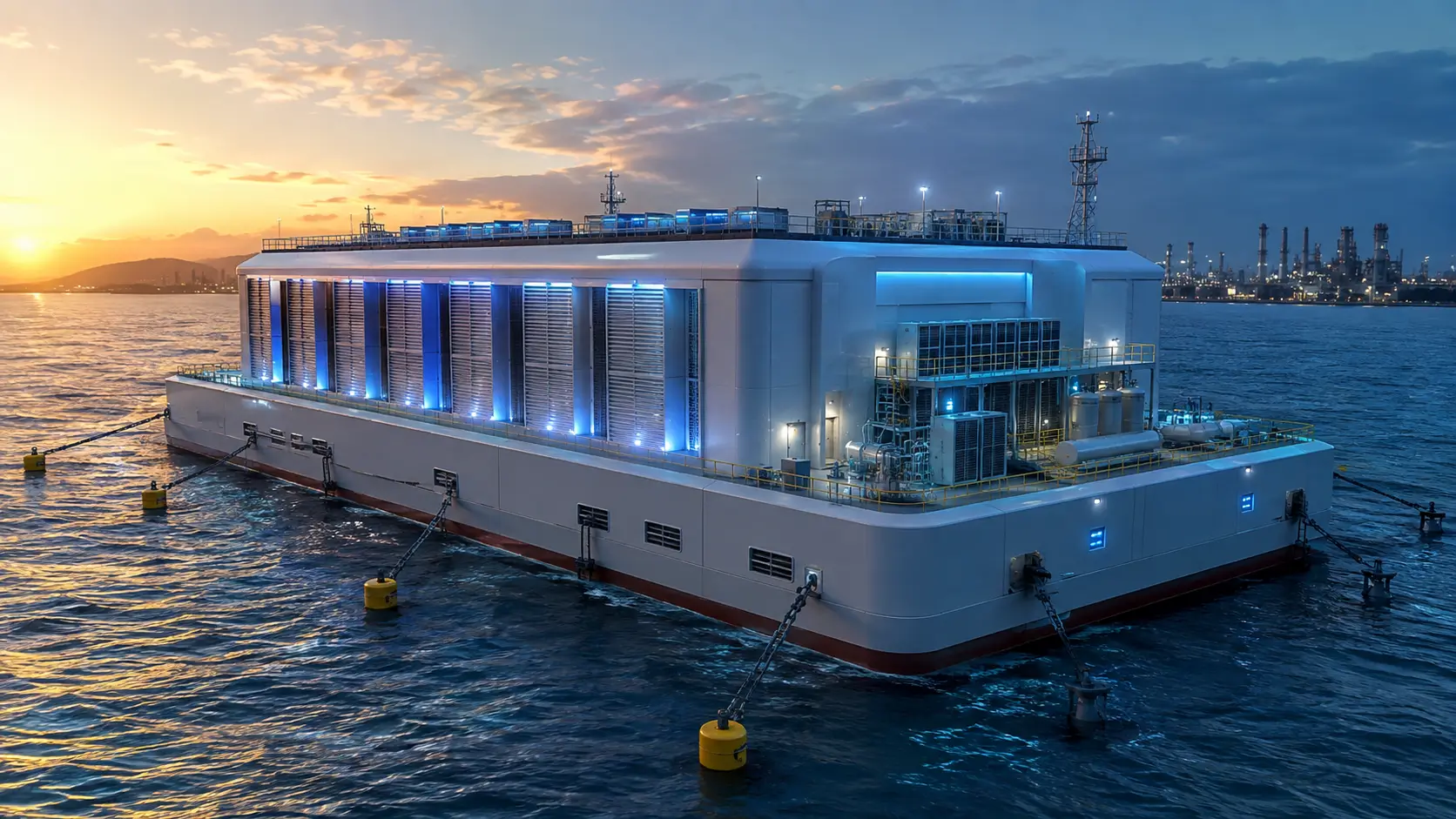
Samsung Develops Floating Data Centers for AI Infrastructure

Why Samsung Is Taking AI Infrastructure Offshore AI infrastructure now faces a practical challenge beyond processor availability. Suitable sites also

Share
Floating Data

Why Samsung Is Taking AI Infrastructure Offshore

AI infrastructure now faces a practical challenge beyond processor availability. Suitable sites also need land, electricity, cooling, connectivity, and dependable operating conditions. Samsung Heavy Industries is developing a floating data center platform for this challenge. In August 2026, Samsung signed an engineering contract with Mousterian Corporation for its first U.S. deployment. Each planned facility is designed for 50MW of critical IT capacity. The project gives enterprises another infrastructure model to consider when conventional sites face physical or utility constraints.

Samsung has moved beyond an early design concept with its 50MW-class platform. The design received Approval in Principle from the American Bureau of Shipping and Lloyd’s Register. That approval validates the design framework, but it does not prove long-term commercial performance. Samsung is also working with Capital Clean Energy Carriers and Lloyd’s Register on project development. A separate partnership with Supermicro covers AI server validation in river and offshore environments. These partnerships combine marine engineering, data-center systems, certification, power, and AI-server expertise.

How the Architecture Addresses Site Constraints

A conventional data center needs suitable land with enough electrical and cooling infrastructure. Site selection also requires construction access and room for future expansion. Samsung’s design shifts part of this requirement from land to a floating platform. The company has described a dedicated newbuild barge for its floating data center architecture. The platform includes data halls, mechanical systems, electrical systems, and supporting power equipment. Its nearshore configuration can also use shore-based electricity instead of relying entirely on onboard generation.

Cooling becomes another important consideration for high-density AI infrastructure. Samsung’s proposed architecture uses seawater as part of its cooling approach. This design brings the surrounding marine environment into the thermal management system. The architecture also incorporates onboard power-generation options for suitable deployments. Such generation could reduce reliance on shore-based electricity where project conditions support self-generation. Operators must still manage heat exchange, corrosion, redundancy, environmental protection, and maintenance requirements. The key question for users is whether the cooling system can maintain stable performance under marine operating conditions.

What AI Operators Need to Consider

AI workloads place heavy demands on power delivery, thermal management, networking, and hardware density. A new facility design must therefore prove performance across the complete infrastructure stack. Samsung’s 50MW design provides a defined capacity target for future deployments. Capacity alone does not establish workload reliability or operational performance. Marine environments introduce vibration, inclination, salt exposure, and humidity changes. Samsung and Supermicro are working to verify AI server operation under river and marine conditions.

Connectivity also becomes important when computing capacity moves away from traditional terrestrial campuses. AI environments require strong links between compute, storage, applications, cloud systems, and users. Physical distance from terrestrial infrastructure can influence network architecture and operating costs. A nearshore facility can remain closer to terrestrial infrastructure than a remote offshore installation. Samsung’s first planned U.S. deployment follows this nearshore approach. Enterprise buyers should assess carrier diversity, cable routes, latency, redundancy, and recovery procedures before committing workloads.

The Commercial Model Will Matter as Much as the Technology

Commercializing floating infrastructure requires more than constructing the physical platform. Samsung has established partnerships across project sourcing, investment, technical development, certification, power, and AI-server validation. Capital Clean Energy Carriers is involved in project sourcing and investment considerations. Lloyd’s Register contributes technical and regulatory expertise to the development process. Samsung Heavy Industries handles technology development and construction for its platform. This structure gives customers several areas to examine before selecting the model for production infrastructure.

The economics will determine whether floating infrastructure becomes a repeatable deployment category. Samsung has highlighted standardized shipbuilding processes for design and equipment integration. A repeatable process could support consistent deployment across suitable future projects. Customers must still compare construction costs with land, grid connection, cooling, insurance, maintenance, and connectivity. Lifecycle cost remains more important than the physical novelty of the platform. A strong commercial case requires project-level evidence showing where the model delivers measurable value.

What Could Determine Adoption After 2028

Regulation will remain important because floating facilities involve both data-center and maritime requirements. American Bureau of Shipping and Lloyd’s Register are already involved in Samsung’s design process. Their involvement provides technical assessment for the proposed architecture. Individual deployments will still need to address applicable local requirements. These may include maritime, environmental, electrical, coastal, port, and infrastructure permissions. Operators also need clear procedures for emergency response, fire protection, evacuation, maintenance, and recovery.

Environmental performance also requires detailed project-level evaluation. Seawater cooling does not automatically make a facility environmentally preferable. Operators must examine heat discharge, marine impacts, fuel choices, emissions, and corrosion management. Construction and maintenance can also contribute to the facility’s environmental footprint. Samsung’s architecture incorporates onboard generation options, while nearshore facilities can use shore-based electricity. Those choices will influence how individual projects align with customer sustainability requirements.

What End Users Should Watch Before Adoption

Enterprises planning AI capacity should treat Samsung’s platform as an additional infrastructure option. It should not yet be viewed as a replacement for established land-based data centers. Potential use cases are most relevant where land, power, cooling, or development constraints limit expansion. A floating platform could provide another location for compute capacity without requiring equivalent permanent land. Customers should demand evidence covering availability, reliability, cooling, networking, maintenance, security, insurance, and recovery. These factors remain critical when infrastructure supports business applications that require dependable service.

Samsung’s 2028 commercialization target will test the transition from engineering validation to enterprise infrastructure. The company already has partners covering shipbuilding, certification, investment, power, and AI-server technology. The next stage will require project execution and real-world equipment validation. It will also require repeatable maintenance processes and predictable operating performance. Enterprises should watch deployment evidence instead of relying on announcements alone. If performance meets enterprise requirements, floating infrastructure could offer another option for constrained AI deployment locations.


[simple-author-box]

More from AI Infrastructure

A large computing site can operate within its permits, meet its engineering targets, and

A transformer can leave a refurbishment shop looking almost indistinguishable from a new unit,

A self-powered AI site can appear electrically independent until the machines supplying its power

COMPUTE WEEKLY

The briefing that 40,000+ tech leaders read every Monday. Sharp, fast, essential.

Great! We’ve received your information.

Building an AI Startup Without Owning GPUs

Not owning GPUs has become the default, deliberate strategy for building an AI company — not a compromise founders accept reluctantly. H100 rental rates fell 64-75% in fifteen months, a dense ecosystem of neoclouds and inference-as-a-service providers now lets startups skip infrastructure entirely, and credit programs can fund a company’s first year before a founder writes a check
Most Read

A transformer can leave a refurbishment shop looking almost indistinguishable from a new unit,

Why Samsung Is Taking AI Infrastructure Offshore AI infrastructure now faces a practical challenge

AI infrastructure decisions for high-density deployments increasingly involve what happens after electricity enters the

Demand is broadening across enterprise workloads APAC’s infrastructure story is changing in ways that

AI infrastructure decisions increasingly influence what enterprises can build, test, and deliver. They also

Disruptor Spotlight

Cerebras Systems

The chip that makes Nvidia nervous. Cerebras’ Wafer Scale Engine is rewriting the rules of AI inference at scale.
Faster
0 x
YoY Revenue
0 x
Transistors
0 T
Market Pulse
MSFT
+1.02%
NVDA
+0.66%
AMZN
-0.078%
AMD
-6.95%
TSMC
-2.98%
Indicative only · Not financial advice
Upcoming Events
SEP
The AI Infrastructure Race (India)
WEBINAR · ONLINE
The AI Infrastructure Race: Won on Power, Land and Trust — Not Capital
MAY
0
AI Infrastructure Summit
DUBAI · IN PERSON
MEA’s premier AI infrastructure event.
JUN
0 0
Compute Forecast Summit
SINGAPORE · IN PERSON
Our flagship APAC event. Early bird open.
Latest Moves
Live
ecolab
Ecolab Deepens Cooling Strategy With $4.75B CoolIT Acquisition
Ecolab is making one of its biggest moves yet into AI infrastructure after completing its $4.75 billion acquisition of liquid cooling specialist CoolIT Systems
Pure DC AVK Europe data center microgrid Dublin 110MW AI infrastructure Ireland 2026
Pure DC and AVK Deploy Europe’s First 110 MW Data Center Microgrid in Dublin
The Pure DC Dublin microgrid has made history as Europe’s first large-scale on-site data center microgrid, launched in partnership with power solutions provider AVK at Pure DC’s campus in Ireland.
Pace Digitek
Pace Digitek Partners With MEGMEET to Expand AI Data Center Power Business
India’s AI infrastructure ecosystem continues to mature as domestic technology manufacturers move beyond traditional telecommunications and industrial markets toward high-growth digital infrastructure opportunities
Follow Compute Forecast
11K followers
1200 followers
Companies to Watch
CW
CoreWeave
Neo Cloud · $19B · IPO Watch
CB
Cerebras Systems
AI Hardware · $4.25B · Pre-IPO
G42
G42
Sovereign AI · Abu Dhabi
H
Humain
Saudi AI · $40B Fund
Latest Podcast
AI Capex, Cloud Margins & the Nuclear Bet
48 MIN · 25 APR 2026

Samsung Develops Floating Data Centers for AI Infrastructure

Why Samsung Is Taking AI Infrastructure Offshore AI infrastructure now faces a practical challenge beyond processor availability. Suitable sites also

Share
Floating Data
0
847 SHARES

0
SHARES

[simple-author-box]

More from AI Infrastructure

A transformer can leave a refurbishment shop looking almost indistinguishable from a new unit,

Why Samsung Is Taking AI Infrastructure Offshore AI infrastructure now faces a practical challenge

AI infrastructure decisions for high-density deployments increasingly involve what happens after electricity enters the

Demand is broadening across enterprise workloads APAC’s infrastructure story is changing in ways that

COMPUTE WEEKLY

The briefing that 40,000+ tech leaders read every Monday. Sharp, fast, essential.

Great! We’ve received your information.

Global AI Infrastructure Outlook 2026

The briefing that 40,000+ tech leaders read every Monday. Sharp, fast, essential.
Download Free
Most Read

A transformer can leave a refurbishment shop looking almost indistinguishable from a new unit,

Why Samsung Is Taking AI Infrastructure Offshore AI infrastructure now faces a practical challenge

AI infrastructure decisions for high-density deployments increasingly involve what happens after electricity enters the

Demand is broadening across enterprise workloads APAC’s infrastructure story is changing in ways that

AI infrastructure decisions increasingly influence what enterprises can build, test, and deliver. They also

Disruptor Spotlight

Cerebras Systems

The chip that makes Nvidia nervous. Cerebras’ Wafer Scale Engine is rewriting the rules of AI inference at scale.
Faster
0 x
YoY Revenue
0 x
Transistors
0 T
Market Pulse
NVDA
$924.60
+2.4%
MSFT
$421.30
+1.1%
AMZN
$192.80
-0.6%
NVDA
$924.60
+2.4%
NVDA
$924.60
+2.4%
Indicative only · Not financial advice
Upcoming Events
MAY
0 0
DCD Global — London
LONDON · IN PERSON
World’s largest DC event. CF is media partner.
MAY
0
AI Infrastructure Summit
DUBAI · IN PERSON
MEA’s premier AI infrastructure event.
JUN
0 0

Compute Forecast Summit

SINGAPORE · IN PERSON
Our flagship APAC event. Early bird open.
Latest Moves
  • Live
Sam Altman
OpenAI appoints new Chief Infrastructure Officer to lead $100B DC programme
27 APR · OPENAI
Sam Altman
OpenAI appoints new Chief Infrastructure Officer to lead $100B DC programme
27 APR · OPENAI
Sam Altman
OpenAI appoints new Chief Infrastructure Officer to lead $100B DC programme
27 APR · OPENAI
Follow Compute Forecast
18.4K followers
12.1K followers
9.3K subscribers
41 episodes
Companies to Watch
CW
CoreWeave
Neo Cloud · $19B · IPO Watch
CB
Cerebras Systems
AI Hardware · $4.25B · Pre-IPO
G42
G42
Sovereign AI · Abu Dhabi
CW
Humain
Saudi AI · $40B Fund
Latest Podcast
AI Capex, Cloud Margins & the Nuclear Bet
48 MIN · 25 APR 2026
Scroll to Top








