
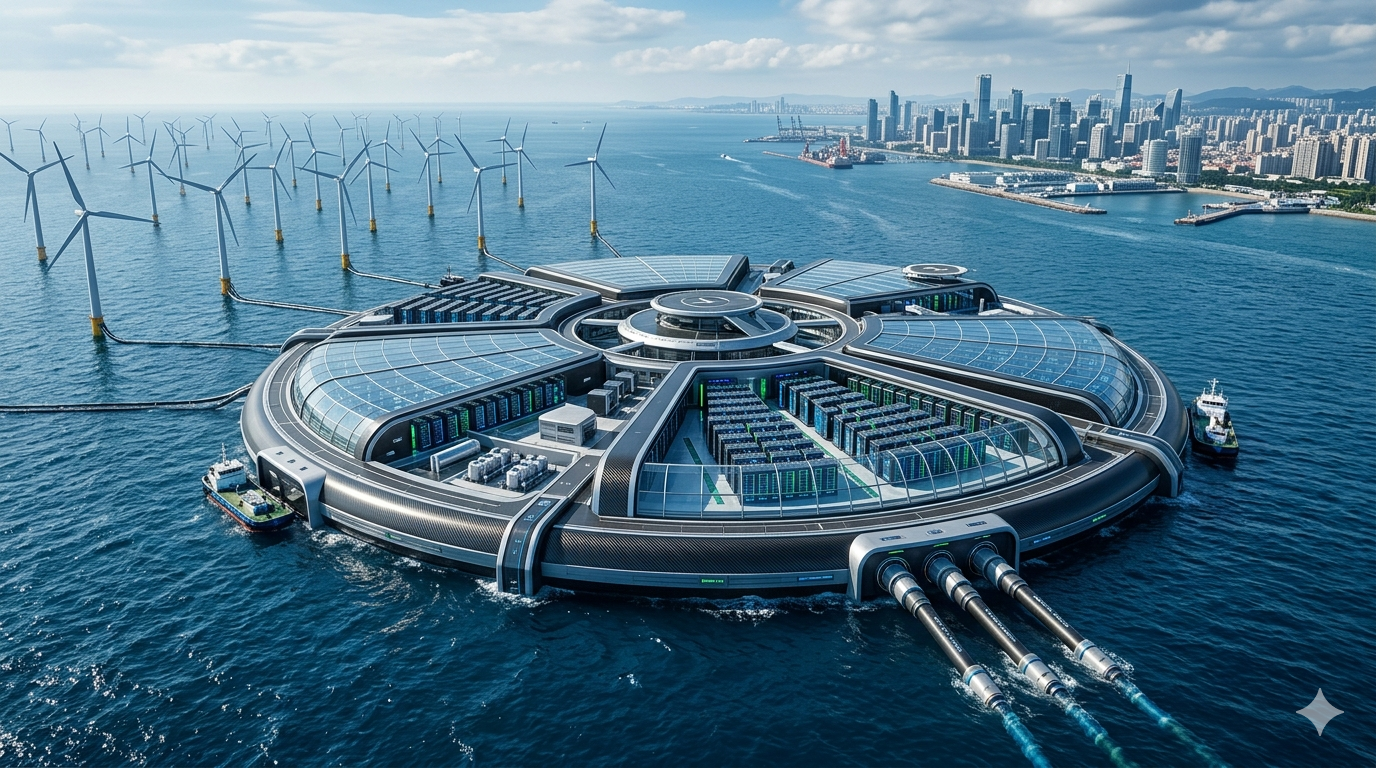
AI’s Next Data Center May Not Be on Land
For years, the data center industry has focused on building bigger facilities, securing more power, and finding new ways to cool increasingly dense compute environments. Artificial intelligence has accelerated all three challenges. Modern AI clusters consume enormous amounts of electricity, generate unprecedented levels of heat, and require vast amounts of land near fiber routes and power infrastructure. As hyperscalers race to deploy AI infrastructure, a surprising alternative is beginning to gain attention: floating data centers. What once sounded like a futuristic experiment is gradually becoming a serious infrastructure strategy. Projects announced in Japan, Singapore, and elsewhere suggest that the future of AI computing may extend beyond traditional industrial parks and into coastal waters.

The AI Era Has Created Four Infrastructure Bottlenecks
The global AI buildout is exposing structural weaknesses in traditional data center development. Operators increasingly face four major constraints: land availability, power access, water consumption, and climate-related risks. Finding suitable land near major population centers has become increasingly difficult and expensive. At the same time, electrical grids in many regions are struggling to support the energy requirements of new AI campuses. Water consumption has become a growing concern as cooling systems face greater scrutiny from regulators and local communities. Extreme weather events, flooding, earthquakes, and rising temperatures add further complexity to site selection. Floating data centers present a unique proposition because they potentially address all four challenges simultaneously.
Why The Ocean Is Becoming Attractive To Data Center Operators
Cooling remains one of the largest operational expenses inside modern data centers. Industry estimates suggest cooling can account for roughly 30% to 40% of total facility power consumption, particularly in AI-heavy environments where GPUs generate significantly more heat than traditional servers. Floating facilities can use surrounding seawater as a natural heat sink. Instead of relying solely on power-intensive chillers and cooling towers, operators can leverage the ocean’s thermal capacity to remove heat more efficiently. The result could be lower energy consumption, reduced freshwater requirements, and improved sustainability metrics. As AI infrastructure scales toward gigawatt levels, these advantages become increasingly attractive.
Japan Wants To Build The World’s First Floating Green AI Data Center
The latest momentum comes from Yokohama, where a consortium that includes Nippon Yusen Kabushiki Kaisha (NYK), NTT Facilities, Eurus Energy Holdings, MUFG Bank, and the City of Yokohama has signed a memorandum of understanding to develop what they describe as the world’s first offshore floating green data center. The demonstration facility is expected to operate from a floating platform powered initially by solar generation and battery storage before integrating offshore wind energy. The long-term vision is even more ambitious. Future deployments could be positioned near offshore wind farms, allowing data centers to consume renewable electricity closer to where it is generated. Such a model could reduce transmission constraints while creating a new category of off-grid AI infrastructure.

Singapore Is Testing The Same Idea
Japan is not alone in exploring offshore compute infrastructure. Singapore’s Keppel Data Centres has been advancing plans for a Floating Data Centre Park designed to address many of the same challenges facing dense urban markets. Singapore’s approach focuses heavily on cooling innovation. The proposed facility would utilize seawater-based cooling systems that the company believes could improve cooling efficiency by up to 80% compared with traditional approaches.
The project is also designed to reduce dependence on freshwater resources while integrating alternative energy infrastructure, including LNG and potentially hydrogen-based power generation. For a nation where land scarcity remains one of the biggest obstacles to data center expansion, floating infrastructure offers a compelling alternative.
Floating Data Centers Could Change How AI Infrastructure Is Deployed
Traditional hyperscale projects often require years of planning, permitting, land acquisition, and construction before becoming operational. Floating data centers introduce a different deployment model. Many concepts rely on modular architectures that can be manufactured offsite and deployed similarly to maritime infrastructure. This approach could shorten deployment timelines while enabling operators to scale capacity incrementally. Instead of waiting years for a large campus to be completed, future operators may be able to deploy floating compute modules as demand grows. This modularity aligns closely with how AI infrastructure demand is evolving. Compute requirements are increasing rapidly, making flexible expansion strategies increasingly valuable.
Renewable Energy Could Become A Native Feature
One of the most intriguing aspects of floating infrastructure is its potential connection to offshore renewable energy. Many of the world’s largest offshore wind projects are being built far from major consumption centers. Floating data centers could be positioned closer to these energy sources, reducing transmission losses and allowing direct integration with renewable generation.
As governments push for lower-carbon digital infrastructure, the ability to colocate compute with offshore wind assets may become a significant competitive advantage. The concept transforms the relationship between energy generation and compute consumption, bringing the two physically closer together.
The Challenges Are Just As Significant
Despite the excitement, floating data centers face considerable obstacles before becoming mainstream. Marine environments are harsh. Saltwater corrosion, wave motion, storms, typhoons, and long-term structural maintenance all introduce challenges that land-based facilities do not encounter. Network connectivity must remain highly reliable despite offshore locations.
Regulatory frameworks involving maritime operations, environmental compliance, and data sovereignty add further complexity. Operators must also ensure that heat discharged into surrounding waters does not negatively affect marine ecosystems. While floating facilities may solve some infrastructure constraints, they introduce a new set of engineering and operational challenges that remain largely untested at hyperscale.
Could Floating Data Centers Become The Standard Model?
Probably not everywhere. Land-based facilities will continue to dominate in regions with abundant space, stable grids, and favorable climates. However, floating data centers could emerge as a strategic option in coastal markets facing land shortages, power constraints, water scarcity, or sustainability requirements.
Cities such as Singapore, Tokyo, Hong Kong, Seoul, and parts of Europe may find offshore infrastructure particularly attractive because traditional expansion opportunities are increasingly limited. Rather than replacing conventional data centers, floating facilities may become an additional deployment model within a broader AI infrastructure strategy.
The Bigger Story Is About AI Infrastructure Flexibility
The significance of floating data centers extends beyond cooling efficiency or renewable energy integration. They represent a broader shift in how the industry thinks about compute infrastructure. For decades, data centers were fixed assets tied to specific locations. AI is changing that assumption. Operators are now exploring modular facilities, edge deployments, nuclear-powered campuses, AI factories, and floating infrastructure.
The industry is searching for new ways to deliver compute where power, cooling, and connectivity can be secured most efficiently. Floating data centers may not solve every challenge facing AI infrastructure. Yet they illustrate how rapidly the industry is rethinking the physical foundations of the AI economy. In a world where compute demand continues to surge, the next generation of data centers may be built as much around oceans and energy systems as around servers and GPUs.











