
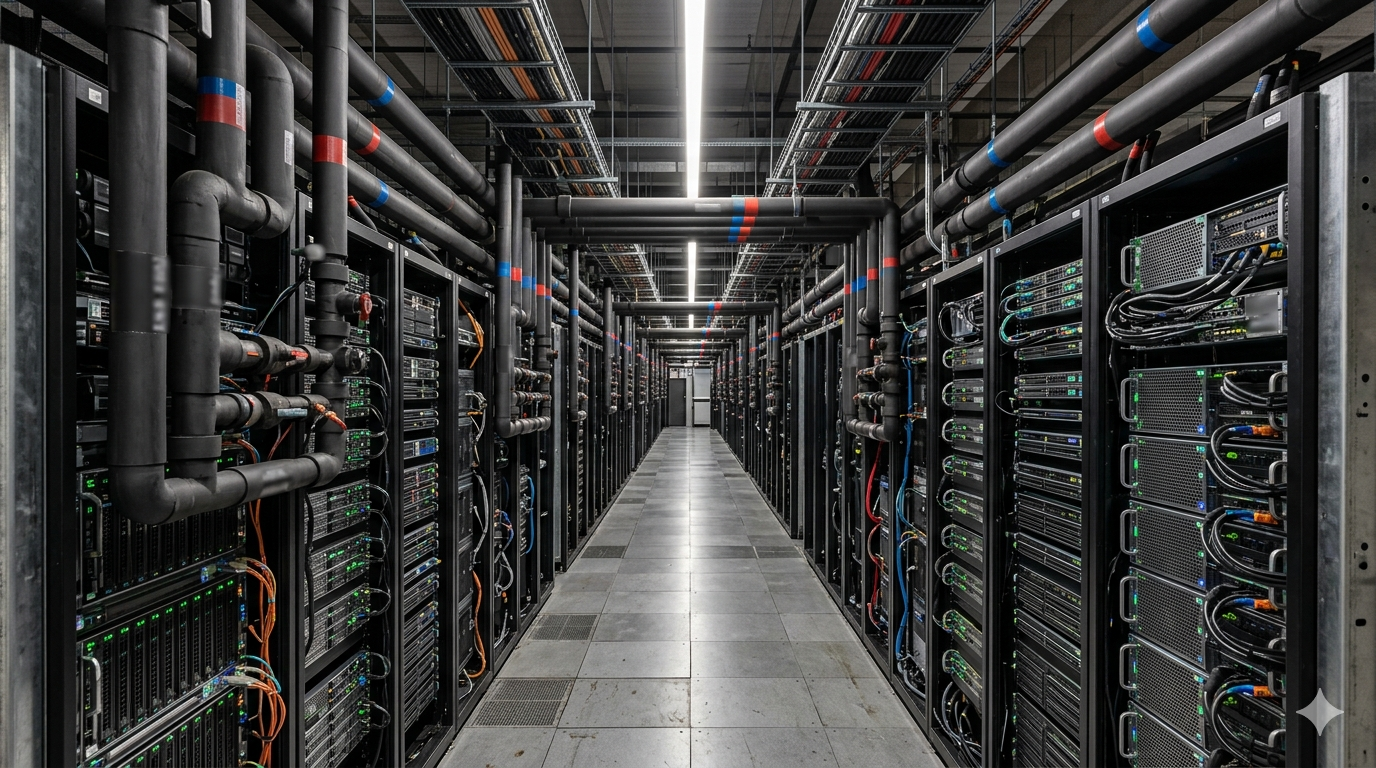
The data center industry spent a decade getting comfortable with high-density compute. What was once a specialist challenge for supercomputing environments has become a mainstream engineering problem as AI workloads push rack power requirements well beyond what conventional infrastructure can handle. The transition from 5 to 10 kilowatts per rack to 50 to 100 kilowatts felt dramatic at the time. The shift now underway toward 300, 600, and eventually beyond 1,000 kilowatts per rack is not a continuation of that trend. It is a different engineering problem entirely.

NVIDIA’s Vera Rubin NVL144 systems require over 300 kilowatts per rack. The Rubin Ultra NVL576 will exceed 600 kilowatts. Google has already unveiled a 1-megawatt rack design. These are not speculative roadmap items. They are the specifications that facilities under design today must accommodate, and the engineering challenges they create extend far beyond cooling alone. Power delivery, structural loading, fire suppression, and the fundamental geometry of data center floor planning all break in ways they did not break at 100 kilowatts.
Why the Engineering Problem Is Harder Than It Looks
Cooling at 100 kilowatts per rack already pushes engineering limits in ways that conventional air-cooled facilities cannot accommodate. At 600 kilowatts, the problem is not just bigger. It is qualitatively different. Heat flux densities at that level make chip-level thermal management a first-order concern, not a facility-level one. The coolant system must remove heat fast enough to prevent silicon degradation before the thermal load reaches the facility cooling infrastructure. That means engineers must start the solution at the chip and work outward, not the other way around.
Power delivery creates a parallel challenge. A rack drawing 600 kilowatts demands electrical infrastructure specifically designed for that load, including transformers, switchgear, busbars, and power distribution units that handle sustained megawatt-scale delivery without compounding efficiency losses. The 54-volt DC power distribution systems that served previous generations of high-density compute cannot meet megawatt-scale rack requirements. NVIDIA’s Kyber platform moves to 800-volt power architecture to address this, but operators must redesign power distribution infrastructure they cannot simply retrofit from lower-voltage systems.

What the Structural and Physical Constraints Actually Mean
High-density AI infrastructure carries structural constraints that data center designers are still working through. A 600-kilowatt rack carries a very different hardware payload than a conventional server rack. The cooling hardware alone, including cold plate manifolds, coolant distribution units, and supporting plumbing infrastructure, adds significant weight beyond the compute hardware itself. Consequently, floor loading specifications adequate for previous generations need revision before facilities can support the next AI accelerator deployments.
Floor space efficiency also changes at extreme density. Facilities that maximised racks per square foot must shift to maximising kilowatts per square metre, which produces very different layout logic. Spacing between high-density AI pods must accommodate coolant infrastructure, maintenance access, and the physical scale of rack-level systems substantially larger and heavier than conventional server racks. Some new builds in 2026 resemble industrial facilities more than traditional data centers, and at the engineering level that description is accurate.
The Cost Implications That Are Being Underestimated
Capital expenditure per megawatt is reaching levels that planning models from even two years ago did not anticipate. At rack densities of 600 kilowatts and above, construction costs run two to four times higher than legacy data center models. Liquid cooling infrastructure alone for a 10-megawatt GPU cluster adds between $5 million and $20 million in capital cost above an equivalent air-cooled facility. Those numbers are changing the economics of AI infrastructure development in ways that determine which operators can participate and at what scale.
Operational costs scale similarly. Energy remains the primary operational expense, and cooling efficiency at extreme densities matters more per unit of compute than at lower densities. A facility achieving excellent power usage effectiveness at 50 kilowatts per rack may perform very differently at 300 or 600 kilowatts because the cooling systems operate in regimes their designers never optimised for. Operators investing in genuine engineering research at extreme density, rather than simply scaling up what worked at lower densities, are building a durable cost advantage that will matter more as the industry moves further up the rack power curve.
The Facilities Being Built Right Now Are Already Behind
The most uncomfortable reality about the 600kW rack problem is that many facilities currently under construction will not serve the hardware generations that arrive before the end of their design life. A facility permitted in 2024 for 100 to 150 kilowatt rack densities may face operational constraints within three to four years as Rubin Ultra and subsequent GPU generations push requirements beyond what its power and cooling infrastructure can support. That timeline is short relative to the 15 to 20-year asset life that data center construction economics assume.
The industry is beginning to address this through design philosophies that prioritise adaptability over optimisation for a single hardware generation. Leaving conduit capacity for future plumbing, specifying floor loading well above current requirements, designing secondary plant with headroom for future density, and building power distribution infrastructure upgradeable without full facility shutdown are all approaches operators are now incorporating. None of them fully solve the problem of designing today for hardware specifications not yet finalised, but they reduce the cost and disruption of adapting as those specifications become clear. Operators who treat their current facilities as the first phase of a multi-generation asset, rather than a fixed design, are making better long-term infrastructure decisions than those optimising only for the hardware available at the time of construction.











