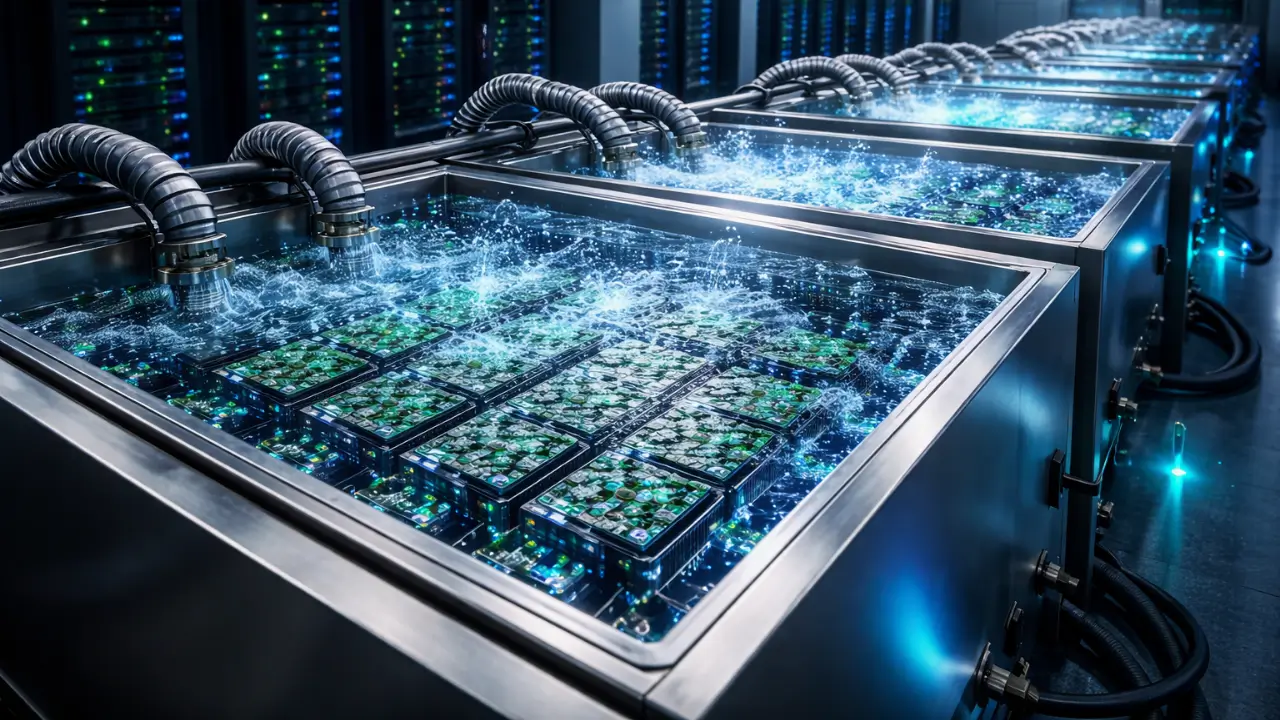
Immersion Cooling Hardware Design at the Server Level
For decades, enterprise server hardware evolved around a single, largely unquestioned assumption: air would remain the primary medium for heat removal. Immersion cooling hardware design is now challenging that assumption as compute intensity rises, driven by artificial intelligence, machine learning inference, and high-performance computing. Fans, vents, heat sinks, and raised-floor airflow models historically dictated everything from motherboard layouts to data hall architecture.
Immersion cooling hardware design represents a structural departure from air-based engineering. By submerging servers directly into dielectric fluids, operators remove airflow from the thermal equation altogether. This shift forces hardware designers to rethink materials, components, mechanical layouts, and even reliability models. The result is not simply improved cooling performance, but a fundamentally different approach to how computing infrastructure is built and operated.
The Thermal Limits of Air-Cooled Design
Air cooling has reached diminishing returns at high densities. Modern AI accelerators now approach or exceed 700 watts per device, while high-end CPUs continue trending upward, placing sustained pressure on air-based thermal systems. At the rack level, densities beyond 40–50 kW introduce escalating complexity, including larger heat sinks, higher fan speeds, and increasingly narrow thermal margins.
Industry studies and operator disclosures indicate that fans can account for 5–15% of total server power consumption, with the upper range observed in high-density AI and HPC air-cooled deployments. At the facility level, airflow management drives additional capital and operating expense through containment systems, raised floors, and oversized cooling plants. These constraints increasingly limit scalability, site selection, and power utilization efficiency.
Immersion cooling addresses these challenges by replacing air with dielectric fluids that conduct heat far more efficiently. Once air disappears from the system, however, nearly every element of hardware design must change.
Hardware Without Air: A New Design Baseline
Motherboards Reimagined for Liquid Environments
In immersion systems, motherboards no longer depend on directed airflow. Component placement can prioritize electrical efficiency and signal integrity rather than thermal zoning. This freedom enables shorter signal paths, fewer board layers, and more consistent performance under sustained load.
At the same time, continuous exposure to dielectric fluids introduces new material constraints. Plastics, coatings, and elastomers must be qualified for long-term chemical compatibility. As a result, hardware vendors increasingly design and certify motherboards specifically for immersion rather than adapting air-cooled platforms.
The End of Fans, Heat Sinks, and Shrouds
One of the most visible consequences of immersion cooling hardware design is the elimination of mechanical cooling components. Fans, heat sinks, vapor chambers, and airflow shrouds become unnecessary. Their removal simplifies server assemblies and reduces the number of moving parts susceptible to wear.
This change alters reliability profiles. Mechanical failures associated with fan degradation decline, particularly in high-density environments where thermal stress accelerates component aging. Operators report fewer reactive maintenance events, as cooling-related failure points largely disappear.
Component-Level Implications
CPUs and Accelerators Built for Submersion
Processor packaging evolves under immersion conditions. Heat spreaders no longer optimize for air interfaces, allowing flatter contact surfaces and more uniform thermal transfer to liquid. This consistency supports sustained high-performance operation, especially for AI training workloads that operate at steady-state utilization for extended periods.
Accelerator platforms from vendors such as NVIDIA increasingly align with liquid-ready deployments, as power envelopes continue to expand beyond air-cooled feasibility. Immersion enables these devices to operate closer to theoretical performance limits without aggressive throttling.
Power Delivery and Voltage Regulation
Voltage regulation modules benefit materially from immersion environments. Uniform cooling reduces thermal gradients across power delivery components, improving electrical stability under fluctuating workloads. This stability supports higher density designs while lowering thermal stress on sensitive circuitry.
However, immersion imposes stricter insulation and spacing requirements. Hardware designers must ensure that exposed contacts, solder joints, and power rails remain protected against long-term fluid exposure, reinforcing the need for tighter collaboration between board designers and fluid suppliers.
Storage, Cabling, and I/O in Immersion Systems
Rethinking Storage Media
Hard disk drives, with their mechanical assemblies, are rarely deployed at scale in immersion environments, despite being technically engineerable for submersion. Sealing complexity, cost, and reliability considerations make them impractical for most immersion use cases. As a result, immersion deployments accelerate the industry-wide transition toward solid-state storage.
Solid-state drives, particularly NVMe-based architectures, integrate well into immersion systems when properly validated. This shift aligns with broader demand for low-latency, high-throughput storage in AI and analytics-driven data centers.
Cabling and External Interfaces
Cabling strategies change substantially. Traditional front- and rear-panel I/O becomes less relevant when servers operate within immersion tanks. Designers increasingly favor simplified backplane connections and modular interfaces optimized for rapid extraction and service.
External connectivity often routes through sealed bulkhead connectors at the tank level, reducing cable congestion and improving serviceability. These decisions, however, require early coordination between hardware design and facility layout planning.
From Racks to Tanks: Layouts Without Airflow
The Decline of the Standard Rack
Immersion cooling challenges the dominance of the 19-inch rack. While some deployments retain rack-compatible form factors, many immersion environments adopt tank-based architectures optimized for fluid circulation rather than vertical airflow.
These systems support significantly higher compute density per square meter. Without hot and cold aisle requirements, data halls become more compact, with shorter cable runs and fewer mechanical systems consuming floor space.
Service Models and Operational Design
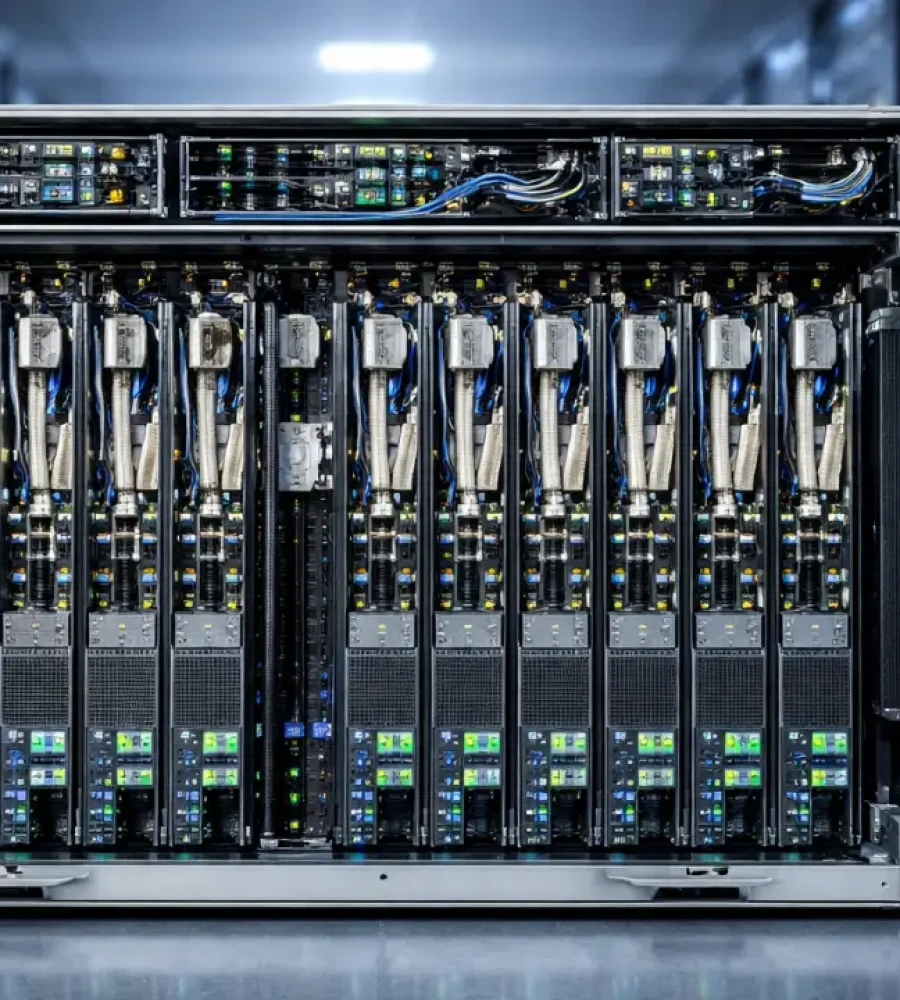
Hardware design increasingly reflects new operational workflows. Servers are often engineered as modular sleds that can be lifted from tanks for maintenance without draining fluid or shutting down adjacent systems. This approach reduces downtime but requires robust sealing, standardized handling procedures, and redesigned service tooling.
From a broader perspective, these operational shifts move data center maintenance closer to industrialized, repeatable processes rather than traditional IT room practices.
Reliability, Lifespan, and Risk Profiles
Immersion cooling alters how hardware ages. Uniform thermal conditions reduce thermal cycling, a primary contributor to solder joint fatigue and component degradation. Early operator data and reliability modeling suggest that immersion-cooled systems may deliver longer usable lifespans, although long-term, fleet-wide data is still emerging.
New risk categories also appear. Fluid quality management becomes essential, as contamination can affect thermal performance or material integrity. Hardware vendors increasingly work alongside fluid manufacturers to certify long-term compatibility, reinforcing tighter ecosystem dependencies.
Economics Driving Design Decisions
Capital and Operating Cost Implications
Immersion cooling introduces upfront investment in tanks, fluids, and specialized hardware. In return, it reduces reliance on complex air handling infrastructure. Operator case studies show that well-optimized immersion-cooled facilities can achieve power usage effectiveness (PUE) levels approaching 1.03–1.05, compared with 1.3 or higher in dense air-cooled environments.
These efficiency gains influence hardware design priorities. Vendors increasingly optimize platforms around total cost of ownership rather than component-level cost, emphasizing performance stability at high utilization.
Alignment With AI and HPC Growth
AI and HPC clusters demand sustained performance, predictable thermals, and extreme power density. Immersion cooling supports tank-level densities exceeding 100 kW without resorting to exotic airflow architectures.
Chipmakers, including Intel, increasingly reference liquid and immersion readiness in platform roadmaps. This positioning underscores that immersion is transitioning from experimental deployment to a mainstream design consideration shaping future hardware generations.
Strategic Implications for Technology Leaders
For CXOs and infrastructure leaders, immersion cooling hardware design represents more than a cooling decision. It influences procurement strategy, vendor qualification, and long-term capacity planning. Hardware designed for immersion cannot always be redeployed into air-cooled environments, reinforcing the need for deliberate architectural choices.
At the same time, immersion expands strategic flexibility. By decoupling compute density from airflow constraints, operators can deploy high-performance infrastructure in geographies previously constrained by climate, space, or power availability. This shift carries implications for sovereign AI, edge deployments, and emerging digital markets.
Conclusion: Designing for a World Without Air
Immersion cooling changes how hardware is designed because it removes the foundational assumption that air governs thermal behavior. Servers become simpler, denser, and more mechanically reliable. Components operate closer to performance limits, and data halls evolve toward compact, fluid-centric layouts.
From a broader perspective, immersion cooling hardware design reflects a maturation of digital infrastructure. As compute demand accelerates and efficiency becomes strategic, hardware engineered for liquid environments moves from niche innovation to operational necessity. For industry leaders, understanding this transition is no longer optional—it defines how next-generation infrastructure will be built.