NVIDIA H200 shipments delayed to Q3  · BREAKING: Microsoft confirms 3GW data centre expansion in Asia-Pacific ·  AWS announces new sovereign cloud regions in India and UAE  · Arm-based servers now 24% of hyperscale deployments ·  EU AI Act enforcement enters phase two  · Global data centre investment hits $612B in 2026 ·  TSMC Arizona yields improve to 68% on 3nm process  · OpenAI valuation reaches $400B after latest funding round ·  NVIDIA H200 shipments delayed to Q3  · BREAKING: Microsoft confirms 3GW data centre expansion in Asia-Pacific ·  AWS announces new sovereign cloud regions in India and UAE  · Arm-based servers now 24% of hyperscale deployments ·  EU AI Act enforcement enters phase two  · Global data centre investment hits $612B in 2026

India Colocation Market Growth Outpacing Grid Infrastructure

India’s colocation market is one of the fastest-growing in the world right now, and the investment case behind it is

Share
India colocation market data center grid infrastructure Maharashtra 2026

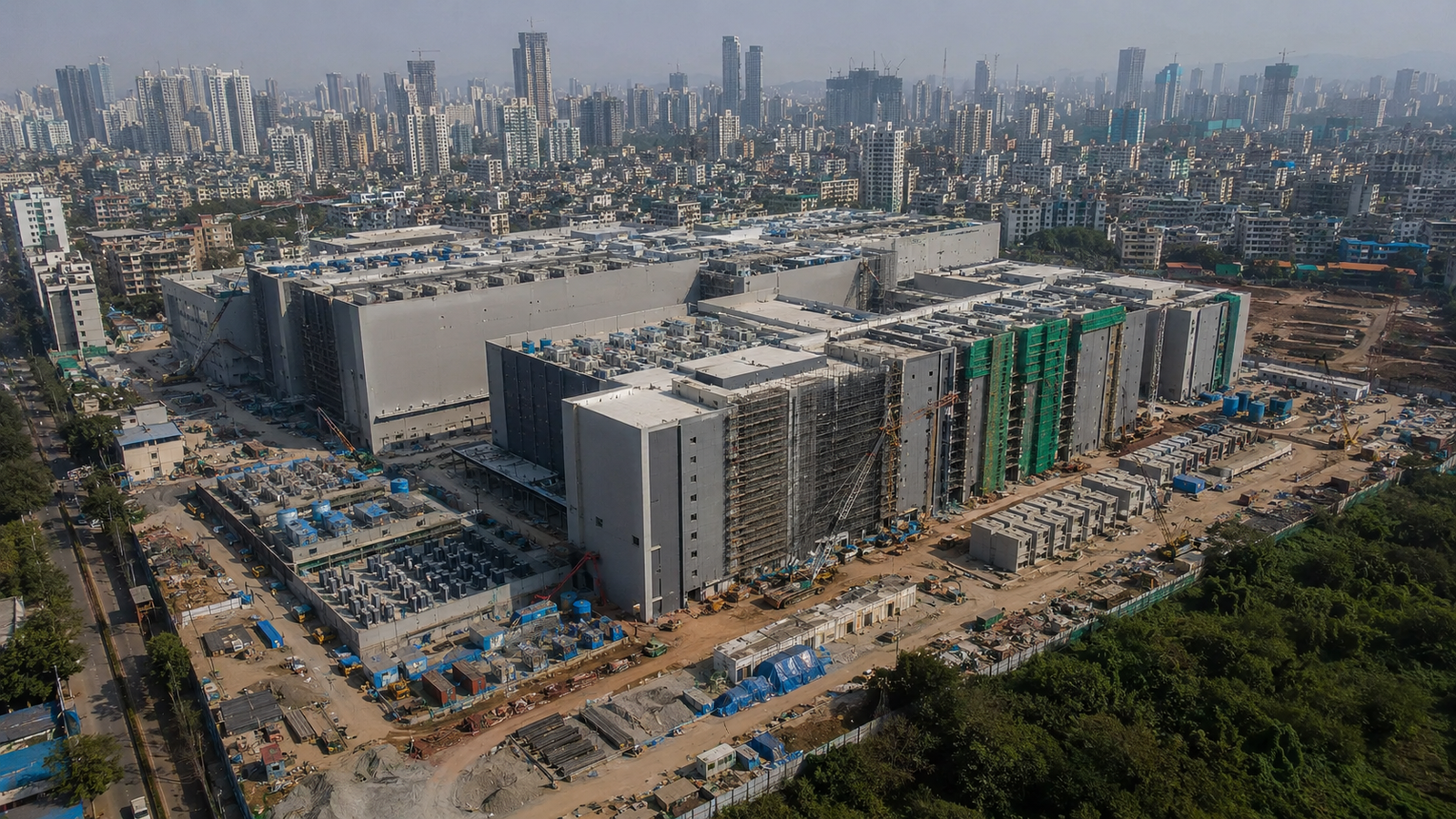
India’s colocation market is one of the fastest-growing in the world right now, and the investment case behind it is genuinely strong. Demand is structural. Cloud adoption, AI workloads, data localisation requirements, and enterprise digitisation are all pulling in the same direction. The pipeline of announced projects is enormous, and global operators from Equinix to AirTrunk to AdaniConneX are competing for the same land and power contracts in the same handful of cities.

That last detail is the problem. The India colocation market is growing at a pace that the grid infrastructure supporting it cannot absorb because planners and utilities did not build it for this level of demand, and the industry has largely framed that reality as an engineering challenge to solve at the facility level rather than a systemic constraint that requires a different kind of attention. The gap between the capacity developers are announcing and the power infrastructure that can reliably serve it at scale is widening, and it will become much harder to route around as the pipeline of upcoming projects starts commissioning.

The India Colocation Market Has Concentrated Itself Into a Grid Bottleneck

Mumbai and Chennai make obvious commercial sense as colocation hubs. Both cities offer the connectivity infrastructure, enterprise customer density, regulatory familiarity, and proximity to submarine cable landing stations that operators need to justify large capital commitments. When the first wave of hyperscale operators made site selection decisions for India, these were unambiguously correct choices.

The problem with obvious choices is that everyone makes them. India’s colocation capacity is now heavily concentrated in Maharashtra and Tamil Nadu, with more than a quarter of all upcoming data center power capacity sitting in Maharashtra alone. That concentration is compounding grid demand beyond the density that utilities originally planned local distribution infrastructure to serve. Maharashtra’s distribution companies are financially stressed, carrying substantial dues to generators that limit their ability to upgrade infrastructure at the pace the market needs. Tamil Nadu manages the country’s largest installed wind capacity but faces real balancing challenges as intermittent renewable supply grows faster than the storage and transmission capacity needed to manage it reliably. Every new hyperscale campus connecting in these states adds large, continuous load to a system built for a fundamentally different demand profile.

Operators Are Solving the Symptom, Not the Problem

The industry’s response to grid variability in India has been sensible at the facility level. Operators are investing heavily in on-site UPS systems, diesel generation backup, and dedicated substations. Major Indian colocation operators have announced substantial solar PPA arrangements to reduce dependence on the state grid. Behind-the-meter generation is becoming standard practice for new campus developments rather than a premium option.

These are rational decisions that protect individual facilities. They do not resolve the systemic constraint, and in some ways they make it worse. When every large operator builds behind-the-meter generation and dedicated substation capacity, each facility becomes more resilient while collectively adding more interconnection demand to the transmission infrastructure upstream. The high-voltage transmission lines feeding the industrial zones where most campuses are sited, and the substations stepping down power for distribution at scale, are not being upgraded at the same rate that campus-level generation capacity is being added. The gap is not at the meter. It is in the shared infrastructure between the grid and the perimeter fence, and no individual operator can fix that unilaterally regardless of how much they invest in their own plant.

As India’s data center boom becomes a transmission problem, the facility-level workarounds that worked for the first generation of campuses will become insufficient for the next.

Later-Entry States Have a Grid Advantage Nobody Is Fully Pricing

Telangana, Andhra Pradesh, and Uttar Pradesh are entering the colocation development pipeline later than Maharashtra and Tamil Nadu. From a market maturity standpoint that looks like a disadvantage. From a grid infrastructure standpoint it may turn out to be a genuine structural advantage that the market is not yet fully pricing.

These states are building and upgrading transmission infrastructure now, with grid modernisation investment flowing through national programmes targeting renewable integration and distribution reliability. A campus sited in Hyderabad or Vizag today may be connecting to materially better transmission infrastructure than one sited in Navi Mumbai at the same time, at lower interconnection cost and with fewer years of grid variability risk to manage. The operators treating Tier 2 state expansion purely as a cost-reduction play are undervaluing what they are actually getting: early grid access in states where transmission capacity is growing toward the demand rather than trailing behind it.

That positioning compounds over time in ways that are easy to underestimate when the market narrative is still focused on which operator is winning the Mumbai land grab. The operator with a well-connected campus in Hyderabad or Pune in 2027 may have a more reliable delivered uptime record than one with a larger campus in Navi Mumbai that is managing grid variability through diesel backup and behind-the-meter solar. Delivered reliability, not announced megawatts, is what enterprise and hyperscale customers will be evaluating when they renew contracts.

The Market Needs a Transmission Story, Not Just a Capacity Story

The India colocation market narrative the industry tells is a demand story, and the demand is real. What it needs to become is also a transmission story, because announced capacity and reliable delivered uptime are not the same thing. The distinction matters most when the pipeline of upcoming projects starts commissioning at scale and every new campus in Maharashtra or Tamil Nadu is competing for grid access and interconnection bandwidth that existing infrastructure can no longer expand quickly enough to provide.

India’s government is investing in grid modernisation, and the trajectory is improving. But grid infrastructure investment cycles run on multi-year timelines and the data center build cycle is running faster than that. The operators who understand the gap and are building site selection, grid relationships, and power procurement strategies around it now, rather than treating power as an engineering problem to solve after the land deal closes, will be the ones whose capacity announcements translate into reliable commissioned infrastructure when the market tests the difference.


[simple-author-box]

More from AI Infrastructure

Power negotiations often conclude long before operational constraints reveal themselves inside a live facility.

Artificial intelligence infrastructure has compressed deployment timelines to the point where electrical capacity is

Boards increasingly expect organizations to support sustainability reporting with evidence that aligns with governance

COMPUTE WEEKLY

The briefing that 40,000+ tech leaders read every Monday. Sharp, fast, essential.

Great! We’ve received your information.

We couldn’t process your submission. Please retry

Building an AI Startup Without Owning GPUs

Not owning GPUs has become the default, deliberate strategy for building an AI company — not a compromise founders accept reluctantly. H100 rental rates fell 64-75% in fifteen months, a dense ecosystem of neoclouds and inference-as-a-service providers now lets startups skip infrastructure entirely, and credit programs can fund a company’s first year before a founder writes a check
Most Read

Infrastructure planning discussions often prioritize engineering, construction, and utility considerations before examining how end

AI infrastructure deployment schedules depend on coordinated progress across hardware availability, electrical infrastructure, cooling

Artificial intelligence has transformed the economics of digital infrastructure. Every new AI model requires

Data centers do not visibly smoke. They have no smokestacks, no visible exhaust, and

Artificial intelligence has transformed the economics of digital infrastructure. Companies once competed by acquiring

Disruptor Spotlight

Cerebras Systems

The chip that makes Nvidia nervous. Cerebras’ Wafer Scale Engine is rewriting the rules of AI inference at scale.
Faster
0 x
YoY Revenue
0 x
Transistors
0 T
Market Pulse
NVDA
$924.60
-2.11%
MSFT
$421.30
-2.94%
AMZN
$192.80
-4.87%
AMD
$924.60
-2.40%
TSMC
$924.60
-2.32%
Indicative only · Not financial advice
Upcoming Events
SEP
The AI Infrastructure Race (India)
WEBINAR · ONLINE
The AI Infrastructure Race: Won on Power, Land and Trust — Not Capital
MAY
0
AI Infrastructure Summit
DUBAI · IN PERSON
MEA’s premier AI infrastructure event.
JUN
0 0
Compute Forecast Summit
SINGAPORE · IN PERSON
Our flagship APAC event. Early bird open.
Latest Moves
Live
ecolab
Ecolab Deepens Cooling Strategy With $4.75B CoolIT Acquisition
Ecolab is making one of its biggest moves yet into AI infrastructure after completing its $4.75 billion acquisition of liquid cooling specialist CoolIT Systems
Pure DC AVK Europe data center microgrid Dublin 110MW AI infrastructure Ireland 2026
Pure DC and AVK Deploy Europe’s First 110 MW Data Center Microgrid in Dublin
The Pure DC Dublin microgrid has made history as Europe’s first large-scale on-site data center microgrid, launched in partnership with power solutions provider AVK at Pure DC’s campus in Ireland.
Pace Digitek
Pace Digitek Partners With MEGMEET to Expand AI Data Center Power Business
India’s AI infrastructure ecosystem continues to mature as domestic technology manufacturers move beyond traditional telecommunications and industrial markets toward high-growth digital infrastructure opportunities
Follow Compute Forecast
11K followers
1200 followers
Companies to Watch
CW
CoreWeave
Neo Cloud · $19B · IPO Watch
CB
Cerebras Systems
AI Hardware · $4.25B · Pre-IPO
G42
G42
Sovereign AI · Abu Dhabi
H
Humain
Saudi AI · $40B Fund
Latest Podcast
AI Capex, Cloud Margins & the Nuclear Bet
48 MIN · 25 APR 2026

India Colocation Market Growth Outpacing Grid Infrastructure

India’s colocation market is one of the fastest-growing in the world right now, and the investment case behind it is

Share
India colocation market data center grid infrastructure Maharashtra 2026
10
847 SHARES

0
SHARES

[simple-author-box]

More from AI Infrastructure

Infrastructure planning discussions often prioritize engineering, construction, and utility considerations before examining how end

AI infrastructure deployment schedules depend on coordinated progress across hardware availability, electrical infrastructure, cooling

Artificial intelligence has transformed the economics of digital infrastructure. Every new AI model requires

Data centers do not visibly smoke. They have no smokestacks, no visible exhaust, and

COMPUTE WEEKLY

The briefing that 40,000+ tech leaders read every Monday. Sharp, fast, essential.

Great! We’ve received your information.

We couldn’t process your submission. Please retry

Global AI Infrastructure Outlook 2026

The briefing that 40,000+ tech leaders read every Monday. Sharp, fast, essential.
Download Free
Most Read

Infrastructure planning discussions often prioritize engineering, construction, and utility considerations before examining how end

AI infrastructure deployment schedules depend on coordinated progress across hardware availability, electrical infrastructure, cooling

Artificial intelligence has transformed the economics of digital infrastructure. Every new AI model requires

Data centers do not visibly smoke. They have no smokestacks, no visible exhaust, and

Artificial intelligence has transformed the economics of digital infrastructure. Companies once competed by acquiring

Disruptor Spotlight

Cerebras Systems

The chip that makes Nvidia nervous. Cerebras’ Wafer Scale Engine is rewriting the rules of AI inference at scale.
Faster
0 x
YoY Revenue
0 x
Transistors
0 T
Market Pulse
NVDA
$924.60
+2.4%
MSFT
$421.30
+1.1%
AMZN
$192.80
-0.6%
NVDA
$924.60
+2.4%
NVDA
$924.60
+2.4%
Indicative only · Not financial advice
Upcoming Events
MAY
0 0
DCD Global — London
LONDON · IN PERSON
World’s largest DC event. CF is media partner.
MAY
0
AI Infrastructure Summit
DUBAI · IN PERSON
MEA’s premier AI infrastructure event.
JUN
0 0

Compute Forecast Summit

SINGAPORE · IN PERSON
Our flagship APAC event. Early bird open.
Latest Moves
  • Live
Sam Altman
OpenAI appoints new Chief Infrastructure Officer to lead $100B DC programme
27 APR · OPENAI
Sam Altman
OpenAI appoints new Chief Infrastructure Officer to lead $100B DC programme
27 APR · OPENAI
Sam Altman
OpenAI appoints new Chief Infrastructure Officer to lead $100B DC programme
27 APR · OPENAI
Follow Compute Forecast
18.4K followers
12.1K followers
9.3K subscribers
41 episodes
Companies to Watch
CW
CoreWeave
Neo Cloud · $19B · IPO Watch
CB
Cerebras Systems
AI Hardware · $4.25B · Pre-IPO
G42
G42
Sovereign AI · Abu Dhabi
CW
Humain
Saudi AI · $40B Fund
Latest Podcast
AI Capex, Cloud Margins & the Nuclear Bet
48 MIN · 25 APR 2026
Scroll to Top