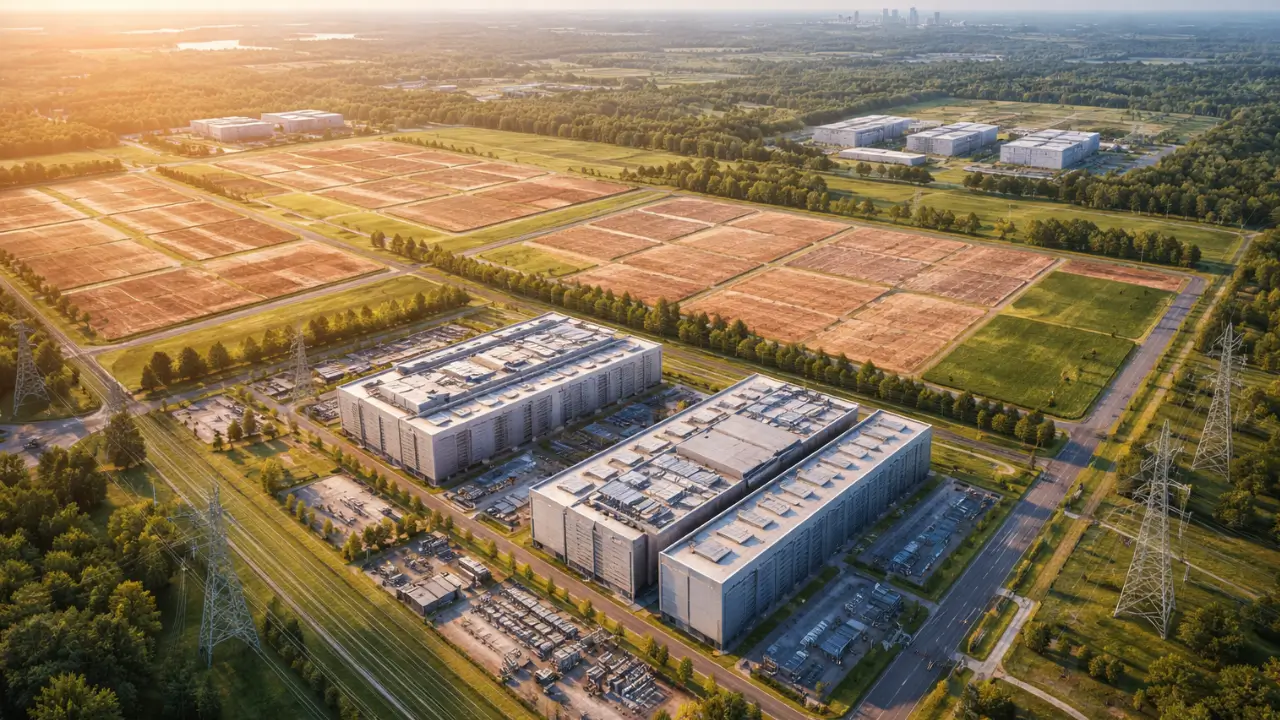
The New Front Line of Data Center Competition
Land has re-emerged as one of the most decisive variables in global data center expansion. Not undeveloped acreage alone, but parcels that arrive with zoning clarity, proximity to grid infrastructure, environmental approvals, and entitlement momentum already in place. Across North America, Europe, and Asia-Pacific, early land acquisition has become a competitive differentiator well before construction timelines are set.
For hyperscalers, colocation providers, and infrastructure investors, the pace of growth is now increasingly shaped upstream. Advantage often accrues to those that secured viable land positions years earlier. In many mature and emerging markets, the scarcity of build-ready sites has turned land banks into strategic assets, influencing expansion feasibility, speed to market, and capital efficiency.
This shift reflects a broader reassessment of development risk. While construction execution and financing remain critical, entitlement uncertainty, power access constraints, and permitting duration have become dominant variables. Land is no longer a passive input but an early determinant of competitive position.
Why “Build-Ready” Now Matters More Than Size
The definition of prime data center land has narrowed. Scale alone no longer guarantees suitability. Operators increasingly prioritize parcels that can transition from acquisition to construction without prolonged regulatory resets.
Power Access as a Core Land Attribute
Grid access has become inseparable from land valuation. In established hubs such as Northern Virginia, Frankfurt, and Singapore, utilities have publicly acknowledged tightening capacity and extended connection queues. In several large-load markets, timelines for new high-capacity connections now stretch multiple years, depending on location and load profile.
As a result, land located near substations, transmission corridors, or pre-designated industrial power zones carries a distinct premium. Sites without credible power pathways are increasingly viewed as speculative, regardless of price. Early grid alignment has therefore become a prerequisite rather than an optimization.
Zoning Certainty Over Theoretical Flexibility
Zoning approvals, once considered procedural, are now treated as strategic safeguards. In the United States, rezoning timelines for industrial or mission-critical use frequently extend beyond a year, particularly as local authorities reassess data center impacts on energy infrastructure and community resources. Comparable scrutiny exists across European planning regimes through environmental and land-use reviews.
Build-ready parcels with established industrial zoning or data center-specific entitlements have consequently gained disproportionate value. In recent transactions disclosed by developers and brokers, entitled land has traded at significant premiums to nearby unzoned sites, reflecting time certainty rather than physical attributes.
The Rise of Land Banking as a Growth Strategy
Hyperscale buyers increasingly favor partners with visible land pipelines. Developers able to demonstrate several years of buildable inventory are perceived as lower-risk counterparts, particularly for phased expansion programs. This dynamic has favored platforms with balance sheet capacity to carry land through extended pre-development periods.
Public disclosures from operators such as Equinix and Digital Realty have repeatedly emphasized land acquisition and entitlement progress as foundational to long-term growth planning, underscoring land readiness as a strategic enabler rather than a tactical decision.
Private Capital and Early Aggregation
Infrastructure-focused private equity has also become more active at the land stage. Several funds now back early land aggregation strategies, particularly in secondary markets positioned for spillover demand from constrained metros. These platforms seek to control future scarcity rather than compete once demand fully materializes.
This trend has altered competitive dynamics. Developers without secured land positions increasingly rely on joint ventures or powered-shell acquisitions rather than leading greenfield development.
Regional Variations in the Land Scramble
North America: Power Availability and Community Constraints
In the United States, land availability is less constrained by physical supply than by power access and community response. In markets such as Northern Virginia, public scrutiny around grid load and land use has increased, contributing to longer approval cycles. As a result, developers are moving earlier into adjacent jurisdictions or alternative states, securing land before policy sentiment shifts.
Texas, Ohio, and parts of the Southeast have benefited from this redistribution, supported by comparatively favorable grid conditions and industrial zoning. However, accelerated land absorption in these regions has begun to narrow that advantage.
Europe: Entitlements and Environmental Complexity
European development environments place greater emphasis on environmental assessments and planning alignment. Land suitable for data centers must navigate multi-layered approval processes, often extending timelines. This has elevated the value of parcels with pre-cleared environmental pathways or industrial precedents.
In constrained markets such as Amsterdam and Dublin, where policy interventions and grid limitations have reshaped expansion, operators increasingly pursue land years ahead of construction to preserve optionality.
Asia-Pacific: Density and Policy Alignment
In Asia-Pacific, urban density compresses land availability. Markets such as Singapore and Tokyo place strong emphasis on alignment with national infrastructure strategies, making government-supported zones particularly valuable.
India presents a different profile. While land supply remains relatively available, parcels near major metros with assured power, connectivity, and permitting clarity are being absorbed rapidly, especially around Mumbai, Chennai, and Hyderabad.
How Early Land Control Alters Cost Structures
Early land acquisition influences economics beyond speed to market.
Land secured ahead of zoning clarity or before market acceleration often carries lower acquisition costs. While entitlement and holding expenses apply, early movers frequently achieve lower all-in development costs than late entrants competing for fully entitled sites.
This advantage can translate into more competitive customer pricing or improved margin resilience during periods of cost inflation.
Financing and Risk Perception
From a capital markets perspective, land readiness reduces execution risk. Lenders and investors increasingly favor projects with secured land and advanced entitlements, viewing them as less exposed to regulatory or grid-related delays. This perception can improve financing terms and reduce contingency buffers. In an environment of tighter underwriting standards, such predictability has become a meaningful differentiator.
The Risk of Over-Accumulation
Aggressive land banking is not without risk. Holding undeveloped land ties up capital and exposes owners to tax, zoning, and policy shifts. In some jurisdictions, governments have revisited incentive structures or imposed new conditions related to energy use and environmental impact. Land acquired under earlier assumptions may require redesign or re-entitlement.
Demand Timing Uncertainty
While long-term demand drivers such as cloud expansion and AI workloads remain intact, short-term absorption can fluctuate. Developers holding extensive land inventories must manage balance sheet exposure carefully.
As a result, some operators increasingly favor phased acquisitions or option-based structures that preserve access while limiting upfront risk.
Land as Strategy, Not Inventory
The data center sector has entered a phase where land strategy influences competitive positioning as much as capital or technical capability. Build-ready sites are no longer passive inputs but active instruments of control over growth timelines and market access.
Early land acquisition allows operators to negotiate from strength with utilities, respond faster to customer demand, and reduce development uncertainty. It also raises barriers to entry, reshaping competitive dynamics across regions.
From a broader perspective, the race for build-ready land reflects an industry that increasingly competes on foresight. In this environment, those that planned earliest may not only build first, but sustain growth longest.