A long-planned experiment reaches its narrowest moment
After decades of scientific planning, diplomatic negotiation, and industrial coordination, the ITER fusion reactor has entered the most technically sensitive phase of its existence. At a sprawling construction site near Cadarache in southern France, the world’s largest nuclear fusion experiment is no longer defined by cranes and contracts alone. Instead, the project is now shaped by integration, verification, and the unforgiving constraints of plasma physics.
Formally known as the International Thermonuclear Experimental Reactor, ITER was created to answer a single unresolved question in energy science: whether controlled nuclear fusion can be sustained at a scale relevant to future power systems. The facility does not exist to generate electricity. Its mandate focuses on proving whether fusion reactions can be reliably produced, confined, and studied long enough to justify the next generation of reactors.
That ambition now confronts operational reality. Core systems are being brought together for the first time in coordinated sequences. In fusion research, this transition represents a decisive narrowing of uncertainty, where decades of design assumptions must align with physical behavior inside a functioning machine.
What ITER is designed to demonstrate, and what it is not
ITER is often described as an attempt to recreate the energy of the stars on Earth. Scientifically, that comparison reflects fusion’s underlying process rather than the reactor’s immediate purpose. The machine has been designed as an experimental platform, not as a source of commercial electricity.
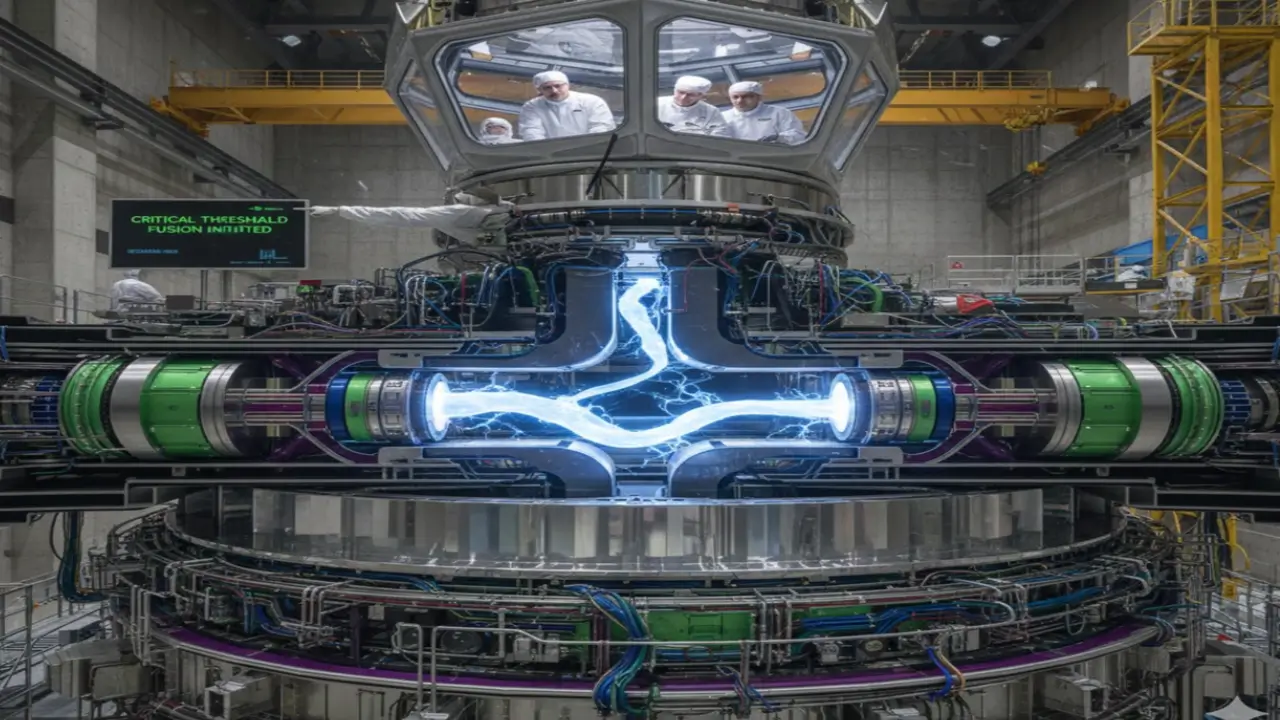
Using a tokamak configuration, ITER relies on powerful superconducting magnets to confine plasma inside a toroidal chamber. Under these conditions, hydrogen isotopes can reach temperatures exceeding those at the core of the sun, enabling fusion reactions to occur. The resulting energy is released as heat, which future reactors may one day convert into electricity.
Central to ITER’s mission is the demonstration of fusion energy gain, commonly expressed as Q ≥ 10. This metric refers to the ratio of fusion power produced in the plasma to the power injected to heat it. Importantly, this goal does not imply net electrical output to the grid. Electricity generation remains the responsibility of subsequent demonstration reactors that would build on ITER’s findings.
From geopolitical vision to physical machine
The origins of ITER lie in late 20th-century scientific diplomacy, when fusion research emerged as a rare area of sustained international cooperation. Over time, that vision solidified into a formal agreement among seven governing members: the European Union, China, India, Japan, South Korea, Russia, and the United States.
Together, these members represent a substantial share of the world’s population, industrial capacity, and scientific expertise. Beyond formal membership, many additional countries contribute through industrial supply chains, research collaborations, and technical partnerships. This global structure has shaped ITER into one of the most complex engineering projects ever undertaken.
Major components were manufactured across multiple continents and transported to southern France for final assembly. Each arrived with distinct engineering standards and production histories. Integrating those systems into a single operational device required years of alignment work, requalification, and, in some cases, redesign.
Why the current phase carries exceptional risk
ITER has now entered a stage dominated by system integration and early commissioning activities. At this point, individual subsystems are tested not in isolation, but in combination, under increasingly realistic operating conditions.
Superconducting magnets must maintain stability at cryogenic temperatures while carrying immense electrical currents. At the same time, vacuum systems are required to preserve ultra-low pressures inside the plasma chamber. Control software must respond within milliseconds to evolving plasma behavior, while cooling systems manage extreme thermal loads without introducing mechanical stress.
Unlike earlier construction stages, challenges identified now cannot be resolved through straightforward replacement. Corrections often require partial disassembly, additional testing, or revised operational strategies. For that reason, project leaders have emphasized verification and risk reduction over speed, even when doing so extends timelines.
The phrase “critical phase,” frequently used in reporting, reflects this convergence of complexity. While not an official scientific milestone, the term captures a period when small deviations can produce disproportionate consequences.
Fusion’s long struggle with control and stability
Fusion energy has resisted practical application not because of weak theoretical foundations, but because of the difficulty of controlling plasma under extreme conditions. Plasma behaves collectively, responding to magnetic fields, temperature gradients, and instabilities in ways that can change rapidly.
Earlier fusion experiments achieved important milestones, including high temperatures and brief periods of confinement. However, none combined scale, duration, and stability at the level ITER is designed to attempt. Each previous generation of machines addressed only part of the challenge.
ITER’s unprecedented size introduces both opportunity and risk. Larger plasmas can, in theory, offer improved confinement. At the same time, maintaining precise magnetic control across such a large system demands engineering tolerances that push the limits of current technology.
A project shaped by cooperation rather than competition
Unlike private fusion ventures or nationally focused laboratory programs, ITER does not pursue proprietary advantage. Its mandate emphasizes transparency, shared data, and collective learning across borders.
All experimental results generated at ITER are intended for open scientific dissemination. As a result, the reactor functions as a global reference platform rather than a commercial prototype. Researchers worldwide will be able to use its findings to refine models, validate simulations, and guide future reactor designs.
This approach brings trade-offs. Decision-making proceeds deliberately, and changes require consensus among partners. Nevertheless, the knowledge generated is designed to benefit the entire fusion community rather than a single organization or country.
Energy relevance without near-term promises
ITER’s progress unfolds against a backdrop of accelerating global energy transitions. Governments are investing heavily in renewable generation, energy storage, grid modernization, and efficiency improvements. Fusion occupies a much longer time horizon within this landscape.
Rather than competing with near-term solutions, ITER addresses a strategic question about the future. Its experiments are intended to determine whether fusion merits continued investment as a long-term energy option beyond the middle of the century.
By focusing on feasibility rather than deployment, the project provides clarity for policymakers and planners. Positive results would support sustained research and development, while clear limitations would redirect resources before larger commitments are made.
Schedule realism and evolving expectations
Significant delays have marked ITER’s construction history. Early timelines anticipated initial plasma experiments in the mid-2020s. Revised schedules now place the first plasma milestone in the early-to-mid 2030s, followed by progressively more complex experimental phases.
These changes reflect both technical discoveries and governance decisions. In several cases, component defects prompted extensive repair programs rather than acceptance of increased operational risk. Such choices slowed progress but reinforced confidence in the machine’s long-term reliability.
Although delays have attracted criticism, they also underscore the conservative engineering philosophy applied to fusion experiments operating at the edge of known physics.
What constitutes success at ITER
Public discussion often frames ITER’s outcome as a simple success-or-failure proposition. In practice, the project’s value will be measured across multiple dimensions.
Achieving stable plasma confinement at design parameters would validate decades of theoretical work. Even partial achievement would generate critical data on plasma behavior, materials performance, and control strategies. Unexpected limitations, if identified, would inform the design of future reactors before commercial deployment.
In that sense, ITER’s success lies in reducing uncertainty. Each experimental result, whether confirming or challenging expectations, advances understanding.
Why ITER advances quietly
Despite its scale and ambition, ITER progresses largely outside daily headlines. Technical milestones lack spectacle, and the facility’s remote location contributes to its low public profile. Moreover, the language of fusion science resists simplification.
Behind the scenes, however, energy ministries, research institutions, and engineering firms follow developments closely. Findings from ITER will influence fusion strategies worldwide, including those pursued by private ventures exploring alternative confinement approaches.
Silence, in this context, reflects anticipation rather than neglect.
Standing at a threshold defined by physics
As ITER enters this delicate phase, its future depends less on funding commitments and more on empirical outcomes. The machine now exists as an integrated system. Its components are being tested together under increasingly demanding conditions.
Progress will not arrive through dramatic announcements. Instead, it will emerge through cautious experimentation, peer-reviewed analysis, and incremental learning. For fusion science, this phase represents a narrowing path toward proof.
Whatever the outcome, ITER is now positioned to deliver answers that decades of theory alone could not provide, marking a defining moment in humanity’s pursuit of controlled fusion energy.