
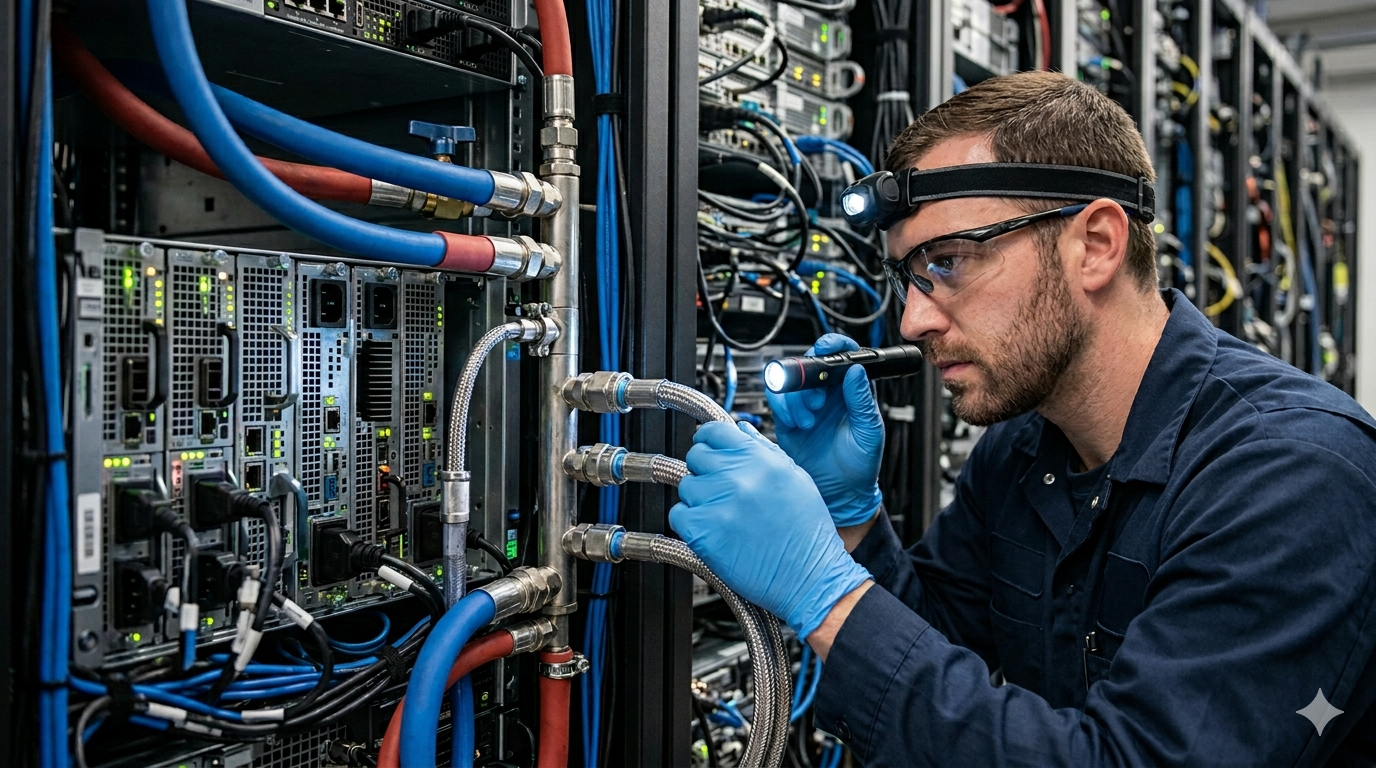
The AI infrastructure industry sold liquid cooling as a performance solution. Denser GPU clusters. Lower operating temperatures. Better power usage effectiveness. Higher compute density per square meter. All of these claims are accurate. What the industry did not sell, because most operators had not yet experienced it at scale, was the operational reality of maintaining liquid cooling infrastructure across facilities running tens of thousands of GPUs continuously at high utilization. That reality is now arriving, and it is more demanding than the facilities teams who inherited these systems were prepared for.

Air-cooled data centers have a maintenance profile that the industry has spent decades optimizing. CRAC units, hot-aisle containment systems, and raised floor plenums are well-understood technologies with established service intervals, readily available replacement parts, and a large workforce of trained technicians. Liquid cooling infrastructure, by contrast, is still establishing its operational baseline. Seal degradation rates under continuous high-load operation, coolant chemistry management requirements, leak detection system reliability, and planned maintenance window requirements are all being learned in real time as the first generation of large-scale liquid-cooled AI facilities accumulates operational hours.
The Seal and Leak Problem
The most operationally consequential maintenance challenge in liquid-cooled AI data centers is leak prevention and detection. Every connection point in a liquid cooling system is a potential leak site. A facility running direct-to-chip cooling across ten thousand GPU servers may have hundreds of thousands of connection points between coolant manifolds, quick-disconnect fittings, cold plates, and distribution loops. Each of these connections must maintain integrity under continuous thermal cycling as GPUs ramp between idle and full load states throughout the day. The thermal expansion and contraction that accompanies these load cycles stresses fittings in ways that static connections do not experience.
Seal degradation under continuous thermal cycling is faster than most facilities teams anticipated based on vendor specifications developed under laboratory conditions. Real-world operational data from early large-scale deployments shows that fitting inspection and replacement cycles need to be more frequent than initial maintenance schedules assumed. The consequence of undetected leaks in liquid-cooled environments is severe. Even small coolant releases can cause immediate GPU failures if liquid contacts circuit boards. Larger leaks can disable entire cooling zones, forcing emergency shutdowns of the GPU clusters they serve. The downstream cost of a major leak event in a facility running committed hyperscaler workloads substantially exceeds the cost of the maintenance program that would have prevented it.

The Coolant Chemistry Challenge
Maintaining the chemical properties of liquid coolant in a large-scale data center cooling loop is a continuous operational requirement that air-cooled facilities simply do not have. Coolants degrade over time through oxidation, biological contamination, and chemical reactions with the metals in the cooling loop. Degraded coolant reduces heat transfer efficiency, accelerates corrosion of cooling infrastructure components, and can deposit scale that reduces flow rates and clogs narrow cooling channels. Monitoring coolant chemistry, replenishing additives, and scheduling full coolant replacement cycles require expertise and operational processes that most data center teams did not previously need.
The challenge is compounded by the variety of cooling technologies now deployed in AI data centers. Direct-to-chip cooling, rear-door heat exchangers, and immersion cooling all use different coolant formulations with different chemistry management requirements. A facility running multiple cooling approaches across different equipment generations may be managing several distinct coolant chemistries simultaneously. As covered in our analysis of the time-to-power crisis as AI’s hidden scaling ceiling, the operational complexity that AI infrastructure creates extends well beyond the power and grid challenges that receive most attention. Coolant chemistry management is a less visible but equally demanding dimension of that complexity.
The Technician Shortage Nobody Talked About
The workforce implications of the shift to liquid cooling are the maintenance challenge that receives the least attention and will prove the most difficult to address quickly. Air-cooled data center operations require technicians trained in HVAC systems, electrical infrastructure, and IT hardware. Liquid cooling operations require all of those skills plus specialized knowledge of fluid dynamics, chemical handling, hydraulic system maintenance, and leak detection that the data center technician workforce has not yet developed at meaningful scale.
Technicians who can competently maintain large-scale liquid cooling systems in AI data centers are in short supply relative to the demand this buildout is creating. Cooling equipment vendors and data center operators are developing training programmes to build internal capability, but it takes years to turn trainees into competent field technicians. In the near term, operators are competing for a small pool of experienced liquid cooling technicians, and their compensation is rising rapidly in response to the demand imbalance. As a result, the operational cost premium of liquid cooling over air cooling is not just the capital cost of the cooling infrastructure itself. It also includes the workforce development investment required to maintain it reliably, and most facility economics analyses have not adequately modelled that cost.
What Operators Should Be Planning For
Operators who manage the liquid cooling maintenance challenge most effectively treat it as a first-order operational design problem rather than an afterthought to the cooling architecture decision. They design facilities with accessible connection points that technicians can inspect without taking adjacent servers offline, specify coolant monitoring systems that provide continuous chemistry data instead of requiring periodic manual sampling, and invest in technician training programmes before facilities come online rather than after maintenance problems emerge. These practices reduce the operational cost of liquid cooling compared with operators who deploy the same hardware without the same level of operational preparation.
The broader lesson is that liquid cooling is not simply a hardware upgrade over air cooling. It is a fundamentally different operational model that requires different skills, different processes, and different maintenance economics. The industry will develop the operational frameworks that liquid cooling demands. However, it will do so through accumulated experience at operating facilities rather than through vendor specifications written before that experience existed. The operators who accumulate that experience earliest, and who invest in documenting and institutionalizing what they learn, will have a durable operational advantage over those who are still climbing the learning curve when liquid cooling becomes the industry standard rather than the leading edge.











