
NVIDIA H200 shipments delayed to Q3  · BREAKING: Microsoft confirms 3GW data centre expansion in Asia-Pacific ·  AWS announces new sovereign cloud regions in India and UAE  · Arm-based servers now 24% of hyperscale deployments ·  EU AI Act enforcement enters phase two  · Global data centre investment hits $612B in 2026 ·  TSMC Arizona yields improve to 68% on 3nm process  · OpenAI valuation reaches $400B after latest funding round ·  NVIDIA H200 shipments delayed to Q3  · BREAKING: Microsoft confirms 3GW data centre expansion in Asia-Pacific ·  AWS announces new sovereign cloud regions in India and UAE  · Arm-based servers now 24% of hyperscale deployments ·  EU AI Act enforcement enters phase two  · Global data centre investment hits $612B in 2026

Prefabricated Modules Are Redefining AI Data Center Deployment

The construction timeline for a conventional data center has always been one of the most stubborn constraints in infrastructure development.

Share
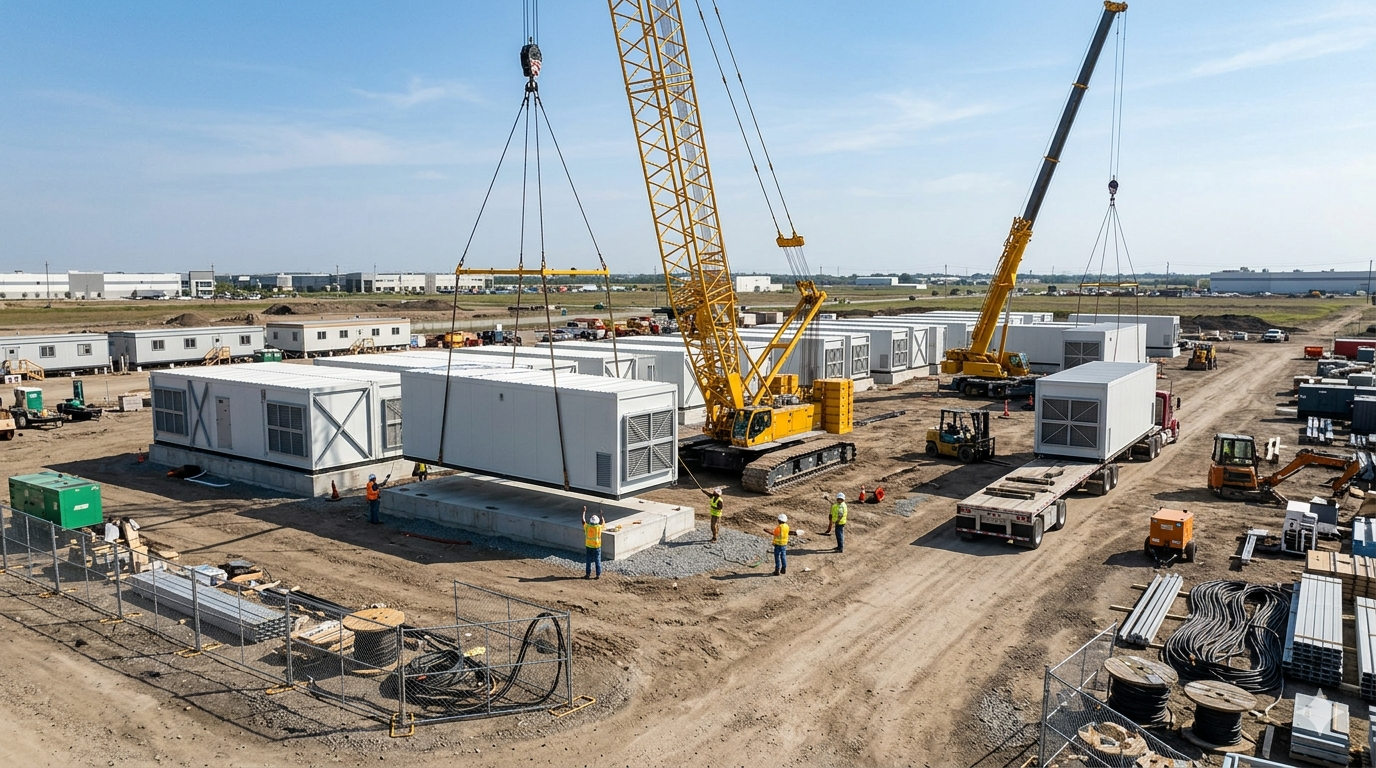
prefabricated data center modules AI deployment construction site installation

The construction timeline for a conventional data center has always been one of the most stubborn constraints in infrastructure development. Site preparation, structural work, mechanical and electrical installation, commissioning, and testing follow a sequence that resists compression beyond a certain point regardless of how much capital or labor an operator throws at it. For most of the industry’s history, this timeline was an accepted reality rather than a competitive problem, because the pace at which customers needed capacity rarely outstripped what conventional construction could deliver. AI infrastructure has broken that equilibrium. The demand for compute capacity that hyperscalers and AI-native companies generate moves faster than conventional construction can respond, and the gap between what the market needs and what traditional building methods deliver creates a structural opening for prefabricated modular approaches.

Prefabricated data center modules are factory-built infrastructure units that arrive on site with mechanical, electrical, and in some cases IT infrastructure pre-installed and pre-tested. The manufacturing process runs in parallel with site preparation rather than sequentially after it, which removes one of the primary sources of schedule delay in conventional construction. A module that leaves the factory with its cooling system installed, its power distribution equipment wired, and its monitoring infrastructure commissioned can deploy on a prepared site in days rather than the months that field installation of equivalent systems requires. The parallel workstream model that prefabrication enables does not just accelerate deployment. It also shifts a significant portion of quality risk from the unpredictable field environment to the controlled factory environment, where standardized processes produce more reliable outcomes than site-based installation achieves.

Why AI Workloads Changed the Calculus

Conventional data center construction optimized for flexibility and longevity at the expense of speed. Engineers designed buildings to accommodate a range of potential tenants and workload types across a twenty-to-thirty-year operational life, which meant their mechanical and electrical systems carried headroom and configurability that AI infrastructure does not require. AI training facilities need maximum power density, optimized cooling for sustained high-intensity loads, and high-bandwidth network infrastructure between racks. Prefabricated modules designed specifically for AI workloads eliminate the generalist overhead that conventional construction carries, delivering purpose-built infrastructure faster and at lower cost per unit of AI compute capacity.

The urgency that hyperscalers and cloud operators bring to AI capacity expansion has also changed the commercial calculus around prefabrication. A hyperscaler that needs to bring AI training capacity online to meet customer commitments does not treat a six-month reduction in deployment timeline as a convenience. It treats it as a competitive necessity that justifies paying a premium for modular approaches over conventional construction. The willingness to pay for speed has created a commercial environment that supports investment in modular manufacturing capacity at a scale that makes the economics of prefabrication increasingly competitive with conventional construction even when speed is not the primary consideration.

The Manufacturing and Supply Chain Dimension

The shift toward prefabricated modules transfers a significant portion of data center construction activity from the job site to the factory floor, creating both opportunities and challenges for the supply chains that serve the industry. Factory production of modules enables quality control processes, material handling efficiencies, and workforce specialization that field construction cannot replicate. A factory that produces the same module configuration repeatedly develops process knowledge and tooling that reduce production time and improve consistency across units. The learning curve benefits of factory production compound over time in ways that site-based construction cannot access because each field project starts from a relatively clean slate regardless of how many similar projects the contractor has previously completed.

Standardized module designs allow operators to establish long-term relationships with equipment suppliers that provide pricing certainty and delivery reliability that project-by-project procurement cannot match. A manufacturer producing modules at volume can commit to transformer deliveries, cooling equipment specifications, and switchgear configurations across multiple production runs in ways that a site-based contractor procuring for a single project cannot. The supply chain stability that volume production enables grows increasingly valuable in an environment where lead times for critical electrical and mechanical equipment have extended substantially due to demand growth across the broader electrification market.

Cooling Integration in Modular Systems

The integration of cooling systems into prefabricated modules ranks among the most technically demanding aspects of modular data center design and one of the areas where the gap between well-designed and poorly designed modules most directly affects AI workload performance. Air cooling systems integrate into modules with reasonable reliability because their interfaces are relatively standardized and their commissioning requirements suit a factory environment well. Liquid cooling systems present more significant integration challenges because their interfaces with facility water circuits, their leak detection requirements, and their commissioning procedures involve interactions with site infrastructure that a factory cannot fully validate until the module connects to the facility systems it will operate with in service.

The manufacturers who have solved this integration challenge most effectively design modules with clearly defined interfaces that simplify field connection and develop commissioning procedures that separate factory-validated internal functions from the site-dependent connections that require field verification. This design philosophy produces modules that arrive on site ready for connection rather than requiring significant internal commissioning work in the field. The reduction in field commissioning scope that this approach enables is one of the primary mechanisms through which well-designed modular deployments achieve deployment timelines that conventional construction cannot approach.

Limitations That Prefabrication Has Not Resolved

Prefabricated modules compress the above-ground construction timeline significantly, but they do not eliminate the site preparation work that determines when a facility can first accept modules. Civil engineering, foundation construction, utility connections, and site infrastructure must still complete in the field before modules can deploy, and these activities face the same weather, permitting, and labor market constraints that conventional construction encounters. The parallel workstream benefit of prefabrication applies to the above-ground construction phase, not to site preparation, which means that the total project timeline reduction depends substantially on how quickly site preparation completes and how well it parallels the module manufacturing schedule.

The standardization that makes prefabrication efficient also creates constraints that some operators find limiting. A module designed for a specific rack density and cooling configuration delivers maximum value when deployed in applications that match its design assumptions, but operators cannot reconfigure it after manufacture to accommodate workloads with different requirements as efficiently as a conventionally built facility allows. Operators who expect significant evolution in their workload profiles over the operating life of their facilities need to think carefully about whether the deployment speed advantages of prefabrication justify the reduced flexibility that standardized modules carry. For operators whose workload requirements are well-defined and relatively stable, which describes most hyperscale AI training deployments, the flexibility limitation is largely theoretical.


[simple-author-box]

More from AI Infrastructure

Power negotiations often conclude long before operational constraints reveal themselves inside a live facility.

Artificial intelligence infrastructure has compressed deployment timelines to the point where electrical capacity is

Boards increasingly expect organizations to support sustainability reporting with evidence that aligns with governance

COMPUTE WEEKLY

The briefing that 40,000+ tech leaders read every Monday. Sharp, fast, essential.

Great! We’ve received your information.

We couldn’t process your submission. Please retry

Building an AI Startup Without Owning GPUs

Not owning GPUs has become the default, deliberate strategy for building an AI company — not a compromise founders accept reluctantly. H100 rental rates fell 64-75% in fifteen months, a dense ecosystem of neoclouds and inference-as-a-service providers now lets startups skip infrastructure entirely, and credit programs can fund a company’s first year before a founder writes a check
Most Read

Infrastructure planning discussions often prioritize engineering, construction, and utility considerations before examining how end

AI infrastructure deployment schedules depend on coordinated progress across hardware availability, electrical infrastructure, cooling

Artificial intelligence has transformed the economics of digital infrastructure. Every new AI model requires

Data centers do not visibly smoke. They have no smokestacks, no visible exhaust, and

Artificial intelligence has transformed the economics of digital infrastructure. Companies once competed by acquiring

Disruptor Spotlight

Cerebras Systems

The chip that makes Nvidia nervous. Cerebras’ Wafer Scale Engine is rewriting the rules of AI inference at scale.
Faster
0 x
YoY Revenue
0 x
Transistors
0 T
Market Pulse
NVDA
$924.60
-2.11%
MSFT
$421.30
-2.94%
AMZN
$192.80
-4.87%
AMD
$924.60
-2.40%
TSMC
$924.60
-2.32%
Indicative only · Not financial advice
Upcoming Events
SEP
The AI Infrastructure Race (India)
WEBINAR · ONLINE
The AI Infrastructure Race: Won on Power, Land and Trust — Not Capital
MAY
0
AI Infrastructure Summit
DUBAI · IN PERSON
MEA’s premier AI infrastructure event.
JUN
0 0
Compute Forecast Summit
SINGAPORE · IN PERSON
Our flagship APAC event. Early bird open.
Latest Moves
Live
ecolab
Ecolab Deepens Cooling Strategy With $4.75B CoolIT Acquisition
Ecolab is making one of its biggest moves yet into AI infrastructure after completing its $4.75 billion acquisition of liquid cooling specialist CoolIT Systems
Pure DC AVK Europe data center microgrid Dublin 110MW AI infrastructure Ireland 2026
Pure DC and AVK Deploy Europe’s First 110 MW Data Center Microgrid in Dublin
The Pure DC Dublin microgrid has made history as Europe’s first large-scale on-site data center microgrid, launched in partnership with power solutions provider AVK at Pure DC’s campus in Ireland.
Pace Digitek
Pace Digitek Partners With MEGMEET to Expand AI Data Center Power Business
India’s AI infrastructure ecosystem continues to mature as domestic technology manufacturers move beyond traditional telecommunications and industrial markets toward high-growth digital infrastructure opportunities
Follow Compute Forecast
11K followers
1200 followers
Companies to Watch
CW
CoreWeave
Neo Cloud · $19B · IPO Watch
CB
Cerebras Systems
AI Hardware · $4.25B · Pre-IPO
G42
G42
Sovereign AI · Abu Dhabi
H
Humain
Saudi AI · $40B Fund
Latest Podcast
AI Capex, Cloud Margins & the Nuclear Bet
48 MIN · 25 APR 2026

Prefabricated Modules Are Redefining AI Data Center Deployment

The construction timeline for a conventional data center has always been one of the most stubborn constraints in infrastructure development.

Share
prefabricated data center modules AI deployment construction site installation
12
847 SHARES

0
SHARES

[simple-author-box]

More from AI Infrastructure

Infrastructure planning discussions often prioritize engineering, construction, and utility considerations before examining how end

AI infrastructure deployment schedules depend on coordinated progress across hardware availability, electrical infrastructure, cooling

Artificial intelligence has transformed the economics of digital infrastructure. Every new AI model requires

Data centers do not visibly smoke. They have no smokestacks, no visible exhaust, and

COMPUTE WEEKLY

The briefing that 40,000+ tech leaders read every Monday. Sharp, fast, essential.

Great! We’ve received your information.

We couldn’t process your submission. Please retry

Global AI Infrastructure Outlook 2026

The briefing that 40,000+ tech leaders read every Monday. Sharp, fast, essential.
Download Free
Most Read

Infrastructure planning discussions often prioritize engineering, construction, and utility considerations before examining how end

AI infrastructure deployment schedules depend on coordinated progress across hardware availability, electrical infrastructure, cooling

Artificial intelligence has transformed the economics of digital infrastructure. Every new AI model requires

Data centers do not visibly smoke. They have no smokestacks, no visible exhaust, and

Artificial intelligence has transformed the economics of digital infrastructure. Companies once competed by acquiring

Disruptor Spotlight

Cerebras Systems

The chip that makes Nvidia nervous. Cerebras’ Wafer Scale Engine is rewriting the rules of AI inference at scale.
Faster
0 x
YoY Revenue
0 x
Transistors
0 T
Market Pulse
NVDA
$924.60
+2.4%
MSFT
$421.30
+1.1%
AMZN
$192.80
-0.6%
NVDA
$924.60
+2.4%
NVDA
$924.60
+2.4%
Indicative only · Not financial advice
Upcoming Events
MAY
0 0
DCD Global — London
LONDON · IN PERSON
World’s largest DC event. CF is media partner.
MAY
0
AI Infrastructure Summit
DUBAI · IN PERSON
MEA’s premier AI infrastructure event.
JUN
0 0

Compute Forecast Summit

SINGAPORE · IN PERSON
Our flagship APAC event. Early bird open.
Latest Moves
  • Live
Sam Altman
OpenAI appoints new Chief Infrastructure Officer to lead $100B DC programme
27 APR · OPENAI
Sam Altman
OpenAI appoints new Chief Infrastructure Officer to lead $100B DC programme
27 APR · OPENAI
Sam Altman
OpenAI appoints new Chief Infrastructure Officer to lead $100B DC programme
27 APR · OPENAI
Follow Compute Forecast
18.4K followers
12.1K followers
9.3K subscribers
41 episodes
Companies to Watch
CW
CoreWeave
Neo Cloud · $19B · IPO Watch
CB
Cerebras Systems
AI Hardware · $4.25B · Pre-IPO
G42
G42
Sovereign AI · Abu Dhabi
CW
Humain
Saudi AI · $40B Fund
Latest Podcast
AI Capex, Cloud Margins & the Nuclear Bet
48 MIN · 25 APR 2026
Scroll to Top








