
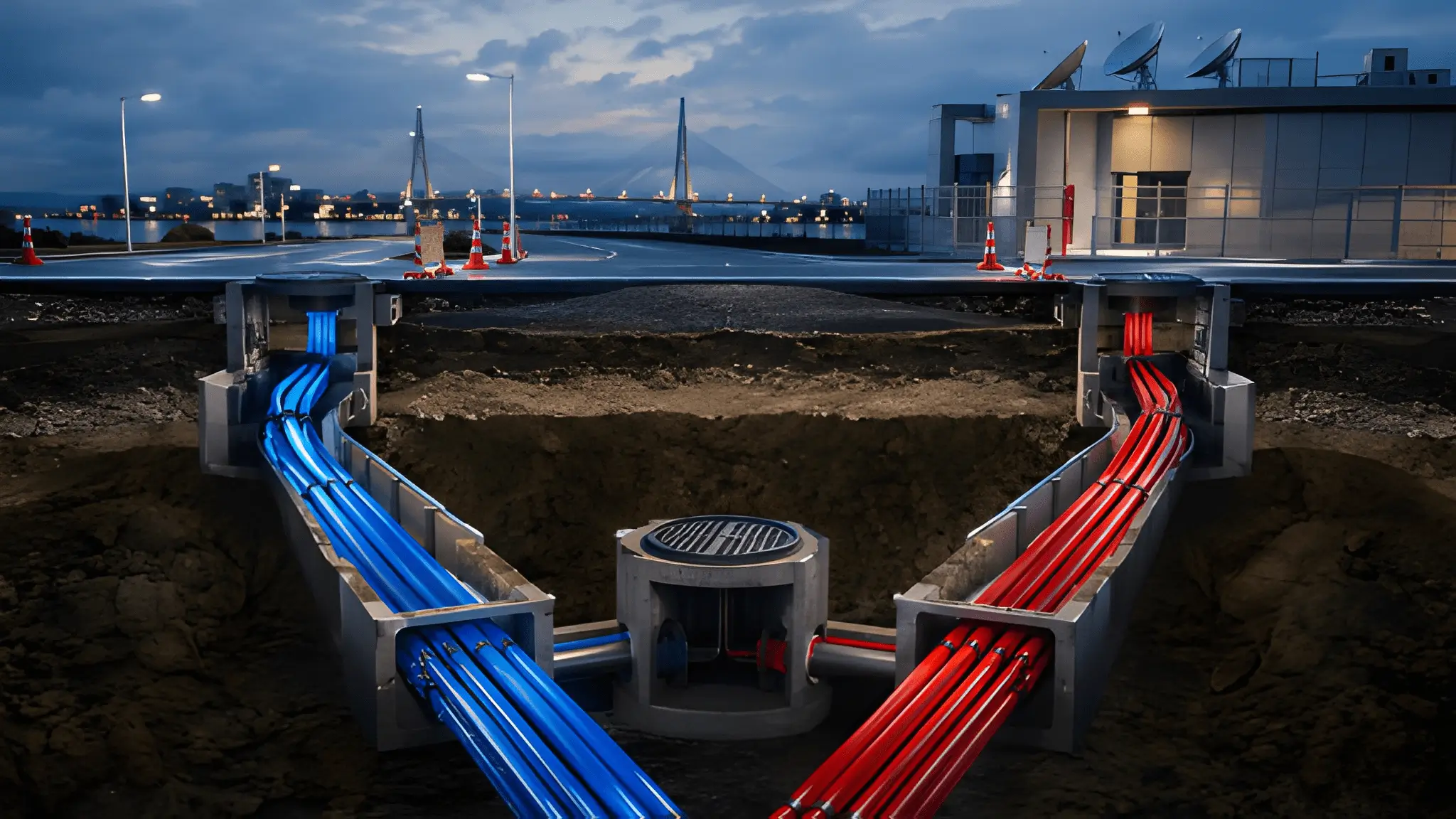
Network resilience often appears stronger in planning documents than it proves during an actual infrastructure failure. Engineering drawings can display separate fiber paths entering opposite sides of a campus while overlooking how those paths traveled together long before reaching the property boundary. Design packages can depict multiple colored routes as independent connectivity paths, yet those diagrams typically do not represent every civil dependency beneath streets, utility corridors, or shared outside plant infrastructure. Decisions made during metro network expansion, permitting, and construction often influence resilience far more than the final campus entrance configuration. Physical infrastructure ultimately determines whether redundant connectivity survives excavation damage, flooding, transportation projects, or utility maintenance without widespread disruption. Organizations investing in high-availability digital infrastructure therefore benefit from validating every outside plant segment rather than accepting logical diversity at face value.

Two Lines on a Map, One Trench in Reality
Network diagrams frequently illustrate two independent carrier paths reaching the same destination from different directions across a metropolitan area. That presentation creates confidence because each circuit appears visually separated throughout the service documentation provided during procurement. Detailed outside plant validation, however, sometimes reveals both services occupying the same underground duct bank for several city blocks before diverging closer to customer facilities. Civil engineering priorities often encourage utilities to share established corridors because existing rights-of-way simplify permitting, maintenance access, and future expansion activities. Shared bridge crossings, common utility easements, and parallel conduit installations can introduce infrastructure dependencies that remain invisible within conventional connectivity drawings. Understanding where physical convergence occurs allows engineering teams to distinguish genuine infrastructure resilience from redundancy that exists only within contractual documentation.
Engineering reviews become considerably more valuable when they extend beyond logical routing information into detailed civil infrastructure records and geographic validation. Construction drawings, conduit ownership records, municipal permitting archives, and carrier outside plant documentation together provide a more accurate representation of physical separation than network topology diagrams alone. Field inspections may identify situations where independent providers lease capacity through identical conduit systems despite marketing their services as separate routes. Likewise, aerial infrastructure can create another hidden dependency when multiple cables share the same bridge attachment or utility pole alignment across vulnerable crossings. Fiber diversity achieves its intended purpose only when every critical segment remains physically independent throughout the route instead of separating only near customer premises. Infrastructure owners who verify these conditions before deployment reduce the likelihood that a single excavation or structural incident interrupts multiple services simultaneously.
Entry Point Illusion
Multiple building entrances are commonly specified during resilient network design because they provide physical separation at the campus boundary while addressing one aspect of pathway diversity. Separate conduit penetrations, diverse meet-me rooms, and isolated equipment spaces certainly improve resilience inside the property when designed correctly. However, those measures cannot eliminate upstream exposure if every conduit ultimately returns to the same lead-in chamber or underground manhole network beyond the site perimeter.Carrier service documentation generally identifies campus entry locations, while detailed outside plant routing beyond the customer boundary may require additional engineering validation or carrier disclosure. This distinction becomes increasingly important for facilities supporting cloud platforms, financial services, healthcare systems, and artificial intelligence workloads where uninterrupted connectivity directly affects operational continuity. Infrastructure validation therefore should continue well beyond the fence line until every meaningful convergence point has been identified and documented.

Lead-in diversity should be evaluated as an engineering characteristic instead of a contractual statement because physical construction determines the actual level of resilience delivered to the facility. Separate conduits entering opposite sides of a campus may still terminate within the same underground vault before extending into municipal infrastructure shared by multiple carriers. Such arrangements reduce the effectiveness of redundant network investments because localized excavation damage near that convergence point could interrupt every supposedly independent service. Design verification benefits from combining geographic information systems, as-built civil drawings, outside plant records, and physical inspections to establish whether infrastructure separation remains intact from end to end. Independent lead-in facilities should maintain distinct containment, separate transition structures, and isolated pathways that minimize common points of failure throughout the entire outside plant segment. Organizations adopting this validation process gain a clearer understanding of actual infrastructure resilience before commissioning mission-critical digital environments.
Where Metro Fibre Actually Converges
Metropolitan fiber infrastructure naturally encounters geographic constraints that influence where multiple routes eventually come together despite appearing separate across planning documents. Rivers, rail corridors, controlled-access highways, tunnels, and utility crossings frequently limit the number of practical civil pathways available to network operators. Infrastructure planners often rely on existing crossings because constructing new bridges, tunnels, or directional drilling projects introduces additional permitting requirements, engineering complexity, and capital investment. Consequently, independent carrier services can share identical bridge structures, underground crossings, or transportation corridors without customers recognizing those common dependencies during procurement. Physical convergence at these locations creates concentrated infrastructure risk because a single structural incident or construction activity may simultaneously affect multiple providers. Comprehensive resilience assessments therefore benefit from identifying every unavoidable geographic bottleneck before critical connectivity services become operational.
Metro network analysis becomes significantly stronger when engineering teams evaluate the complete outside plant environment instead of focusing exclusively on carrier ownership or logical routing information. Geographic information systems, municipal infrastructure databases, utility corridor mapping, and construction records collectively provide valuable evidence regarding where fiber paths physically overlap. Engineers can compare these resources against carrier documentation to determine whether supposedly independent circuits traverse identical transportation infrastructure before reaching separate backbone facilities. Hidden convergence frequently occurs at locations where environmental, regulatory, or engineering limitations restrict the number of feasible construction alternatives available within the metropolitan landscape. Organizations seeking higher levels of operational resilience can request route transparency from providers and validate those findings through independent engineering reviews before approving critical network deployments. These verification practices establish a stronger technical foundation for resilient campus connectivity while reducing uncertainty surrounding shared outside plant infrastructure.
Designing Separation That Survives Construction
Physical separation begins with engineering standards that define measurable distances between independent pathways rather than relying on conceptual route diversity alone. Separate containment systems, dedicated duct banks, isolated utility easements, and individually engineered crossings all reduce the likelihood that a single construction activity affects multiple circuits simultaneously. Civil design teams should evaluate the complete infrastructure lifecycle because future maintenance, utility upgrades, and municipal development projects often introduce new risks long after initial commissioning. Furthermore, construction specifications should require contractors to preserve the physical separation distances defined by the approved engineering design while maintaining independent containment throughout every phase of installation. Engineering inspections performed during construction help confirm that approved drawings accurately reflect the infrastructure ultimately installed beneath the ground. Documentation created through this verification process establishes an auditable record supporting future maintenance, resilience planning, and infrastructure expansion without relying solely on historical assumptions.
Effective resilience also depends on governance practices that preserve separation after construction has concluded because infrastructure conditions continue to evolve over time. New utility installations, transportation improvements, emergency repairs, and municipal redevelopment can gradually reduce originally engineered spacing if change management processes overlook existing critical infrastructure. Campus operators therefore benefit from maintaining detailed as-built documentation, conducting periodic field verification, and requiring engineering review before approving nearby excavation activities. Independent containment should remain protected throughout operational life rather than becoming compromised through incremental civil modifications that appear insignificant when viewed individually. Contract language can reinforce these objectives by requiring evidence of maintained physical independence instead of accepting generalized statements regarding network diversity. Infrastructure resilience improves when engineering discipline, construction oversight, and long-term asset management operate together under consistent technical standards.
Diversity Is Built, Not Declared
Procurement documents, service contracts, and network diagrams remain valuable planning tools, yet they cannot independently demonstrate whether redundant connectivity will withstand real-world infrastructure failures. Physical verification provides the evidence needed to distinguish genuine infrastructure independence from designs that simply appear resilient within logical network representations. Every critical outside plant segment deserves the same engineering scrutiny applied to electrical distribution, cooling systems, and structural integrity because communication infrastructure has become equally essential for continuous operations. Finally, organizations pursuing higher availability should incorporate civil validation into project governance before accepting claims regarding independent network connectivity. Engineering confidence grows from documented physical separation, verified construction practices, and transparent outside plant analysis rather than visual route illustrations alone. Resilient digital campuses ultimately depend upon infrastructure that remains physically independent throughout the complete network journey instead of becoming vulnerable at hidden convergence points beneath the surrounding metropolitan environment.
Sustainable resilience requires continuous verification because metropolitan infrastructure changes throughout its operational life as utilities expand, transportation networks evolve, and maintenance activities reshape underground environments. Engineering teams that periodically reassess physical routing can identify emerging common points of failure before they become operational risks affecting mission-critical services. Independent audits supported by updated as-built records, geographic analysis, and carrier collaboration provide stronger assurance than relying exclusively on historical design assumptions established during initial deployment. Resilient connectivity is best established through engineered physical separation that can be verified with documented infrastructure evidence rather than relying solely on contractual descriptions established during procurement. Applying consistent engineering review across every component of the outside plant aligns connectivity infrastructure with the technical governance typically applied to other critical facility systems. Physical separation therefore becomes a continuously maintained engineering objective that strengthens distributed campus resilience through verifiable infrastructure rather than documented intent alone.











