
Built to Deploy, Not to Last
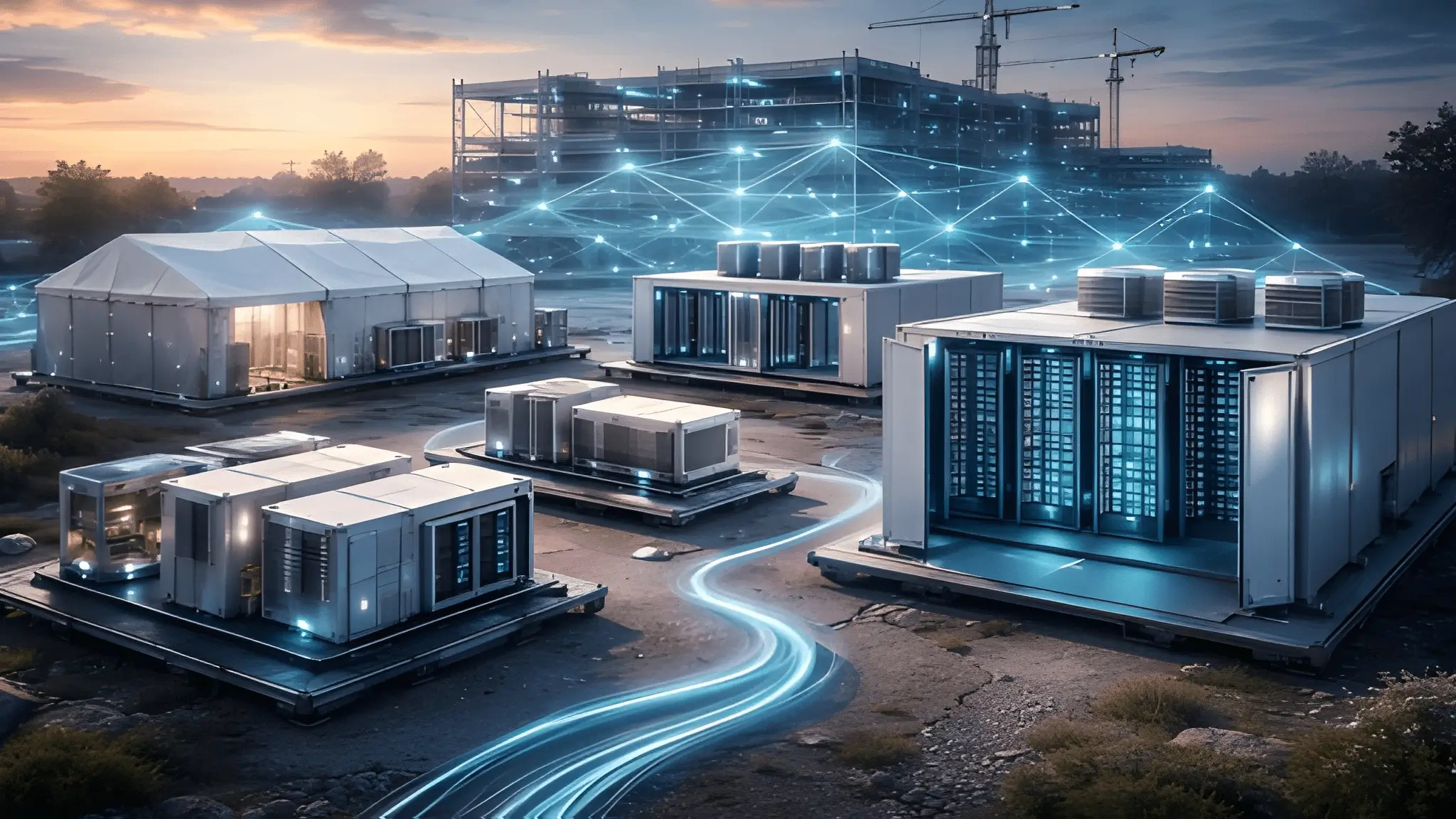
The design philosophy of segments of modern data center infrastructure, particularly modular and edge deployments, has increasingly prioritized deployment velocity alongside durability as demand patterns become more variable. Engineers in modular and prefabricated data center projects prioritize rapid activation timelines, which in some deployments can be measured in weeks rather than years. This change reflects a growing recognition in specific high-growth segments such as AI and edge computing that certain workloads may not justify uniform multi-decade infrastructure commitments. Consequently, modular enclosures such as prefabricated skids, containerized units, and temporary structures have gained operational legitimacy across enterprise and hyperscale environments. Deployment-first strategies allow operators to align infrastructure availability with near-term demand signals rather than speculative long-term forecasts. The resulting architecture emphasizes readiness, portability, and scalability in specific deployment models, contributing to evolving methods of evaluating infrastructure value.

In high-performance computing segments, shorter hardware upgrade cycles reinforce this transition toward more flexible infrastructure models. Certain high-density compute environments, particularly those supporting AI workloads, may require significant upgrades within five to seven years despite facilities being designed for longer operational lifespans. Some operators in rapidly evolving compute segments increasingly treat portions of infrastructure as more adaptable layers that can be upgraded or replaced over shorter cycles. This approach reduces stranded capital risk and aligns asset lifecycles with technology iteration cycles more effectively. Temporary deployments offer a pragmatic solution by enabling continuous replacement without significant sunk-cost penalties. In selected deployment models, greater emphasis is placed on maintaining functional relevance alongside structural longevity.
Short-Lifecycle Infrastructure Is Becoming a Strategy
Some organizations, particularly in edge and high-growth compute segments, treat shorter lifecycle infrastructure as a strategic lever. This shift reflects a growing understanding that flexibility in infrastructure turnover enables faster adoption of emerging technologies without legacy constraints. Enterprises leverage shorter deployment cycles to integrate new hardware generations, optimize energy efficiency, and respond to evolving regulatory environments. In certain deployment models, operators complement traditional long-term amortization with more iterative reinvestment cycles aligned to technology upgrades. This model supports continuous modernization, ensuring that infrastructure remains competitive in performance-sensitive applications. It also reduces the operational friction associated with large-scale retrofits in aging facilities.
The financial implications of this strategy extend beyond capital expenditure optimization, as shorter infrastructure lifecycles can improve alignment between infrastructure costs and revenue generation timelines in environments with rapidly changing demand. Operators can scale investments incrementally, reducing exposure to demand forecasting inaccuracies and market volatility. This approach also mitigates risks associated with technological lock-in, allowing organizations to pivot architectures as workloads evolve. Modular deployments support phased expansion and contraction, enabling precise capacity management across distributed environments. Furthermore, rapid iteration cycles facilitate experimentation with new cooling techniques, power architectures, and workload distribution models. In some operational models, infrastructure strategy incorporates iterative principles that are comparable to software development cycles.

When Construction Becomes Configuration
The transformation of certain data center delivery models has introduced configuration-driven approaches alongside traditional construction methods. Prefabrication and modular assembly techniques enable infrastructure components to arrive pre-integrated, reducing construction complexity and deployment timelines significantly. This shift allows operators to treat infrastructure deployment as a repeatable process, similar to software provisioning workflows. Standardized modules can be assembled, connected, and commissioned with minimal customization, ensuring consistency across deployments. Configuration-driven deployment models improve predictability in cost, performance, and delivery timelines. As a result, aspects of infrastructure deployment increasingly adopt repeatable and standardized processes similar to principles used in DevOps.
The convergence of physical infrastructure and digital orchestration further accelerates this transition, as software-defined controls enable rapid configuration of compute, storage, and networking resources. Operators can deploy capacity in modular increments, aligning infrastructure provisioning with real-time demand signals. This capability can reduce reliance on large-scale construction projects in scenarios where modular deployment is viable. Infrastructure becomes an assemblage of interoperable components that can be configured dynamically based on workload requirements. Consequently, integration between physical infrastructure and digital control systems continues to increase. The result is improved operational agility and responsiveness in environments that adopt these integrated approaches.
The Flexibility Premium No One Is Pricing Yet
Adaptability in infrastructure design introduces a form of economic value that traditional financial models fail to capture effectively. Redeployability, modular scalability, and rapid reconfiguration capabilities provide operators with strategic advantages that extend beyond immediate cost considerations. These attributes enable organizations to respond to demand fluctuations, regulatory changes, and technological advancements with minimal disruption. Conventional ROI frameworks typically prioritize static metrics such as utilization rates and depreciation schedules. This can lead to underestimation of the operational value associated with adaptable infrastructure designs. As infrastructure strategies evolve, financial models may increasingly incorporate flexibility-related factors.
The operational benefits of flexibility manifest in improved resilience, reduced downtime, and enhanced capacity management across distributed environments. Modular infrastructure allows operators to reallocate resources efficiently, minimizing underutilization and maximizing return on deployed assets. This capability proves particularly valuable in edge computing scenarios, where demand patterns vary significantly across locations. Moreover, flexibility reduces the risks associated with overprovisioning, enabling more precise alignment between capacity and demand. Infrastructure investments become more dynamic, supporting continuous optimization rather than static planning. As a result, adaptability is increasingly recognized as an important differentiator in infrastructure strategy.
Compute That Relocates: The End of Fixed Infrastructure
The emergence of semi-mobile and relocatable compute infrastructure introduces alternatives to traditional fixed-location deployment models. Portable data center units, including containerized and skid-mounted systems, enable operators to deploy compute resources closer to demand centers dynamically. This capability supports use cases such as temporary events, disaster recovery, and rapidly evolving edge deployments. Relocatable infrastructure allows organizations to optimize latency, improve service delivery, and reduce dependency on permanent facilities. The ability to move compute resources introduces a new dimension of operational flexibility. It also aligns infrastructure deployment with shifting geographic demand patterns.
In addition, demand-responsive deployment models are being explored as an extension of traditional capacity planning approaches. In certain cases, operators can redeploy modular assets across regions, although this practice remains limited in scale.This approach enhances resource utilization and supports more efficient capital allocation across distributed networks. Relocatable compute also facilitates rapid response to emerging opportunities, such as new market entries or temporary demand surges. In these models, infrastructure can function as a more dynamic asset within defined operational constraints. This evolution represents a gradual shift from traditional data center deployment approaches.
Permanent Is No Longer the Goal
The concept of permanence in certain data center design approaches is evolving in response to changing operational requirements. Infrastructure now serves as an evolving platform that must align with rapidly changing technological and market conditions. Some operators prioritize designs that support continuous evolution alongside long-term stability. This shift reflects a broader recognition that flexibility enables more effective risk management and competitive positioning. The focus has moved toward creating infrastructure that can adapt quickly to new requirements. Permanence is no longer the sole factor defining value in these infrastructure models.
Ultimately, the future of data center infrastructure will increasingly depend on its ability to evolve in response to changing demands. Temporary permanence represents a new paradigm where infrastructure exists in a state of continuous transition, balancing stability with adaptability. This model supports faster innovation cycles, improved resource utilization, and more efficient capital deployment. The industry is expected to continue refining these approaches as technologies and requirements evolve. Infrastructure strategies are placing greater emphasis on responsiveness and agility in relevant deployment scenarios. The definition of permanence will continue to shift as adaptability becomes the primary benchmark of value.











