
When GPUs Start Whispering Before They Burn
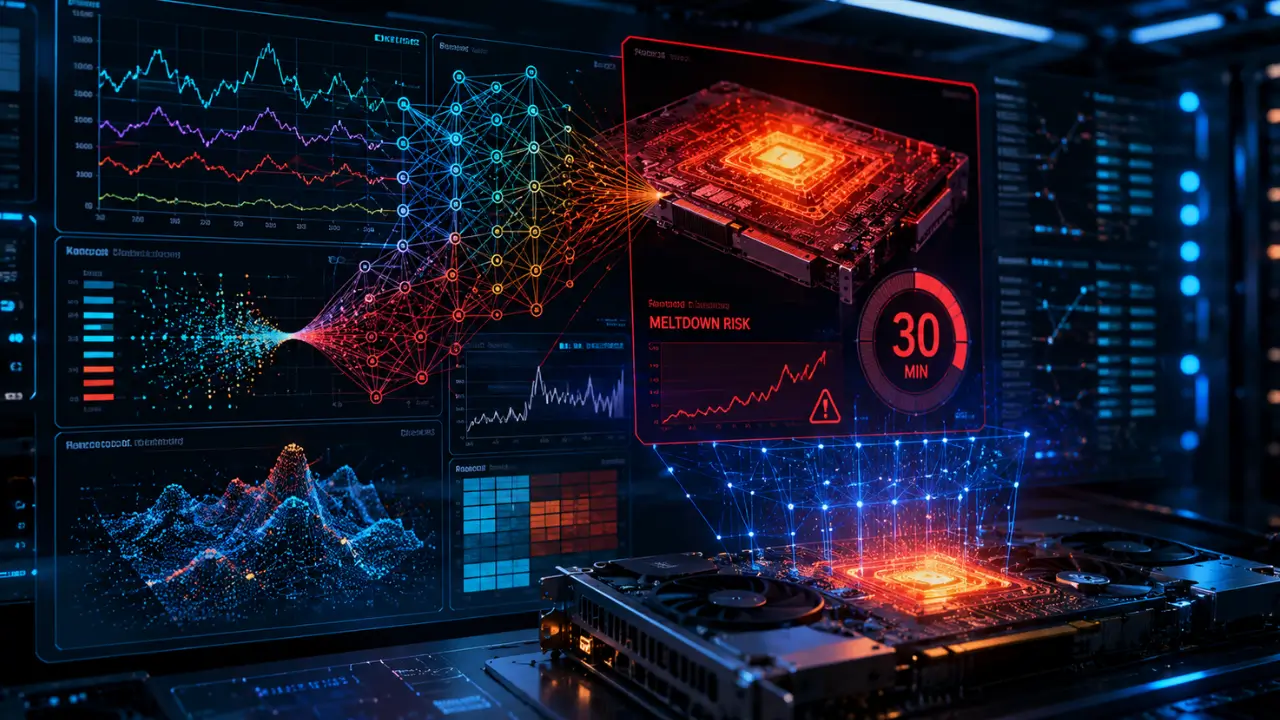
No operator walks into a data hall expecting to hear a rack fail before the dashboards acknowledge it, modern accelerator clusters increasingly exhibit operational characteristics shaped by thermal, electrical, and mechanical stress during sustained high-density workloads. Subtle fan harmonic shifts, transient voltage regulator fluctuations, and minor network latency drift can emerge inside tightly synchronized inference environments before conventional alarms register a critical event. Engineers managing dense accelerator fleets have started noticing that catastrophic thermal events rarely appear suddenly because instability usually develops through dozens of weak operational signals spreading quietly across cooling, networking, and workload orchestration layers. Traditional observability systems discard many of these fluctuations as noise because each signal appears statistically insignificant when evaluated independently against static thresholds. Large-scale telemetry correlation platforms now ingest harmonic fan signatures, thermal gradients, rack vibration patterns, scheduler timing drift, and transient power irregularities together instead of isolating them into disconnected dashboards.

The emerging challenge is not collecting telemetry because hyperscale environments already generate massive streams of operational data every second across GPUs, switches, power systems, and cooling loops. The real problem sits inside correlation logic because conventional monitoring stacks cannot reliably determine whether ten tiny anomalies occurring simultaneously represent coincidence or the beginning of thermal runaway. These systems identify patterns that human operators rarely notice during active incidents because the deviations remain too weak to cross predefined alert thresholds individually. Some infrastructure teams have begun mapping correlations between fan acoustic changes and memory controller instability during high-bandwidth inference bursts because those relationships repeatedly appear before cooling degradation events. Thermal forecasting models also analyze scheduler latency spikes that emerge when accelerators begin redistributing workloads unevenly due to localized heat accumulation across GPU pods.
The 30-Minute Window Nobody Used to See
Infrastructure reliability changed materially once operators realized that thirty minutes of advance warning can alter the economics of a thermal incident entirely inside large AI clusters. Reactive operations historically waited until accelerators throttled, fan curves maxed out, or coolant temperatures crossed emergency thresholds before escalation workflows activated across operations teams. That model worked reasonably well for conventional enterprise workloads because transient degradation rarely carried immediate financial consequences at hyperscale computational densities. AI training environments operate differently because interrupted training cycles can waste expensive compute reservations, invalidate synchronization states, and force expensive restart procedures across interconnected accelerator fabrics. Predictive thermal forecasting systems can provide infrastructure teams with advance operational visibility that supports workload redistribution, targeted maintenance decisions, and cooling stabilization before visible disruption occurs. Infrastructure operators increasingly describe this window as a thermal intervention horizon because it converts emergency response into controlled orchestration rather than frantic mitigation.
This operational shift changes how infrastructure teams think about maintenance because interventions no longer happen exclusively after visible degradation reaches production workloads. Predictive orchestration platforms now trigger workload migration policies automatically when telemetry confidence scores suggest elevated thermal risk inside specific GPU rows or cooling zones. Some operators are exploring predictive maintenance workflows that allow technicians to investigate infrastructure anomalies before accelerators enter sustained thermal stress conditions. Others integrate thermal risk forecasts directly into cluster schedulers so orchestration systems avoid assigning latency-sensitive inference jobs to racks showing abnormal environmental behavior. Moreover, thermal forecasting creates new possibilities for controlled degradation strategies because operators can intentionally reduce utilization slightly across a cluster to prevent concentrated heat escalation later in the compute cycle. AI infrastructure teams increasingly value predictive thermal windows because they protect uptime without requiring aggressive emergency shutdown policies that historically disrupted workloads unpredictably.

Why Traditional DCIM Misses the First Signs of Failure
Conventional DCIM platforms were designed for facilities where thermal behavior remained relatively stable, airflow moved predictably, and computational density changed gradually over time across server environments. Dense accelerator clusters no longer operate within those assumptions because GPU workloads generate volatile heat signatures that fluctuate aggressively according to model architecture, inference concurrency, and synchronization behavior. Many monitoring systems still evaluate racks through isolated telemetry categories such as inlet temperature, power consumption, or fan speed instead of analyzing how those variables influence one another dynamically. This separation creates operational blind spots because thermal instability often emerges through compound interactions spreading simultaneously across electrical, computational, and mechanical layers. A GPU pod may experience unstable airflow due to subtle pressure shifts inside containment corridors while workload schedulers simultaneously redistribute jobs unevenly because network latency increases elsewhere in the cluster.
Modern telemetry fusion platforms address this limitation by treating infrastructure behavior as an interconnected environmental system rather than a collection of independent devices reporting isolated measurements. Correlation engines continuously analyze relationships between airflow stability, rack vibration, network congestion, coolant flow rates, and workload density across thousands of synchronized telemetry inputs. These systems can identify scenarios where micro-vibrations from nearby cooling equipment subtly alter airflow efficiency around accelerator rows during sustained computational peaks. Operators are increasingly studying whether network timing irregularities may correlate with uneven workload distribution patterns during periods of elevated thermal stress across distributed GPU environments. Predictive infrastructure intelligence therefore focuses less on absolute thresholds and more on relational changes unfolding across interconnected systems simultaneously. Some operators now integrate computational telemetry directly into environmental management platforms so workload schedulers and cooling systems respond cooperatively instead of operating through disconnected control planes.
AI Is Learning the “Personality” of Every GPU Rack
Infrastructure operators once treated racks as interchangeable compute units that should behave identically under similar workload conditions across a facility environment. Real-world accelerator deployments have disproven that assumption because every rack develops distinct thermal behavior shaped by airflow geometry, hardware aging, cooling proximity, workload distribution, and environmental microconditions. Predictive telemetry platforms now build behavioral baselines for individual infrastructure segments instead of relying exclusively on universal operating thresholds applied uniformly across a campus. These systems continuously learn how specific racks respond during model training bursts, inference spikes, coolant fluctuations, and ambient temperature changes throughout operational cycles. A rack positioned near a containment boundary may naturally operate with slightly different airflow dynamics than a neighboring rack located beside high-capacity cooling corridors. Behavioral intelligence engines account for those differences automatically by learning normal operating signatures over time rather than forcing every device into rigid thermal expectations.
This behavioral approach becomes increasingly valuable as accelerator environments scale into multi-megawatt clusters where generalized threshold policies create unnecessary operational noise. Static alert systems often produce excessive false positives because they cannot distinguish between healthy environmental variation and genuinely dangerous thermal deviations across heterogeneous hardware environments. Machine learning models instead evaluate whether live telemetry diverges from historically stable behavioral patterns for that specific workload and infrastructure context. Some operators now maintain separate behavioral profiles for training-intensive racks, inference-optimized pods, and mixed computational environments because each operational pattern generates unique thermal signatures. Meanwhile, orchestration platforms increasingly integrate behavioral intelligence into workload scheduling logic so applications migrate proactively toward thermally stable regions during periods of elevated environmental risk. Infrastructure teams also use behavioral forecasting to identify long-term hardware degradation trends that emerge gradually over months rather than during acute incidents.
Data Center May Prevent Failures Quietly
The next generation of AI facilities will likely measure operational maturity not by how quickly teams respond to incidents but by how rarely infrastructure disruptions become visible at all. Predictive environmental intelligence changes the philosophy of uptime because the objective shifts from recovering gracefully after thermal degradation toward preventing instability before workloads notice environmental stress. Accelerator clusters continue pushing computational density higher, which means even minor cooling irregularities can cascade rapidly across tightly synchronized systems if operators lack early predictive visibility. Forecasting platforms now transform telemetry from passive observability data into active operational guidance that shapes scheduling behavior, maintenance timing, cooling optimization, and infrastructure orchestration continuously. The quietest infrastructure environments may soon become the most advanced because invisible prevention reflects deeper operational intelligence than dramatic incident recovery ever could.
Future operational cultures inside AI infrastructure teams will likely revolve around maintaining stable environmental behavior rather than reacting visibly to emergencies after systems degrade under thermal stress. Predictive telemetry fusion platforms continue improving because every thermal event provides additional behavioral data that refines anomaly detection accuracy across future workloads and infrastructure deployments. Facilities operators are gradually moving toward environments where workload schedulers, cooling systems, and reliability orchestration engines coordinate automatically through shared predictive intelligence layers. Silent prevention rather than dramatic intervention increasingly defines the operational direction of hyperscale accelerator environments as thermal forecasting becomes deeply integrated into infrastructure decision-making. The modern data center therefore evolves into a continuously self-observing environment where operational intelligence works quietly in the background to prevent failures before they emerge visibly across production systems.











