
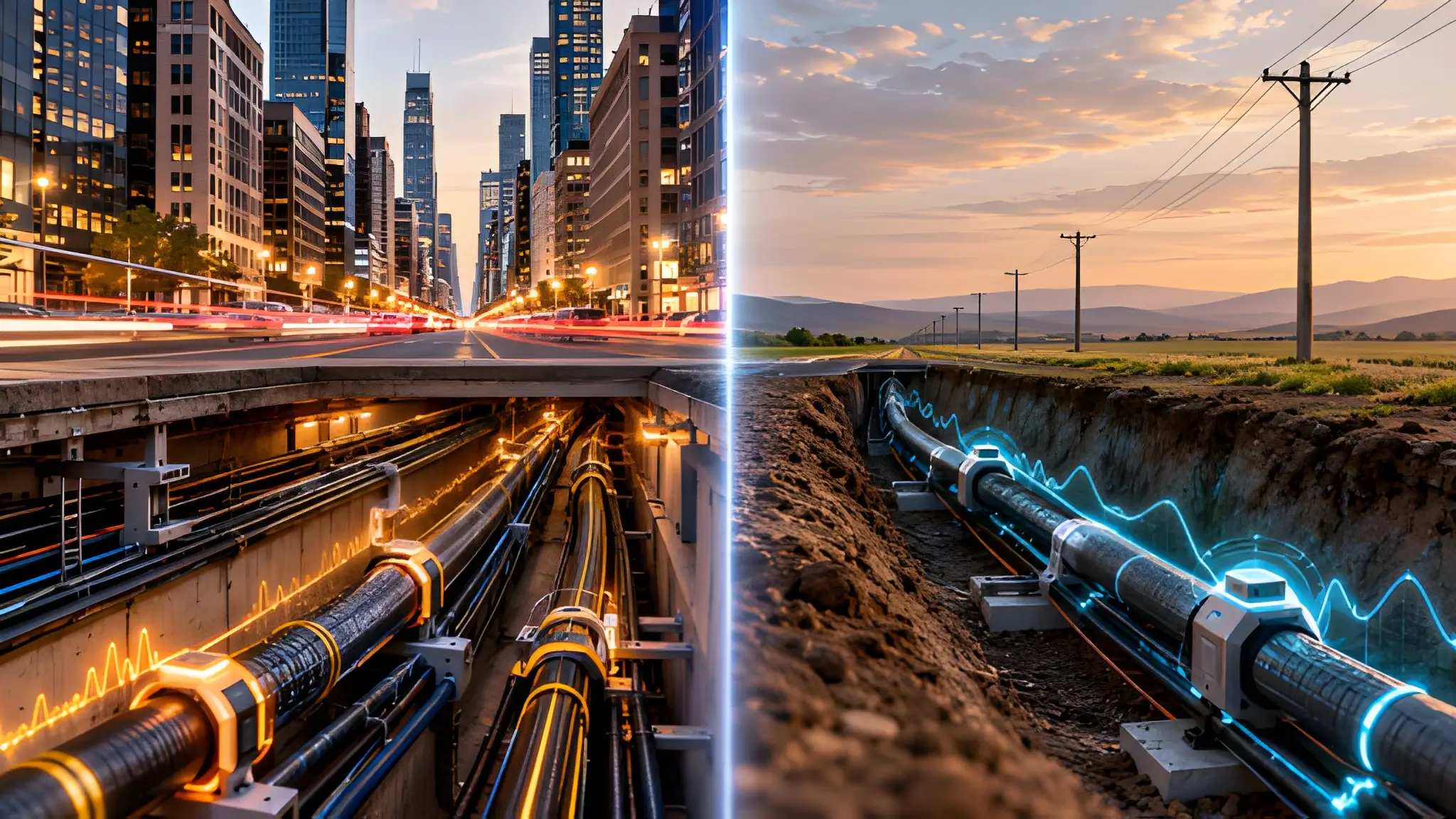
An underground power cable can travel for miles through rural corridors where changing soil conditions, weather exposure, agricultural activity, and occasional maintenance work shape its operating environment. A cable serving an urban AI infrastructure site faces a different operating environment, where road construction, transit systems, telecom ducts, drainage networks, and neighboring electrical circuits compete for space beneath the same streets. These conditions change the meaning of the signals that monitoring systems collect, particularly when acoustic sensing detects vibration or thermal monitoring identifies unusual heat patterns near buried assets. An isolated vibration along a rural route may indicate an approaching vehicle, excavation, or another identifiable event, while similar activity beneath a busy city street could reflect routine traffic or work several meters away from the cable. Treating both environments with identical alarm thresholds can create unnecessary alerts in one location while overlooking developing threats in another.

Urban monitoring also needs to account for potential common-mode failures and interconnected network dependencies, although the extent to which one failure affects other assets depends on the electrical topology, physical routing, and available protection. A rural feeder may offer a relatively straightforward inspection corridor, whereas an urban cable can pass through multiple joints, duct transitions, access chambers, and sections exposed to different thermal and mechanical conditions. Those changes complicate fault localization because a sensor can detect an abnormal event without immediately revealing its precise source or operational significance. For AI infrastructure planners, the central question is not simply whether a cable produces an unusual signal, but whether that signal indicates a credible threat to power continuity, a shared infrastructure dependency, or a developing weakness that maintenance teams should address.
City Routes Don’t Behave Like Country Routes
Urban cable routes operate within a crowded underground environment where physical proximity does not necessarily indicate a direct connection between neighboring assets. Electrical ducts may cross drainage infrastructure, run alongside transit corridors, or pass through chambers containing several services with different access and maintenance requirements. Rural feeds can follow long, relatively linear corridors, although their actual layouts depend on network design, terrain, crossings, access requirements, and the distribution of connected loads. These physical differences influence how vibration travels through the ground, how sensors couple to surrounding structures, and how monitoring systems interpret activity near a cable. A distributed acoustic sensing system measures strain-related changes along an optical fiber, but its output reflects the installation, the surrounding environment, and the nature of the disturbance rather than a universal signature for every excavation event.
The implications become more significant when an urban power connection supports a site with demanding computing loads and limited tolerance for interruptions. Monitoring teams need to understand where the cable passes through shared corridors, where its installation changes, and which nearby activities can generate recurring signals. A route model should connect sensor locations to verified cable alignment, duct configuration, burial conditions, access chambers, and known crossings wherever reliable records exist. Rural monitoring can also benefit from detailed route records, with the relative importance of long-distance event localization, remote access, and inspection logistics depending on corridor length, accessibility, and the monitoring objectives. In a city, short sections of a route may encounter different exposure conditions, so engineers should select spatial resolution according to local vulnerabilities, sensor capabilities, and the precision required to locate a disturbance.

When Every Dig Near Your Feed Is Not an Accident
Excavation near an underground power route creates a particular monitoring challenge because the activity can develop gradually, change tools, and move across the surrounding area before anyone identifies a direct threat. Road resurfacing, foundation work, utility repairs, and mechanical digging can all produce vibrations, but their signals vary with equipment, soil composition, burial depth, and the physical relationship between the activity and the sensing fiber. In some rural corridors, agricultural machinery and occasional excavation may create a relatively sparse background, although activity levels vary with land use, road traffic, construction, and maintenance schedules. Busy urban streets create a different baseline, with recurring traffic, maintenance work, construction machinery, and simultaneous activities potentially overlapping in the same monitoring interval. An effective system must therefore classify the character, location, duration, and progression of an event rather than rely on vibration intensity alone.
Alarm management should begin with an accurate understanding of normal activity along each monitored segment, supported by verified work schedules and field observations where available. A short vibration associated with passing traffic may warrant different treatment from repeated mechanical impacts that intensify near a known cable crossing. Machine-learning classification can assist with recognizing recurring signal patterns, but operators still need to validate performance against local conditions and the actual consequences of missed detections. Excessive sensitivity can flood maintenance teams with low-value alerts, while overly broad filtering can conceal a developing hazard beneath familiar background noise. Monitoring logic should combine event classification with proximity, persistence, route vulnerability, and confidence, then assign an appropriate response instead of treating every alert as an emergency.
Joint Concentration Is Where Urban Risk Multiplies
Cable joints, terminations, manholes, and changes in duct configuration deserve specific attention because they introduce physical or electrical conditions that differ from those along an uninterrupted cable section. Joints must maintain electrical continuity and insulation integrity, while their installation quality, operating load, and surrounding environment influence long-term performance. Urban routes may place joints, access chambers, and installation transitions near street crossings and constrained utility corridors, but the actual concentration of these components depends on route design and installation history. Localized heating can indicate an abnormal operating condition, but engineers must interpret temperature against load, ambient conditions, thermal surroundings, and the characteristics of the cable assembly. Mechanical strain or vibration near an access chamber may signal external activity without proving that the joint itself has suffered damage.
A practical monitoring design should divide an urban route into zones that reflect changes in physical construction, electrical function, thermal behavior, and access conditions. Engineers can establish closer inspection priorities around known joints, terminations, crossings, and sections where cable geometry or heat dissipation changes materially. Distributed temperature sensing can reveal spatial temperature patterns, while acoustic sensing can help locate external disturbances and certain mechanical events; neither method independently confirms every possible insulation defect or internal electrical fault. Combining these observations with load measurements, inspection records, and appropriate electrical diagnostics improves the quality of condition assessments. Thresholds should reflect the expected behavior of each zone and the rate at which a condition changes, rather than applying one temperature or vibration limit indiscriminately along the route.
Shared Trenches Break the Idea of True Redundancy
Two power feeds can appear independent on an electrical diagram while remaining physically exposed to the same underground hazard. Separate circuits may occupy the same trench, share a duct bank, pass through a common access chamber, or follow the same constrained street corridor before reaching different parts of a site. A single excavation, localized flooding event, structural failure, or maintenance error can threaten both routes when their physical separation remains inadequate. Redundancy reviews that focus primarily on feeder identities and connection points may overlook shared physical exposure unless engineers also examine route alignments, common infrastructure, and credible failure scenarios. Engineers must assess the actual cable paths, common civil infrastructure, switching arrangements, and credible failure scenarios before assigning meaningful independence to two supplies.
An effective redundancy assessment should combine route records with acoustic and thermal observations, rather than infer independence from a pair of lines on a drawing. If two feeds pass through the same excavation zone, an escalating vibration event near that corridor may deserve a higher combined-risk assessment even when neither circuit shows an immediate electrical abnormality. Thermal data can add another layer by revealing whether nearby cable sections operate under different loading conditions or face related heat-dissipation constraints. These measurements cannot prove that both supplies will fail, and the absence of an alarm cannot establish that their physical risks are independent. Engineers should map shared trenches, crossings, chambers, and upstream dependencies, then test whether a credible single event could compromise both feeds or prevent timely restoration.
Monitoring Must Know Where It Is
Urban and rural monitoring may require different operating assumptions because local physical conditions influence sensor signals, while the consequences of a cable fault depend on network configuration, available redundancy, and the loads served. Urban routes may warrant closer monitoring around crossings, joints, shared corridors, and active construction zones, while long rural routes may benefit from broad coverage and remote event localization, depending on their physical conditions, accessibility, and operational requirements. Alarm thresholds should reflect locally established operating conditions, sensor installation characteristics, and the level of risk associated with each monitored section. Spatial resolution should support the decision that operators need to make, whether they must identify an excavation approaching a cable, investigate a developing thermal anomaly, or narrow the search area following a suspected fault.
For AI infrastructure planners, monitoring decisions should form part of power resilience planning from the earliest stages of route selection and electrical design. Engineers should document cable alignments, shared underground corridors, joint locations, sensor coverage, and the limitations of existing asset records before establishing alarm policies. They should then validate detection performance against representative urban disturbances and verify that monitoring alerts reach teams capable of assessing and responding to credible threats. Rural routes need the same disciplined approach, but their sensing configurations and response procedures should reflect the different conditions along those corridors. As power requirements and network interdependencies change, monitoring strategies should account for route-specific conditions, validated alarm thresholds, and the capabilities and limitations of the sensing technologies deployed.









