 Skip to content
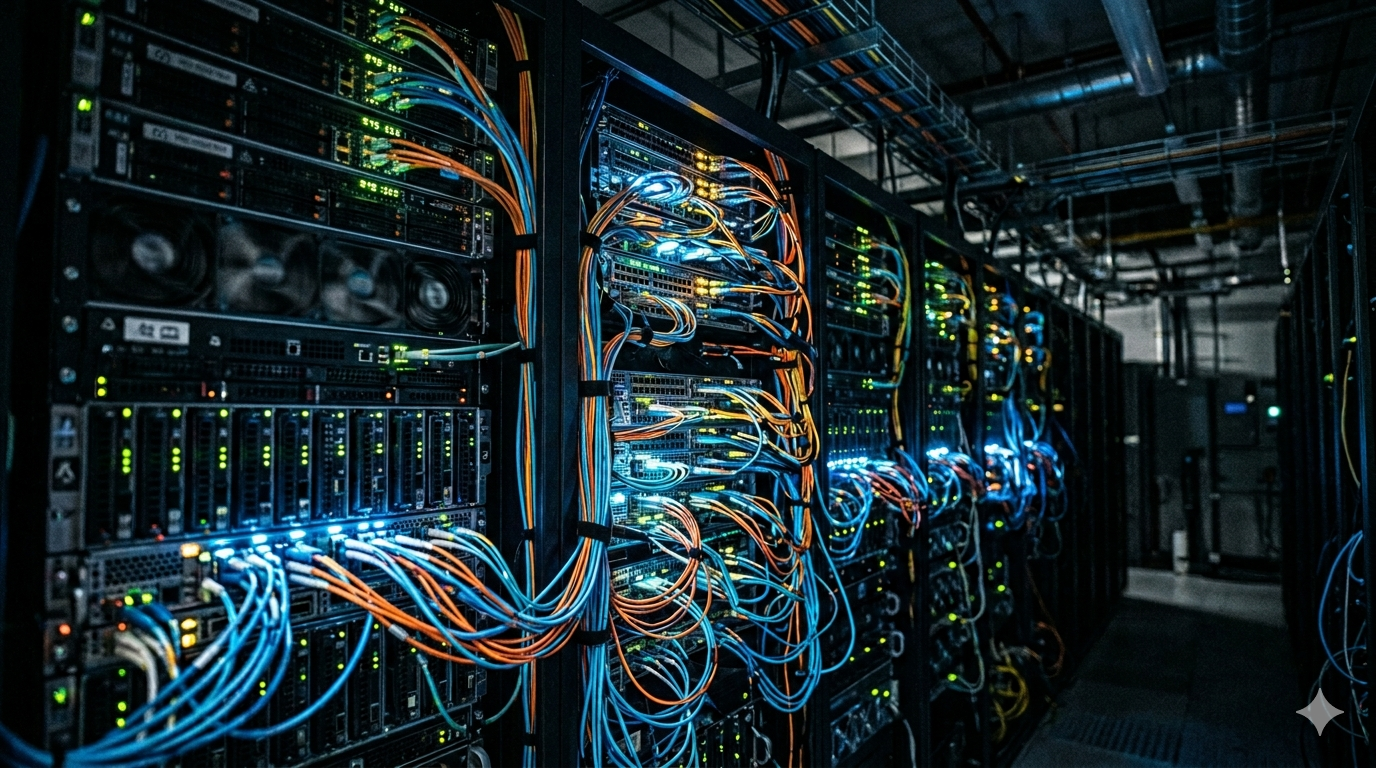
Data center infrastructure has been designed around a specific mental model of how AI works. A user submits a request. A model processes it. A response returns. The transaction completes. The infrastructure required to support that model is well understood. Large GPU clusters handle training. Inference clusters handle requests. Network fabric moves data between them. Cooling removes the heat that compute generates. Power delivers the energy that cooling and compute require.

Agentic AI infrastructure requirements break that mental model entirely. An AI agent does not process a request and return a response. It plans, executes, evaluates, and iterates across multiple steps. It often works over extended time horizons, often in parallel with other agents. It requires persistent access to memory, tools, and external systems throughout the entire execution cycle. The infrastructure implications of that difference are not incremental. They are structural. The data centers being built today were not designed for what agentic AI actually demands. The gap between what exists and what agentic workloads require is about to become one of the most consequential infrastructure challenges the industry has faced.
What Makes Agentic Workloads Fundamentally Different
Training workloads are computationally intensive but structurally simple from an infrastructure perspective. Large batches of data move through GPU clusters in predictable patterns. The compute graph is fixed. Memory access patterns are regular. Networking requirements, while substantial, are well-characterized. Infrastructure engineers know how to build for these workloads. They have been doing it long enough to develop mature design frameworks and operational playbooks.
Standard inference workloads introduced more variability but remained structurally manageable. Requests arrive unpredictably, but each request is stateless. The infrastructure processes it and moves on. No persistent state needs maintaining between requests. No coordination across multiple execution steps is required. The infrastructure scales horizontally to handle variable request volumes without fundamentally changing its architecture. However, agentic workloads break both of these comfortable patterns simultaneously. The infrastructure industry has not yet fully grasped what that means for how facilities need to be designed, built, and operated.

Persistent State Changes Everything
An AI agent maintaining context across a multi-step task requires the infrastructure to store and retrieve that context reliably throughout the entire execution cycle. That context includes the conversation history, the intermediate results of previous steps, the current plan the agent is executing, and the state of any external tools or systems the agent has interacted with. None of this can be reconstructed cheaply if lost. The agent’s ability to complete its task depends entirely on the integrity and availability of that state.
Current GPU high-bandwidth memory is fast but small and expensive. A single high-end GPU carries between 80 and 141 gigabytes of high-bandwidth memory. That capacity suffices for loading a large model and processing a single inference request. It does not suffice for maintaining rich context across a complex multi-step agentic task while simultaneously running the model inference each step requires. The agent must constantly move context in and out of the fast memory tier as it executes. That movement introduces latency that compounds across the execution chain. As explored in our analysis of AI inference cost in enterprise infrastructure, agentic pipelines can consume ten to fifty times more tokens per user-initiated task than standard inference, which makes the memory constraint far more acute than most infrastructure planning assumes.
Why Existing Memory Tiers Cannot Close the Gap
DRAM is larger but slower. Storage systems are large but far too slow for active agent execution. The gap between what agents need and what existing memory hierarchies provide is not a minor engineering challenge. It is a fundamental architectural mismatch. New memory technologies, new system designs, and new approaches to memory management across distributed infrastructure are all required. Processing-in-memory technologies and advanced memory fabrics like CXL represent paths toward closing this gap. However, none of them have reached the maturity and cost-effectiveness required for widespread deployment in production agentic infrastructure on the timelines that enterprise adoption demands.
Latency Requirements That Standard Infrastructure Cannot Meet
Standard inference workloads tolerate response latencies measured in hundreds of milliseconds for most applications. Users asking questions of a chatbot experience that latency as negligible. The interaction feels immediate even when it is not instantaneous. Agentic workloads operate in a fundamentally different latency regime. An agent executing a multi-step task makes dozens or hundreds of inference calls in sequence. Each call’s latency accumulates across the execution chain.
A latency of two hundred milliseconds per call across a fifty-step agent pipeline produces a total execution time of ten seconds before accounting for any other delays. At a hundred steps, that becomes twenty seconds. For many enterprise agentic applications, those latencies are commercially unacceptable. An AI agent handling a customer service escalation, processing a financial transaction, or coordinating a logistics workflow operates in an environment where the business process it supports has its own latency requirements. Meeting those requirements demands end-to-end latency across the entire agentic execution chain that standard inference infrastructure cannot provide reliably.
Additionally, latency variability matters as much as average latency levels. An agent that usually completes in five seconds but occasionally takes thirty seconds is not reliable enough for production enterprise deployment. Standard inference infrastructure optimizes for average latency under expected load conditions. Agentic infrastructure needs to optimize for tail latency under variable and unpredictable load conditions. It is the worst-case performance that determines whether agentic applications can meet the service level requirements of the business processes they support. That is a fundamentally different optimization target. It requires different hardware choices, different software architectures, and different capacity planning approaches than those that serve standard inference well.
The Networking Architecture Problem
Current data center networking was designed around a specific traffic model. East-west traffic between GPU nodes during training is high-bandwidth and predictable. North-south traffic between inference clusters and external users is lower-bandwidth per connection but highly variable in aggregate. The networking fabric that serves both of these traffic patterns well is understood. Hyperscale and neocloud facilities worldwide have deployed it at scale.
Agentic workloads create a different traffic pattern that existing networking architectures handle poorly. Furthermore, agentic AI infrastructure requirements extend well beyond what current networking was designed to handle, compounding the grid interconnection constraints that already limit AI infrastructure development timelines across the most constrained markets. An agent executing a complex task may simultaneously query multiple external APIs, retrieve documents from a vector database, invoke specialized tools, coordinate with other agents running in parallel, and write intermediate results to a persistent memory store. Each of these interactions generates network traffic with different bandwidth, latency, and reliability requirements. Furthermore, the pattern of that traffic is not predictable in advance. The agent’s execution path depends on intermediate results that the agent computes dynamically during execution.
Why Fabric Architecture Needs to Change
Current high-performance networking in AI data centers optimizes for high-bandwidth, low-latency links between a relatively small number of GPU nodes. These nodes communicate in well-characterized collective communication patterns. RoCE, InfiniBand, and similar technologies excel at this traffic profile. They are less well-suited to the heterogeneous, unpredictable, fine-grained communication patterns that agentic workloads generate.
Agentic infrastructure needs a networking fabric that simultaneously provides ultra-low latency for time-sensitive agent-to-agent communication, high bandwidth for bulk data retrieval from memory and storage systems, and reliable connectivity to external services and APIs with consistent latency characteristics. That combination points toward networking architectures fundamentally different from those optimized for training or standard inference. The switching fabric needs to handle a much wider variety of flow sizes and latency requirements. Congestion management becomes significantly more complex when the traffic mix is heterogeneous and unpredictable rather than dominated by large, predictable collective communication flows. Consequently, the networking investments that operators make today in AI data centers may not be sufficient for the agentic era. Fabric architecture and switching infrastructure both need significant additional investment to close the gap.
The External Connectivity Dimension
Agentic workloads are not self-contained. An agent executing a real-world task typically needs to interact with external systems throughout its execution. It may query live databases, call external APIs, access real-time data feeds, or invoke specialized services running outside the data center. Each of these external interactions introduces latency and reliability variability that the agent’s execution plan must accommodate.
This requirement pushes the networking design challenge outside the data center boundary. A data center optimized for training can treat its external connectivity as a secondary consideration. Training jobs are entirely self-contained once the training data loads. Agentic workloads have no such boundary. Their performance depends on the quality of the entire connectivity path from the agent’s execution environment to every external system it interacts with. Therefore, infrastructure operators supporting agentic workloads need to think about their network architecture from the external API endpoint backward, not from the GPU cluster outward. That inversion carries practical implications for where developers site facilities, how operators connect them to internet exchange points, and how they manage external connectivity performance under variable load conditions.
Multi-Agent Coordination and Its Infrastructure Demands
Many production agentic systems do not run a single agent in isolation. An orchestrator agent may direct the activities of dozens of specialist agents, each handling a specific aspect of a complex task. Those specialist agents may themselves spawn sub-agents to handle components of their assigned work. The resulting network of agent interactions generates coordination traffic that has no analog in training or standard inference infrastructure.
The networking infrastructure supporting multi-agent coordination needs to provide low-latency communication between agents running on different physical nodes, in different racks, or in different facility zones. It needs to do this reliably under load conditions that vary dynamically as the agent network expands and contracts during task execution. It also needs to maintain the ordering and consistency guarantees that agent coordination protocols require. Building infrastructure that meets these requirements demands collaboration between networking hardware vendors, software orchestration platform developers, and facility operators. That collaboration has not yet produced mature, production-ready solutions at the scale that enterprise agentic deployment will require.
Memory Hierarchy Redesign at Every Layer
The memory requirements of agentic AI expose gaps at every layer of the current memory hierarchy. At the fastest layer, GPU high-bandwidth memory provides the speed that active inference requires but cannot hold the volumes of context that complex agentic tasks accumulate. At the intermediate layer, DRAM can hold larger context volumes but introduces latency that becomes significant when agents make frequent context retrievals during execution. At the storage layer, NVMe SSDs provide large capacity at reasonable cost but are orders of magnitude too slow for active agent context access.
Agentic infrastructure requires a memory hierarchy that does not currently exist in mature, cost-effective form for AI applications. Specifically, it needs a large, fast, persistent memory tier sitting between GPU high-bandwidth memory and DRAM. That tier needs to provide the capacity to hold rich agent context at latencies that do not create bottlenecks in agent execution chains. The CXL interconnect standard represents the most promising near-term path toward this capability. It enables memory pooling across multiple nodes and allows different memory technologies to participate in a shared memory fabric. However, the hardware ecosystem supporting CXL at production AI infrastructure scale is still developing. The software stack required to use pooled CXL memory effectively in agentic applications does not yet exist in mature form.
Vector Databases and the Retrieval Problem
A critical component of most production agentic systems is the vector database. It stores and retrieves the embeddings that allow agents to access relevant information quickly during execution. Vector databases need to serve retrieval queries with low latency and high accuracy across collections that may contain billions of embeddings representing an enterprise’s entire knowledge base. The performance requirements for these systems at production agentic scale are substantially more demanding than what current deployments require.
Most current vector database deployments operate at scales and latency requirements that fit comfortably within existing infrastructure. However, as agentic applications scale to support millions of concurrent agents each making frequent retrieval queries, the vector database infrastructure becomes a potential bottleneck. Agentic retrieval query patterns differ from those of standard retrieval-augmented generation applications in important ways. Agentic systems make retrieval queries at multiple points during task execution rather than once at the beginning of a response generation cycle. The queries are often conditional on intermediate results, meaning effective batching or pre-computation is not possible. Additionally, the collections being searched may need updating in near real-time as agents write new information back to the knowledge base during task execution. Designing and operating vector database infrastructure at the scale and performance level that mature agentic deployment requires remains an unsolved problem that the industry is only beginning to confront seriously.
The Storage Architecture Implications
Beyond vector databases, agentic workloads create storage requirements that current data center storage architectures were not designed to serve efficiently. Each active agent needs to write intermediate results, read previous context, and update its state throughout its execution cycle. At small scale, these operations place modest demands on storage infrastructure. At the scale of millions of concurrent agents each generating continuous read and write operations, the aggregate I/O load becomes enormous.
Current storage architectures in AI data centers optimize primarily for the large sequential reads that training data loading requires and the moderate random I/O that inference serving generates. The fine-grained, high-frequency, mixed read/write pattern that agentic workloads create is a different problem. Existing storage systems handle it with significantly lower efficiency. NVMe SSDs improve random I/O performance relative to spinning disk but were not designed for the specific access patterns of agentic state management. Addressing the storage architecture implications of agentic workloads requires rethinking storage design from the access pattern outward. Operators need to build systems around the I/O characteristics of agentic workloads rather than retrofitting existing storage into a role nobody designed it to fill.
The Reliability and Fault Tolerance Challenge
Reliability requirements for agentic infrastructure are categorically different from those for training or standard inference infrastructure. A training job that fails can restart from a checkpoint. The cost of failure is measured in compute time and the value of work not completed. An inference request that fails returns an error to the user, who can retry. The cost of failure is a degraded user experience for a single interaction.
An agent that fails mid-execution leaves an incomplete task in an indeterminate state. The cost of failure may include corrupted business processes, incomplete transactions, or actions that the agent took earlier in its execution that nobody can cleanly reverse. That difference in the cost of failure demands a different approach to fault tolerance. Agentic infrastructure needs to maintain checkpoints of agent state at sufficient frequency that recovery from a failure does not lose significant work. It needs to detect failures quickly enough to prevent incomplete agent actions from propagating through business processes. Additionally, it needs to coordinate recovery across distributed agentic systems where multiple agents may be collaborating on a shared task.
Why Current Uptime Standards Are Insufficient
The uptime standards that data centers apply to training and inference infrastructure are not sufficient for production agentic deployment. A data center achieving four nines of availability is unavailable for roughly fifty-two minutes per year. That level of availability is generally considered highly reliable for training and inference workloads. Short outages interrupt individual training runs or inference requests in ways that operators can recover from without significant business impact.
For agentic workloads embedded in business-critical processes, even brief outages may create unacceptable disruptions. An agent managing a supply chain coordination process, processing a financial transaction, or handling a customer service escalation cannot simply pause and resume when infrastructure becomes unavailable. The business processes these agents support have their own time constraints and state dependencies. Furthermore, the complexity of recovering distributed agentic state after an outage means that even a short outage has a larger effective impact on agentic workloads than its duration alone suggests. Consequently, the infrastructure supporting production agentic deployment needs reliability characteristics approaching the standards applied to financial transaction processing systems, not those applied to batch compute workloads.
The Checkpointing and Recovery Problem
Implementing effective checkpointing for agentic workloads is significantly more complex than implementing checkpointing for training jobs. A training checkpoint captures the state of a model at a specific point in a computation that follows a well-defined structure. Restoring from that checkpoint resumes the computation from a known state without ambiguity. An agentic checkpoint needs to capture the state of a potentially complex agent network at a moment when those agents may be in the middle of interacting with external systems, waiting for responses from other agents, or executing actions whose effects have already propagated into the external world.
Restoring an agentic system from a checkpoint therefore requires not just restoring internal state but also reconciling that state with the external world as it exists at the moment of recovery. External systems may have changed since the checkpoint was taken. Actions the agent initiated before the failure may have partially completed. The agent network may need to make decisions about which parts of its previous work to redo and which to treat as already complete based on the state of external systems at recovery time. Building the infrastructure and software frameworks to support this level of sophisticated recovery is a research and engineering challenge that the industry has only recently begun to take seriously.
What Infrastructure Operators Need to Do Now
The gap between current data center infrastructure and what agentic workloads require is not a problem that will solve itself through incremental improvements to existing designs. Operators must make deliberate investments in new architectural approaches to memory, networking, storage, and reliability. They must do this before agentic workloads reach the scale at which the gap becomes a crisis. Early movers will be positioned to serve the enterprise agentic market as it matures. Those who wait for the gap to become obvious will find themselves redesigning infrastructure under the pressure of customer commitments they cannot meet.
The specific investments that matter most vary by operator type. Hyperscalers building general-purpose AI infrastructure need to invest in memory hierarchy innovations and networking fabric architectures that heterogeneous agentic traffic demands. Neocloud operators building specialized AI infrastructure need to develop operational expertise in agentic workload management. That expertise must go beyond what training and inference operations require. Enterprise operators building private AI infrastructure need to map their existing data center investments onto agentic requirements carefully. Identifying where the gaps are most likely to create operational problems before agentic deployments scale is essential. Waiting until those problems surface in production is far more costly than finding them early.
The Window for Proactive Investment
The window for proactive investment in agentic infrastructure is narrowing faster than most operators recognize. Enterprise agentic deployments are scaling from pilot programs to production systems on timelines that compress the planning cycles available for infrastructure investment. An enterprise committing to deploying agentic AI across its operations in 2026 and 2027 needs the supporting infrastructure in place before the workloads arrive, not after.
The lead times for the infrastructure components that agentic workloads require are long. Memory technology development cycles are measured in years. Networking fabric redesigns require hardware investment and software development that cannot compress below certain minimums. Storage architecture changes affect the entire system design of a data center, not just individual components. Furthermore, developing the operational expertise required to run agentic infrastructure reliably takes time. Operators who begin planning for agentic infrastructure requirements now will be materially better positioned than those who wait for the requirements to become fully specified before committing to investment. In infrastructure, the cost of being early is always lower than the cost of being late.
Building the Operational Capability
Physical infrastructure is only one dimension of the agentic infrastructure gap. The industry has equally underdeveloped the operational capability to run agentic workloads reliably at scale, and it matters just as much. Operating a data center that runs training jobs or serves inference requests requires expertise in GPU cluster management, thermal optimization, and network fabric tuning. Operating infrastructure that supports millions of concurrent agents requires something different. Each agent maintains persistent state and executes multi-step plans across extended time horizons. That demands a largely undeveloped operational discipline that the industry has not yet built.
The monitoring systems that detect problems in training and inference infrastructure track metrics like GPU utilization, memory bandwidth, and network throughput. Agentic infrastructure needs monitoring systems that work differently. They must track the state and progress of individual agent executions. They must detect when agents are stuck or behaving unexpectedly. They must also surface infrastructure bottlenecks that manifest as agent performance degradation rather than conventional infrastructure failures. Building those monitoring systems is a major undertaking. Developing the operational playbooks that use them effectively takes additional time. Training the infrastructure teams that implement those playbooks adds another layer of complexity. None of these can be deferred without creating risk in the others.
Why This Gap Will Define the Next Infrastructure Cycle
The training infrastructure buildout defined the first phase of the AI infrastructure era. The inference infrastructure buildout defined the second phase. Agentic infrastructure is the third phase, and it is the most demanding of the three. Each previous phase built on the infrastructure and expertise of the one before it. Training infrastructure provided the GPU clusters and networking fabric that inference infrastructure adapted and extended. Inference infrastructure provided the operational experience and software frameworks that agentic infrastructure will adapt and extend further.
However, the gap between inference infrastructure and agentic infrastructure is larger than the gap between training and inference infrastructure was. The step from training to inference required adapting existing GPU infrastructure for a different workload pattern. The fundamental architectural elements stayed largely unchanged. The step from inference to agentic infrastructure demands more. It requires rethinking memory hierarchy, networking architecture, storage design, and reliability frameworks all at once. Every layer of the infrastructure stack needs to change simultaneously. The operators and vendors who get that rethinking right will define the infrastructure landscape for the next decade of AI development. Those who underestimate the scale of the required change will find themselves building for a world the market has already moved past.












